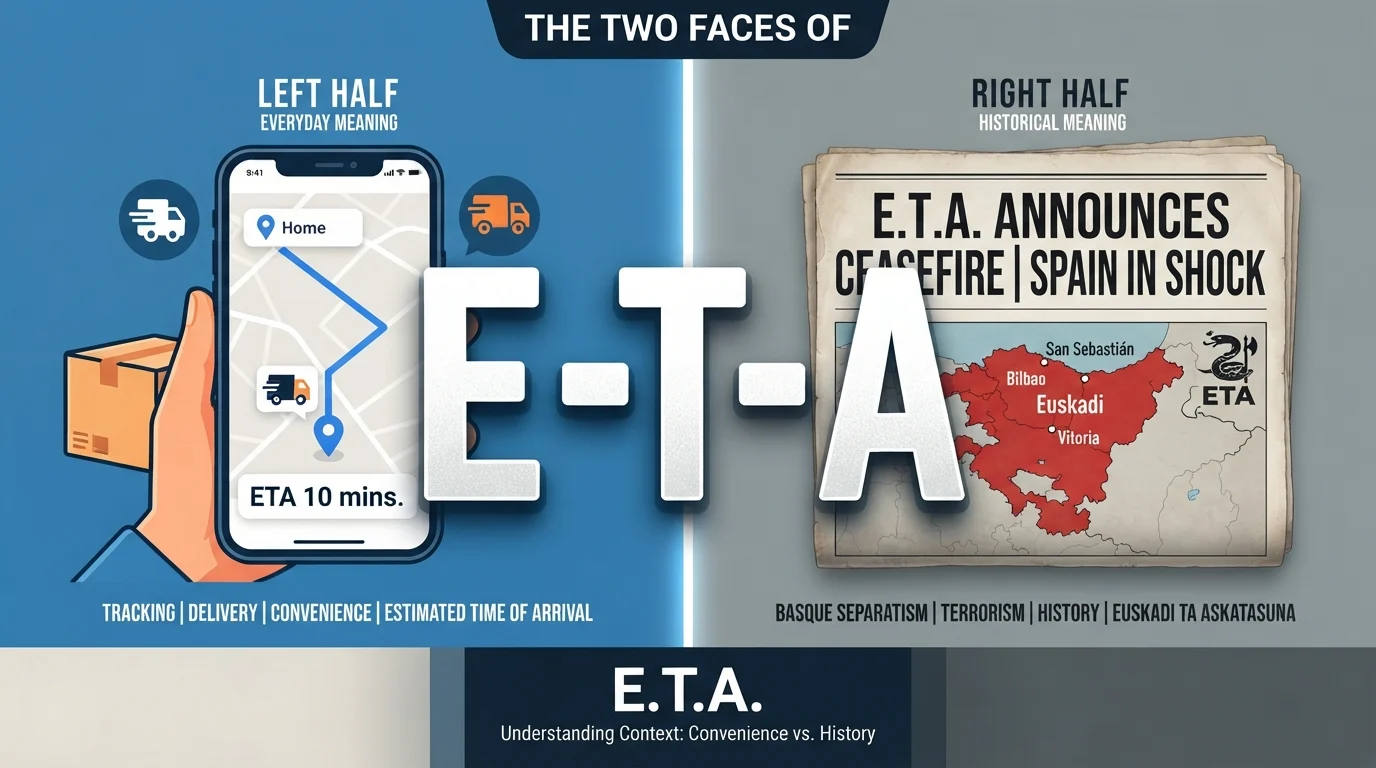
Quick Answer: ETA has two primary meanings. In everyday communication, ETA stands for “Estimated Time of Arrival” the approximate time someone or something will reach a destination. In a completely different context, ETA is also the acronym for Euskadi Ta Askatasuna, a Basque separatist group that operated in Spain and France for over five decades. The meaning depends entirely on context. If someone texts “ETA 10 minutes,” they’re talking about arrival. If you see ETA in a news article about Spanish politics, it’s likely referring to the militant organization that declared a ceasefire in 2011 and disbanded in 2018.
Picture this: You’re waiting for a friend to pick you up. They text you, “ETA 10 mins.” You know exactly what that means they’ll be there soon. Now imagine you’re reading a news article about Basque nationalism in Spain. You see a headline about “ETA prisoners” and “ETA’s legacy.” Same three letters, completely different meaning.
This is the fascinating challenge of acronyms. They compress meaning into a few letters, but that meaning depends entirely on context. ETA is one of the clearest examples of this linguistic double life. On one hand, it’s a mundane abbreviation used billions of times a day in texts, emails, and delivery notifications. On the other, it’s the name of a controversial militant group that shaped Spanish history for generations.
Understanding both meanings of ETA helps you navigate everything from casual conversations to international news. Let’s break down the full picture.
ETA Meaning #1: Estimated Time of Arrival
The Everyday Acronym
“Estimated Time of Arrival” is the most common meaning of ETA in daily life. It’s used everywhere:
- A friend texting when they’ll show up
- A delivery app telling you when your package will arrive
- An airline announcing when a flight will land
- A project manager updating when a task will be completed
The phrase itself is self-explanatory. It’s an estimate, not a guarantee. It’s the time you expect something or someone to arrive based on current information.
Where ETA Came From
The abbreviation “ETA” has been used in military, aviation, and logistics contexts for decades. Before smartphones and delivery apps, pilots and ship captains used ETA to communicate arrival times. The military used it for troop movements and supply deliveries.
As technology made tracking easier and communication faster, ETA became part of everyday vocabulary. Now it’s rare to go a day without seeing or using the term.
How ETA Is Used in Different Industries
| Industry | How ETA Is Used |
|---|---|
| Aviation | Pilots report ETA to air traffic control; airlines share with passengers |
| Shipping | Cargo vessels provide ETA to ports for scheduling |
| Delivery Services | Apps calculate ETA based on traffic, distance, and driver location |
| Project Management | Teams estimate when tasks or milestones will be completed |
| Public Transit | Buses and trains display real-time ETA at stops |
Why ETA Matters in Everyday Life
ETA reduces uncertainty. When you know approximately when something will arrive, you can plan accordingly. You can leave for the airport at the right time.
The rise of real-time tracking has made ETA more accurate than ever. GPS, traffic data, and machine learning now provide estimates that are often within minutes of the actual arrival time.
ETA Meaning #2: Euskadi Ta Askatasuna
The Basque Separatist Group
In a completely different context, ETA stands for Euskadi Ta Askatasuna, which translates to “Basque Country and Freedom” in the Basque language. This was a militant separatist organization that operated primarily in the Basque Country region of northern Spain and southwestern France.
The group was founded in 1959 and sought independence for the Basque Country from Spain and France. Over its decades-long existence, ETA was responsible for hundreds of deaths and thousands of injuries.
Historical Context
The Basque Country is a region with a distinct language, culture, and identity. Under the dictatorship of Francisco Franco (1939–1975), Basque language and culture were suppressed. This repression fueled the rise of ETA as a resistance movement.
What began as a student discussion group evolved into an armed organization. ETA carried out assassinations, bombings, and kidnappings, targeting Spanish government officials, security forces, and later, civilians.
Key Facts About ETA
| Aspect | Details |
|---|---|
| Full Name | Euskadi Ta Askatasuna (Basque Country and Freedom) |
| Founded | 1959 |
| Region | Basque Country (Spain and France) |
| Goal | Basque independence |
| Tactics | Bombings, assassinations, kidnappings |
| Ceasefire Declared | 2011 |
| Disbandment | 2018 |
| Victims | Over 800 killed, thousands injured |
ETA’s Decline and Disbandment
ETA declared a permanent ceasefire in 2011 and formally disbanded in 2018. The group’s decline was driven by several factors: increased Spanish and French police cooperation, public opposition to violence, and the success of Basque political parties that pursued independence through democratic means.
The legacy of ETA remains deeply contested in Spain. Some view the group as freedom fighters resisting oppression. Others see them as terrorists who caused immense suffering. The debate over ETA’s history and its prisoners continues to shape Spanish politics.
How to Tell Which ETA You’re Dealing With
Context Clues
The meaning of ETA is almost always clear from context. Here’s how to tell:
| Context | Likely Meaning |
|---|---|
| Text message about meeting up | Estimated Time of Arrival |
| Delivery or tracking notification | Estimated Time of Arrival |
| News article about Spain or Basque Country | Euskadi Ta Askatasuna |
| Historical or political discussion | Euskadi Ta Askatasuna |
| Aviation or logistics | Estimated Time of Arrival |
| Discussion of terrorism or conflict | Euskadi Ta Askatasuna |
When Ambiguity Occurs
Ambiguity is rare, but it can happen. If someone says “ETA is a problem,” they could mean that arrival estimates are unreliable or that the militant group is a political issue. The surrounding conversation almost always clarifies.
Other Meanings of ETA
Electronic Travel Authorization
Several countries use “ETA” for Electronic Travel Authorization a digital permission to enter a country without a visa. Examples include:
- Canada’s eTA for visa-exempt air travelers
- Australia’s ETA for short visits
- Sri Lanka’s ETA for tourists
- Kenya’s ETA for visitors
These programs streamline entry for travelers from certain countries. They’re not visas but pre-travel authorizations.
ETA in Science and Technology
- Eta (η) is a letter in the Greek alphabet, used in physics to represent efficiency, viscosity, and other concepts.
- Eta is the symbol for the “eta meson,” a subatomic particle.
- ETA can stand for “Event Tree Analysis,” a risk assessment method.
ETA in Pop Culture
The term has appeared in various songs, movies, and TV shows, often referencing either arrival times or the Basque group, depending on the context.
The Evolution of ETA as Slang
ETA in Texting and Social Media
You might see memes or jokes using “ETA” creatively. Someone might post “ETA to Friday” on a Tuesday. It’s playful, but the meaning remains tied to arrival or completion.
The Delivery App Effect
Delivery apps have made ETA part of daily conversation. “What’s the ETA on dinner?” is a common question in households everywhere. The term has become synonymous with anticipation and planning.
Why Understanding Both Meanings Matters
Navigating News and Politics
If you follow international news, you’ll encounter ETA as the Basque separatist group. Knowing its history helps you understand Spanish politics, regional conflicts, and debates about terrorism and independence movements.
Communicating Clearly
When you use ETA in everyday conversation, context usually clarifies your meaning. But if you’re writing for a global audience or in a political context, being aware of the double meaning can prevent confusion.
Cultural Literacy
Understanding the different meanings of ETA is part of being culturally literate. It shows you can navigate both the mundane and the complex, from delivery notifications to geopolitical history.
Frequently Asked Questions
What does ETA stand for? ETA has two main meanings: “Estimated Time of Arrival” in everyday use, and Euskadi Ta Askatasuna, a Basque separatist group.
What does ETA mean in a text? In texting, ETA almost always means “Estimated Time of Arrival.” It’s used to tell someone when you’ll arrive.
What was ETA in Spain? ETA was a Basque separatist militant group that operated from 1959 to 2018. It sought independence for the Basque Country and was responsible for over 800 deaths.
Is ETA still active? No. ETA declared a permanent ceasefire in 2011 and formally disbanded in 2018.
What does ETA mean in travel? In travel, ETA can stand for “Electronic Travel Authorization,” a digital permission to enter certain countries without a visa.
What is the Greek letter Eta? Eta (η) is the seventh letter of the Greek alphabet. It’s used in physics and mathematics to represent various concepts, including efficiency and viscosity.
How do I know which ETA someone means? Context is key. The conversation is about meeting up or deliveries, it’s “Estimated Time of Arrival.” If it’s about Spanish politics or history, it’s the Basque group.
Key Takeaways
| Aspect | Key Point |
|---|---|
| Primary Meaning | Estimated Time of Arrival |
| Secondary Meaning | Euskadi Ta Askatasuna (Basque separatist group) |
| Everyday Use | Texts, delivery apps, travel planning |
| Historical Use | Spanish and Basque politics, conflict, independence movements |
| Travel Meaning | Electronic Travel Authorization |
| Science Meaning | Greek letter eta (η) |
| Context | The meaning is almost always clear from surrounding conversation |
Conclusion: The Power of Context
ETA is a perfect example of how language works. Three simple letters can mean something completely different depending on where you encounter them. In a text from a friend, ETA is a helpful estimate. In a history book about Spain, it’s a loaded term with decades of conflict behind it.
The ability to navigate these double meanings is what makes language so fascinating. It’s not just about knowing definitions it’s about understanding context. When you see “ETA,” you automatically scan for clues. Are we talking about dinner or diplomacy? A package or a political movement?
This flexibility is a feature, not a bug. It shows how efficiently human communication can work. We reuse symbols, trusting that context will sort out the meaning. And most of the time, it does.
So the next time you see ETA, take a moment to appreciate the layers. You’re not just reading an acronym. You’re navigating a linguistic landscape shaped by history, technology, and culture. And that’s a pretty remarkable thing.