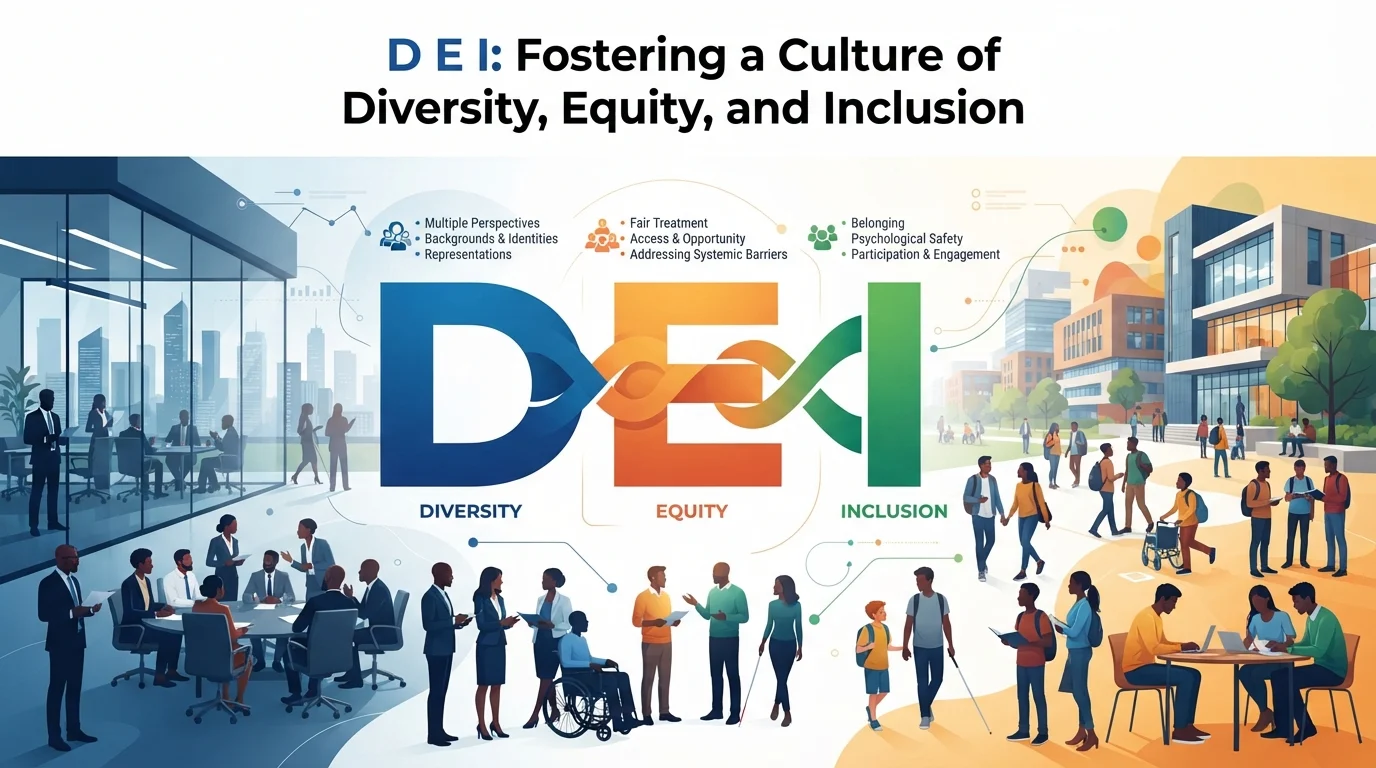
Quick Answer: DEI stands for Diversity, Equity, and Inclusion. Diversity means recognizing and valuing differences in race, gender, age, and other identities. Equity means providing fair opportunities by addressing individual barriers and disadvantages. Inclusion means creating environments where everyone feels welcomed, respected, and able to participate fully . DEI policies aim to counter historical exclusion and level the playing field in workplaces and schools . While DEI has become politically controversial, its core principles trace back to the Civil Rights Act of 1964 .
You’ve seen the letters everywhere. DEI is plastered across corporate websites, debated on cable news, and targeted by executive orders. But what does it actually mean? And why has this three-letter acronym become such a flashpoint?
Here’s the thing: DEI isn’t just corporate jargon or a political football. It’s a framework with real history, real purpose, and real impact on people’s lives. Whether you support it, oppose it, or just want to understand what everyone’s arguing about, you need to know what DEI actually means.
The DEI Meaning: Breaking Down the Acronym
DEI stands for Diversity, Equity, and Inclusion. These three concepts are distinct but interconnected .
Diversity: Who’s in the Room?
Diversity is about representation. It’s the recognition that people come from different backgrounds, hold different identities, and experience the world differently .
Think of it this way: if your organization has people of different races, ages, genders, religions, and abilities, that’s diversity. It’s about counting heads and making sure a variety of perspectives exist .
But here’s a common mistake. People often reduce diversity to just race. In reality, diversity encompasses psychological, physical, and social differences including education, socioeconomic status, sexual orientation, and even learning styles .
Equity: Fairness That Recognizes Different Starting Points
Equity means providing fair treatment, access, and opportunity but not by treating everyone identically .
Picture this: equality gives everyone the same pair of shoes. Equity gives everyone a pair that fits, recognizing that some people have bigger feet or need arch support. In the workplace, equity might mean offering scholarships for underrepresented groups or adjusting interview processes for candidates with disabilities .
The goal is to level the playing field. Not by bringing everyone down to the same starting line, but by acknowledging that some people face barriers others don’t .
Inclusion: Making Sure Everyone’s Voice Matters
Inclusion is the action piece. It’s the deliberate effort to create environments where diverse individuals feel welcome, respected, and valued .
Inclusion means people from all backgrounds can participate fully. Their perspectives are heard. Their contributions are recognized. They don’t feel like outsiders .
Imagine a meeting where everyone speaks over the one quiet person. That’s not inclusive. Now imagine that same meeting where the facilitator actively invites input from everyone and ensures all voices are acknowledged. That’s inclusion in action .
The Origins of DEI: Born from the Civil Rights Movement
DEI might seem like a modern buzzword, but its roots run deep. The concept emerged from the Civil Rights Act of 1964, which outlawed employment discrimination based on race, religion, sex, color, and national origin .
Activists, including figures like Shirley Chisholm, pushed for expanding these protections to cover gender equity. Over the following decades, DEI programs and workplace training expanded, with the 2010s seeing unprecedented prominence. These efforts became closely linked with movements like #MeToo and #BlackLivesMatter, as well as milestones like the legalization of same-sex marriage .
What DEI Looks Like in Practice
DEI isn’t just abstract philosophy. Here are concrete examples of what it looks like in action:
- Employee training programs that help hiring managers better assess candidates with disabilities
- Scholarships to develop skills in underrepresented communities
- Employee Resource Groups that provide support and connection for employees from diverse backgrounds
- Pay equity initiatives to close wage gaps
- Flexible work arrangements accommodating diverse needs
Who Benefits from DEI?
DEI programs benefit a wide range of groups. White women have actually been among the biggest beneficiaries, with initiatives helping close the gender pay gap and increase representation in leadership .
The LGBTQ+ community has gained protections, recognition of Pride Month, and expanded healthcare benefits . Employees seeking IVF and fertility treatments have seen increased insurance coverage thanks to DEI advocacy . People with disabilities have received better training and workplace accommodations . Even veterans often receive preferential hiring and dedicated support programs .
Why DEI Matters: The Case for These Programs
Historical Context
DEI programs exist because of historical inequities. Until relatively recently, many Ivy League institutions didn’t allow Black or female students at all, regardless of qualifications . Even with affirmative action in place, Black and Hispanic people remained underrepresented in top colleges as of 2017 .
The data tells a clear story. Women make up 55.4% of the U.S. workforce but earn just 83.6% of men’s wages . Unemployment rates are higher among Americans with disabilities (7.3%) compared to those without (3.4%) . Black and Hispanic workers earn less on average than white workers .
These aren’t ancient history problems. These are current realities that DEI programs aim to address.
The Business Case for DEI
Beyond fairness, DEI makes business sense. A 2023 McKinsey report found that companies with diverse leadership teams were associated with higher financial returns . Companies in the top quartile for gender and ethnic diversity were 39% more likely to outperform their peers .
HR professionals overwhelmingly support DEI. A survey found that 96% believe diversity leads to a better-functioning company, and 71% personally support DEI programs . Additionally, 76% of workers are more likely to stay with an employer that supports DEI, with that number jumping to 86% among Gen Z employees .
The Backlash: Why DEI Is Under Attack
Despite its supporters, DEI has faced significant backlash. In 2023, the Supreme Court struck down affirmative action programs . President Trump entered his second term with an executive order dismantling DEI programs across the federal government, calling them “radical and wasteful” .
Critics argue that DEI programs discriminate against qualified candidates, promote a “woke” agenda, or ignore merit. Elon Musk has declared, “DEI is just another word for racism” . Some conservatives have equated DEI initiatives with racial quotas, though supporters point out that quotas have been illegal for decades .
The backlash has real consequences. Government-funded nonprofits have been asked to remove DEI-related materials from their websites. Several companies have scaled back their DEI efforts .
Common Misconceptions About DEI
Here’s what DEI is not:
- It’s not a quota system. Quotas have been illegal since the 1978 Bakke decision .
- It’s not about “diversity hires.” That term is often used to imply someone was hired only to fill a demographic checkbox rather than for their qualifications .
- It’s not partisan. Diversity, equity, and inclusion aren’t owned by any political party. Creating accessible, inclusive environments is everyone’s right .
What DEI Means for the Future
DEI is at a crossroads. Executive orders and legal challenges threaten to dismantle programs built over decades. But the underlying issues DEI addresses pay gaps, underrepresentation, discrimination haven’t disappeared.
Organizations are adapting. Many are tweaking programs to suit the political environment while maintaining the goal of a more diverse workplace . Some are rebranding DEI as “DEIB” (adding belonging) or “JEDI” (Justice, Equity, Diversity, Inclusion) .
What’s clear is that the conversation isn’t going away. Whether you view DEI as essential fairness or government overreach, its impact on workplaces, schools, and society is undeniable.
Frequently Asked Questions
What does DEI stand for? DEI stands for Diversity, Equity, and Inclusion.
What is the difference between equality and equity? Equality means treating everyone the same. Equity means giving people what they need to succeed, recognizing that people have different starting points and face different barriers.
Is DEI the same as affirmative action? Not exactly. DEI refers broadly to policies that promote diversity, equity, and inclusion in workplaces and schools. Affirmative action historically referred to special consideration based on race or gender in hiring or admissions, though quotas have been illegal since the Bakke decision.
Who benefits from DEI programs? DEI programs benefit many groups, including women, people of color, LGBTQ+ individuals, people with disabilities, veterans, and employees needing fertility treatments.
Why are DEI programs being banned? In January 2025, President Trump signed an executive order dismantling federal DEI programs, calling them “radical and wasteful.” Critics argue DEI programs ignore merit and can be discriminatory.
Do DEI programs actually work? Research shows mixed results. Some studies link DEI to improved financial performance and employee retention, while other studies find some programs ineffective. HR professionals overwhelmingly support DEI programs, with 96% saying diversity leads to a better-functioning company.
Key Takeaways
| Aspect | Key Point |
|---|---|
| Meaning | Diversity, Equity, and Inclusion |
| Diversity | Representation of different identities and perspectives |
| Equity | Fair treatment that recognizes different barriers and starting points |
| Inclusion | Creating environments where everyone feels welcomed and valued |
| Origins | Civil Rights Act of 1964 |
| Supporters | 96% of HR professionals believe diversity benefits companies |
| Critics | Argue DEI programs ignore merit and promote discrimination |
| Current Status | Under attack federally; being scaled back in some corporate settings |
Conclusion: What DEI Means for All of Us
DEI isn’t just an acronym to memorize for HR training. It’s a framework that shapes workplaces, schools, and communities across America. Understanding what it means and why it matters helps you navigate the debates, make informed decisions, and engage meaningfully with the world around you.
The controversy around DEI shows no signs of fading. Executive orders and legal battles will continue. But the core questions DEI addresses How do we create fair opportunities? How do we ensure everyone can participate fully? aren’t going anywhere.
Whether you agree with DEI programs or oppose them, knowing the facts lets you join the conversation with confidence.