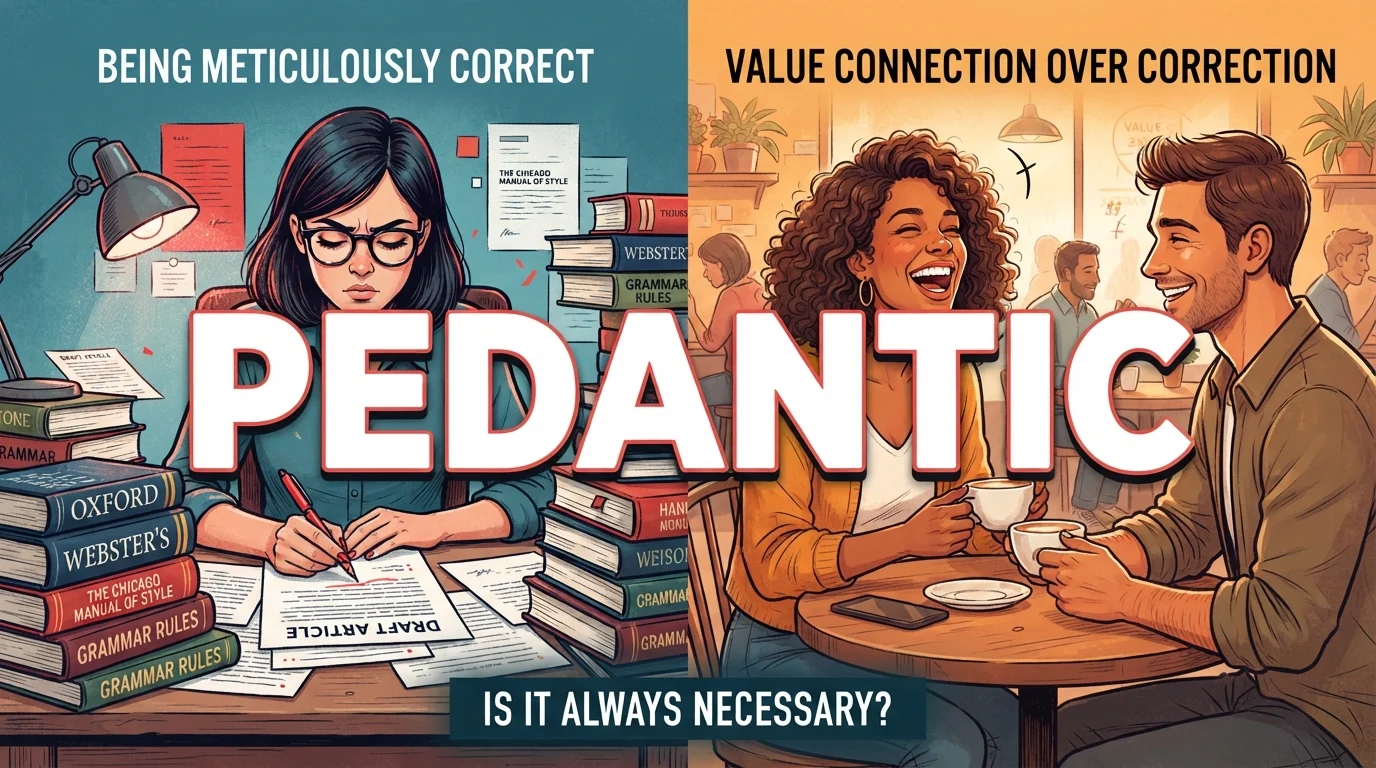
Quick Answer: Pedantic describes someone who is excessively concerned with minor details, formal rules, or precise definitions often in a way that annoys others. A pedantic person corrects small mistakes that don’t matter, insists on technical accuracy in casual conversation, and focuses on the letter of the law rather than its spirit. The word comes from the Italian pedante, a term for a schoolteacher, and it carries a negative connotation. While being precise can be valuable, being pedantic means prioritizing trivial correctness over communication, connection, or common sense.
You know the type. You’re telling a story about how you ran a marathon, and someone interrupts to say, “Actually, it was a half-marathon.” You mention that you’re “literally dying of laughter,” and they point out that you are, in fact, not dying. You share a fun fact you heard, and they launch into a ten-minute explanation of why it’s technically inaccurate.
That person is being pedantic. And chances are, you’ve wanted to throw something at them.
The pedantic meaning is all about an excessive focus on minor details and formal rules. It’s the difference between caring about accuracy and caring about being right. A pedantic person isn’t just precise they’re annoyingly, unnecessarily, counterproductively precise. They correct you when it doesn’t matter.
Understanding what pedantic really means can help you recognize the behavior in yourself and others. It can also help you appreciate when precision matters and when it’s just getting in the way.
Pedantic Meaning: What Does It Actually Mean?
The Core Definition
The Cambridge Dictionary defines pedantic as “giving too much attention to formal rules or small details.” Merriam-Webster adds that a pedantic person is “narrowly, stodgily, and often ostentatiously learned” and displays “unimaginative adherence to formal rules.”
The key elements are: excessive attention to detail, an emphasis on formal rules over practical communication, and a tendency to show off knowledge in a way that alienates others.
The Italian Origin
The word “pedantic” comes from the Italian pedante, which referred to a schoolteacher or a learned person. In the 16th and 17th centuries, “pedant” was used to describe someone who made an ostentatious display of their learning. The implication was that they cared more about showing off their knowledge than about actually being useful or wise.
The root is related to the Greek paideuein, meaning “to teach.” But over time, the word took on a negative connotation. A pedant wasn’t just a teacher they were a teacher who was insufferable about it.
Pedantic vs. Precise
Being precise is a virtue. Doctors need to be precise. Engineers need to be precise. Lawyers need to be precise. Precision saves lives, builds bridges, and ensures justice.
Being pedantic is a vice. The difference is context and intent. A precise person cares about accuracy because it matters. A pedantic person cares about accuracy because they want to be right, or because they can’t let go of minor errors, or because they don’t understand that communication is about connection, not just information transfer.
| Aspect | Precise | Pedantic |
|---|---|---|
| Intent | Ensure accuracy where it matters | Show off knowledge or assert superiority |
| Context | Appropriate to the situation | Inappropriate or excessive |
| Effect | Builds trust and clarity | Annoys and alienates |
| Focus | The important details | Every detail, no matter how trivial |
| Example | “The dosage is 5 mg, not 50 mg.” | “You said ‘less’ when you should have said ‘fewer.'” |
The Pedantic Personality
Pedantic behavior often stems from a desire for control. By focusing on small details, a pedantic person can feel a sense of mastery in a chaotic world. It can also be a way to assert intellectual superiority a way of saying, “I know more than you.”
Sometimes, pedantry is a symptom of anxiety. People who are anxious about being wrong themselves may become hyper-focused on the errors of others. It’s a defense mechanism, a way to deflect attention from their own insecurities.
Pedantic in Everyday Life: Examples and Scenarios
The Grammar Pedant
The most famous type of pedant is the grammar pedant. This is the person who corrects your use of “who” versus “whom,” points out that you ended a sentence with a preposition, and reminds you that “decimate” originally meant to kill one in ten.
Grammar pedants are often mocked online. Memes and jokes abound about people who can’t resist correcting a Facebook post. The irony is that many grammar “rules” they enforce aren’t even real rules. Ending a sentence with a preposition is perfectly fine in English. “Decimate” has evolved to mean “destroy a large portion of.” Language changes, and pedants often refuse to accept it.
The Technical Pedant
In technical fields, pedantry can be more serious. A software developer who insists on perfect code formatting might slow down a project. A scientist who argues about terminology might derail a productive meeting. A medical professional who corrects a patient’s layman’s terms might damage the therapeutic relationship.
The technical pedant often has good intentions. They want things to be done correctly. But they fail to recognize that not every situation calls for maximum precision.
The Social Pedant
Social pedants correct people on matters of etiquette, social norms, or factual accuracy in casual conversation. They’re the ones who say, “Actually, it’s pronounced ‘croissant,’ not ‘cross-ant.'” They correct your pronunciation of foreign words. They point out that your “fun fact” is actually a myth.
This type of pedantry is particularly damaging to relationships. It signals that you care more about being right than about being kind. It turns conversations into competitions.
The Legalistic Pedant
In legal and bureaucratic contexts, pedantry can have real consequences. A contract that’s interpreted pedantically might lead to unfair outcomes. A law that’s enforced to the letter might contradict its spirit. A policy that’s followed rigidly might fail to serve its purpose.
Legal pedantry is sometimes necessary. Contracts need to be precise. Laws need to be clear. But when pedantry becomes an end in itself, it can undermine justice and common sense.
Why People Become Pedantic
The Desire for Control
Pedantry is often about control. The world is messy, unpredictable, and full of ambiguity. By focusing on small, controllable details, a pedantic person creates a sense of order. Correcting someone else’s grammar, for example, gives a fleeting sense of power and certainty.
The Need for Superiority
Some pedants are motivated by a desire to feel superior. By pointing out others’ mistakes, they elevate themselves. This is especially common among people who feel insecure about their own intelligence or status. Pedantry becomes a way to assert dominance in a socially acceptable way.
Anxiety and Perfectionism
Anxiety and perfectionism can also drive pedantic behavior. People who are anxious about making mistakes themselves may become hyper-vigilant about the mistakes of others. Perfectionists may struggle to let go of minor errors, even when they don’t matter.
The Curse of Knowledge
Sometimes, pedantry comes from a genuine place. The “curse of knowledge” is a cognitive bias where experts struggle to imagine what it’s like not to know something. A doctor who corrects a patient’s terminology isn’t trying to be annoying they’re just so immersed in their field that they can’t help but be precise.
The Positive Side of Pedantry
When Precision Matters
Pedantry isn’t always bad. In some contexts, precision is essential. A surgeon who is pedantic about instrument counts is preventing a catastrophe. An accountant who is pedantic about decimal points is protecting a client’s finances. A safety inspector who is pedantic about protocols is saving lives.
The key is context. Pedantry is a virtue when the stakes are high and the details matter. It’s a vice when the stakes are low and the details are trivial.
The Value of Expertise
Experts are often pedantic because they know things that others don’t. A linguist who corrects your etymology might be annoying, but they’re also sharing knowledge that’s genuinely interesting if you’re open to hearing it.
The challenge for experts is to share their knowledge without alienating others. The best teachers and communicators find ways to be precise without being pedantic.
| Context | Is Pedantry Appropriate? |
|---|---|
| Medical dosage | Yes, always |
| Legal contracts | Yes, always |
| Casual conversation | Rarely |
| Social media comments | Almost never |
| Academic peer review | Sometimes |
| Parenting | Depends on the situation |
How to Deal with Pedantic People
Don’t Take the Bait
Pedantic people often want a reaction. They want you to engage in a debate about whether “fewer” is really necessary. The best response is often to acknowledge their correction and move on. “Thanks for the note. Anyway, as I was saying…”
Use Humor
A lighthearted response can defuse pedantry. “Oh, you’re right. I’ll hand in my grammar badge immediately.” Humor signals that you’re not threatened and that you don’t take the correction too seriously.
Set Boundaries
If someone is consistently pedantic in a way that’s damaging your relationship, it’s okay to set a boundary. “I appreciate your attention to detail, but when we’re just chatting, I’d rather not be corrected on every small thing.”
Recognize the Intent
Sometimes pedantry comes from a good place. A colleague who corrects your report might be trying to help you avoid embarrassment. A friend who corrects your pronunciation might be trying to save you from future awkwardness. Recognizing the intent can make the behavior easier to tolerate.
How to Be Less Pedantic Yourself
Ask Yourself: Does It Matter?
Before correcting someone, ask yourself: Does this correction matter? Will it change the outcome of the conversation? Will it help the other person? If the answer is no, let it go.
Consider the Relationship
Is this someone you want to build a relationship with? If so, prioritize connection over correction. You can always share your knowledge later, in a way that’s helpful rather than hurtful.
Embrace Linguistic Evolution
Language changes. It always has and always will. The rules you learned in school might not be rules anymore. “Whom” is falling out of use. “Literally” is used figuratively. “Irregardless” is in the dictionary. Fighting these changes is a losing battle.
Practice Intellectual Humility
Remember that you don’t know everything. The things you’re certain about might be wrong. The rules you’re enforcing might be outdated. Approaching conversations with humility makes you less likely to be pedantic and more likely to learn something new.
Frequently Asked Questions
What does pedantic mean in simple terms? Pedantic means being excessively concerned with minor details and formal rules, often in a way that annoys others.
What is the difference between pedantic and precise? Precision is appropriate and useful. Pedantry is excessive and often trivial. A precise person cares about accuracy that matters. A pedantic person cares about accuracy that doesn’t.
Is pedantic an insult? Yes, “pedantic” is generally used as a criticism. Calling someone pedantic means they’re being annoyingly focused on small details.
Where does the word pedantic come from? It comes from the Italian pedante, meaning schoolteacher, which itself relates to the Greek paideuein, meaning “to teach.”
What is a pedantic person like? A pedantic person corrects small mistakes, insists on technical accuracy in casual settings, and focuses on rules over communication.
Is being pedantic a mental health condition? No, pedantry is a behavior, not a diagnosis. However, it can be associated with anxiety, perfectionism, or autism spectrum conditions in some cases.
How do I stop being pedantic? Ask yourself if the correction matters, consider the relationship, embrace linguistic evolution, and practice intellectual humility.
Key Takeaways
| Aspect | Key Point |
|---|---|
| Core Meaning | Excessively concerned with minor details and formal rules |
| Origin | Italian pedante (schoolteacher), from Greek paideuein (to teach) |
| Connotation | Negative annoying, nitpicky, show-offy |
| Opposite | Broad-minded, flexible, focused on the big picture |
| Common Types | Grammar pedants, technical pedants, social pedants |
| When It’s Okay | High-stakes situations where precision matters |
| When It’s Not | Casual conversation, social media, relationships |
| How to Deal | Don’t take the bait, use humor, set boundaries |
| How to Improve | Ask if it matters, prioritize connection, practice humility |
Conclusion: The Fine Line Between Precision and Pedantry
Pedantry is a fascinating human behavior. It sits at the intersection of knowledge, ego, anxiety, and social dynamics. The pedantic person often knows a lot but their knowledge becomes a barrier rather than a bridge.
Understanding the pedantic meaning helps us navigate a world full of would-be correctors. It helps us recognize when precision is valuable and when it’s just noise. And it helps us look at our own behavior with honesty.
Do you insist on rules that no longer serve a purpose? If so, you might be a pedant. The good news is that pedantry can be unlearned. It starts with a simple question: “Does this correction help, or does it just make me feel superior?”
In a world that’s messy, ambiguous, and constantly changing, the ability to let go of minor details is a superpower. It allows us to connect with others, to be present in conversations, and to focus on what truly matters. Precision has its place. But so does grace.