Quick Answer: The evil eye meaning is the belief that a look, especially one driven by envy or excessive admiration, can cause harm, bad luck, or illness to the person being looked at. It is also the name for the protective blue amulet, the nazar, worn to ward off that harm, and for a hostile glare in everyday speech.
The evil eye meaning is one of the oldest and most widespread beliefs in human history. It appears in ancient Mesopotamia, Greece, and Rome. It also appears in the Middle East, South Asia, and Latin America. People still use it today in jewellery, home decorations, and everyday phrases. Yet people use the term in three different ways. Mixing them up causes confusion.
In this guide, you will learn the evil eye meaning in each sense. You will also learn where the belief comes from. The guide covers what the famous blue amulet means. It also shows how people use the phrase in modern English.
Evil Eye Meaning: What Does Evil Eye Mean?
The evil eye has three main meanings, and they are related but distinct.
First, it means the belief itself. Certain people can inflict harm, bad luck, or illness simply by looking at someone. They often do so with envy or overpowering admiration. People often think the harm is unintentional. A person may not know they have given the evil eye. Their envious glance alone can do the damage.
Second, it means a hostile look in everyday speech. To “give someone the evil eye” means to glare at them with disapproval, anger, or jealousy. People usually use it figuratively and playfully today. For example, a mother may give her teenager the evil eye for staying on the phone. People do not believe she casts a curse.
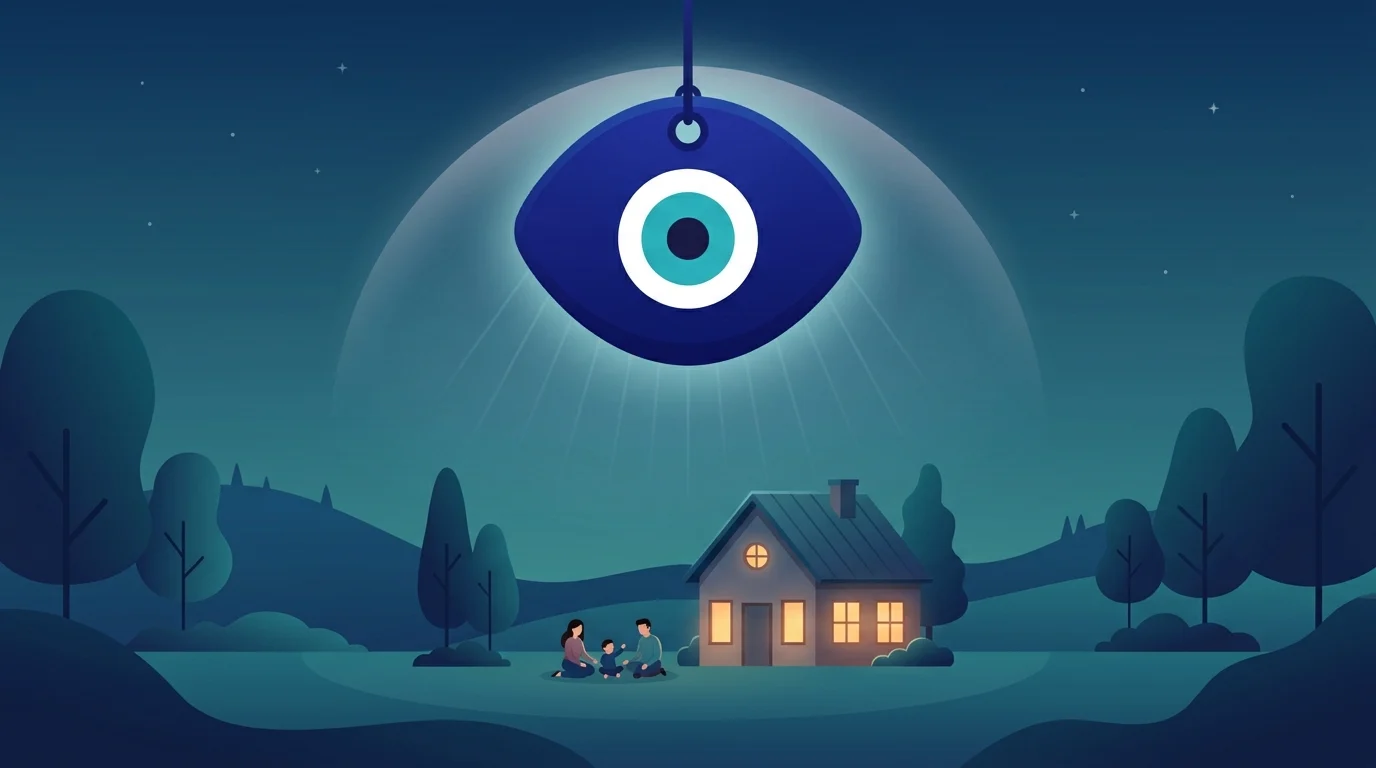
Third, it means the protective charm. This is the blue, eye-shaped amulet. Turkish and Arabic traditions call it nazar. People wear or display it to deflect the evil eye. When someone buys an “evil eye bracelet,” they usually mean this protective object, not the curse itself. The charm defeats an eye with an eye.
Origin and History of the Evil Eye
The evil eye meaning goes back at least 5,000 years. The Sumerians, Babylonians, and Assyrians recognised it. Ancient Egyptians also recognised it from around 3000 BC. Ancient Greek texts called it mati. In Roman writing, poets such as Virgil mention it bewitching lambs. It also appears in the Old Testament, the Quran, and later European folklore.
The first known use of the English phrase “evil eye” dates to before the 12th century. That long history makes it one of the most durable folk beliefs ever recorded. Scholars such as Alan Dundes edited a landmark collection on the subject. Dundes argued that it may be the most widespread superstition in human history. It appears in so many cultures with the same basic shape.
Why did the belief spread so far? Anthropologists suggest it gave societies a way to explain sudden misfortune. For example, a healthy child might fall ill. A good harvest might fail, and a run of luck might turn bad. Blaming an envious glance provided an explanation. It also served a social purpose, and it discouraged people from flaunting wealth or good fortune too openly.
The Evil Eye Around the World
Different cultures give the evil eye different names, but the core idea stays remarkably consistent. Spanish-speaking cultures call it mal de ojo, literally “bad eye.” Italian tradition calls it malocchio. Hebrew calls it ayin hara, “evil eye.” Turkish and Arabic cultures call it nazar, which also names the protective amulet.
Who do people think is most vulnerable? Traditionally, children and newborns face the greatest risk. They are precious and visibly admired. People experiencing visible good fortune also face risk. Examples include a new home, a beautiful wedding, and a successful harvest. Many traditions treat excessive praise as risky. For that reason, people often follow compliments to a baby with a protective phrase or gesture. In Muslim cultures, they may say “mashallah,” meaning “what God has willed.”
Protection takes many forms: amulets, prayers, rituals, and gestures. People in parts of Europe use the horned hand gesture to ward off the evil eye. They extend the index and little fingers for this gesture. In Latin America, people may place a red bracelet or a seed amulet on a baby’s wrist. People in the Mediterranean and Middle East hang the blue nazar bead in homes, cars, and workplaces.
The Nazar: The Blue Evil Eye Amulet
The nazar is the most recognisable symbol of the evil eye tradition today. It is a flat, round bead or pendant with concentric circles of dark blue, light blue, white, and black. Those circles resemble an eye. The design is deliberate: an eye to watch for, and deflect, a harmful eye.
Nazar amulets appear as bracelets, necklaces, earrings, keyrings, wall hangings, and car decorations. They are popular far beyond the cultures where the belief began. People wear them partly as fashion and partly as a good-luck symbol. Many wearers do not literally believe in the curse. They still value the amulet as a cultural symbol, a gift, or a reminder of home.
A common folk idea concerns a nazar that cracks or breaks. Such a nazar has absorbed a harmful glance and done its job. People should replace it. Whether or not you believe that, the idea shows something important. People in traditions where the amulet is more than decoration take the protective logic seriously.
Evil Eye in Everyday Speech
In modern English, “give someone the evil eye” is an idiom. It means to glare at someone with hostility or strong disapproval. People use it lightly, often humorously. It does not imply a supernatural belief.
- She gave me the evil eye when I reached for the last slice of cake.
- Don’t give me the evil eye, I was only joking.
- He got the evil eye from his boss for arriving late again.
- Where houseplants are concerned, I seem to have the evil eye: everything I touch dies.
That last example shows a further playful use. Someone jokes about having the evil eye because of bad luck with plants, pets, or gadgets. The humour works because the literal belief is so old and familiar. Everyone recognises the reference, even if nobody takes it literally.
How to Pronounce Evil Eye
Say evil eye as EE-vul EYE. Stress the first syllable of the first word and stress “eye.” Writers usually write the phrase without a hyphen as a noun, “the evil eye.” Some dictionaries list “evil-eye” as an adjective form, as in “an evil-eye charm.”
Synonyms and Related Terms
Related words include malicious gaze, malevolent stare, jinx, hex, and curse, although each carries a different shade. A jinx is a general bringer of bad luck, not necessarily through a look. A hex is a deliberate spell, while the evil eye is often unintentional. Mal de ojo, malocchio, ayin hara, mati, and nazar are cultural names for the belief or its protection. They are not English synonyms in the strict sense. They are essential vocabulary for understanding the tradition.
The opposite ideas are blessing, good luck, and a favourable glance. The evil eye tradition treats this kindly attention as safe. It carries no envy.
Is the Evil Eye Real?
There is no scientific evidence that a look can cause illness or bad luck through supernatural means. Psychologists explain the belief as a way of coping with envy, uncertainty, and random misfortune. They also see it as a social rule. That rule encourages modesty about success.
That scientific view does not erase the cultural importance of the belief. For millions of people, the evil eye meaning is part of family tradition, religious practice, or cultural identity. People wear its symbols with affection and respect. A good guide can hold both facts at once. Science has not proven the belief, yet it remains deeply meaningful to the people who hold it.
Respect matters in discussion. Dismissing someone’s nazar as mere superstition can feel dismissive of their culture. However, insisting that others share the belief would also be unfair. Describing the tradition accurately is the balanced approach. Do so without mockery and without endorsing supernatural claims as fact.
Common Mistakes With Evil Eye
The most common mistake is confusing the curse with the charm. An “evil eye bracelet” is usually a protective nazar, not an object that gives people bad luck. In fact, people wear one to protect themselves, not to harm others.
Another mistake is assuming the evil eye is only a Mediterranean idea. It appears on every inhabited continent, with local names and customs, from South Asia to Latin America to West Africa.
Finally, do not confuse the idiom with the belief in every sentence. “She gave him the evil eye” in a modern novel almost always means a glare, not a curse. Context, as always, decides the meaning.
FAQs About the Evil Eye
What does the evil eye mean?
The belief that an envious or admiring look can cause harm or bad luck, and by extension the hostile glare and the protective amulet associated with that belief.
What is the blue evil eye called?
Nazar, in Turkish and Arabic traditions. It is a protective amulet shaped like an eye.
What does it mean to give someone the evil eye?
To glare at them with anger, disapproval, or jealousy. In modern speech, this is usually figurative.
Where did the evil eye belief come from?
It dates back at least 5,000 years to ancient Mesopotamia and Egypt, and spread through Greece, Rome, the Middle East, South Asia, and Latin America.
Does the evil eye bracelet protect you?
In folk tradition, yes: it is believed to deflect harmful glances. Scientifically, there is no evidence for supernatural protection, but many people value it culturally and personally.
Conclusion
The evil eye meaning covers three connected things. Envy can harm through a look, according to a very old belief. It also means a hostile glare in everyday speech. It also means the blue nazar amulet worn to ward that harm away. From ancient Mesopotamia to modern jewellery shops, the idea has travelled across continents and centuries without losing its shape.
Whether you meet it as folklore, as fashion, or as a phrase in conversation, the evil eye is a reminder of a universal human worry. Being envied can feel dangerous. In addition, a watchful eye, even a glass one, can feel like protection.