Quick Answer: A “skink” is primarily a type of lizard belonging to the family Scincidae, known for its smooth, shiny scales and often reduced limbs . However, the word has a surprising triple life. It can also be a British slang slur for a white person or an archaic term for a bartender . The word originates from the Greek skinkos, but an older, unrelated English word meaning “to pour liquor” also exists .
You might know “skink” as that quick little lizard you see darting across a sun-warmed rock. But like a good spy with multiple identities, this five-letter word has more secrets than you would expect. Depending on who is speaking and when, “skink” could mean a shiny reptile, a racial slur in British slang, or even a medieval bartender .
The primary skink meaning is zoological. We are talking about the Scincidae family, the second-largest family of lizards on the planet . They are the ultimate survivors, found everywhere from your backyard garden to scorching deserts. But the linguistic journey of the word itself is just as fascinating as the creature’s evolutionary path. Let’s peel back the layers of this truly unique word.
What Does Skink Mean? The Triple Identity
The Zoological Definition
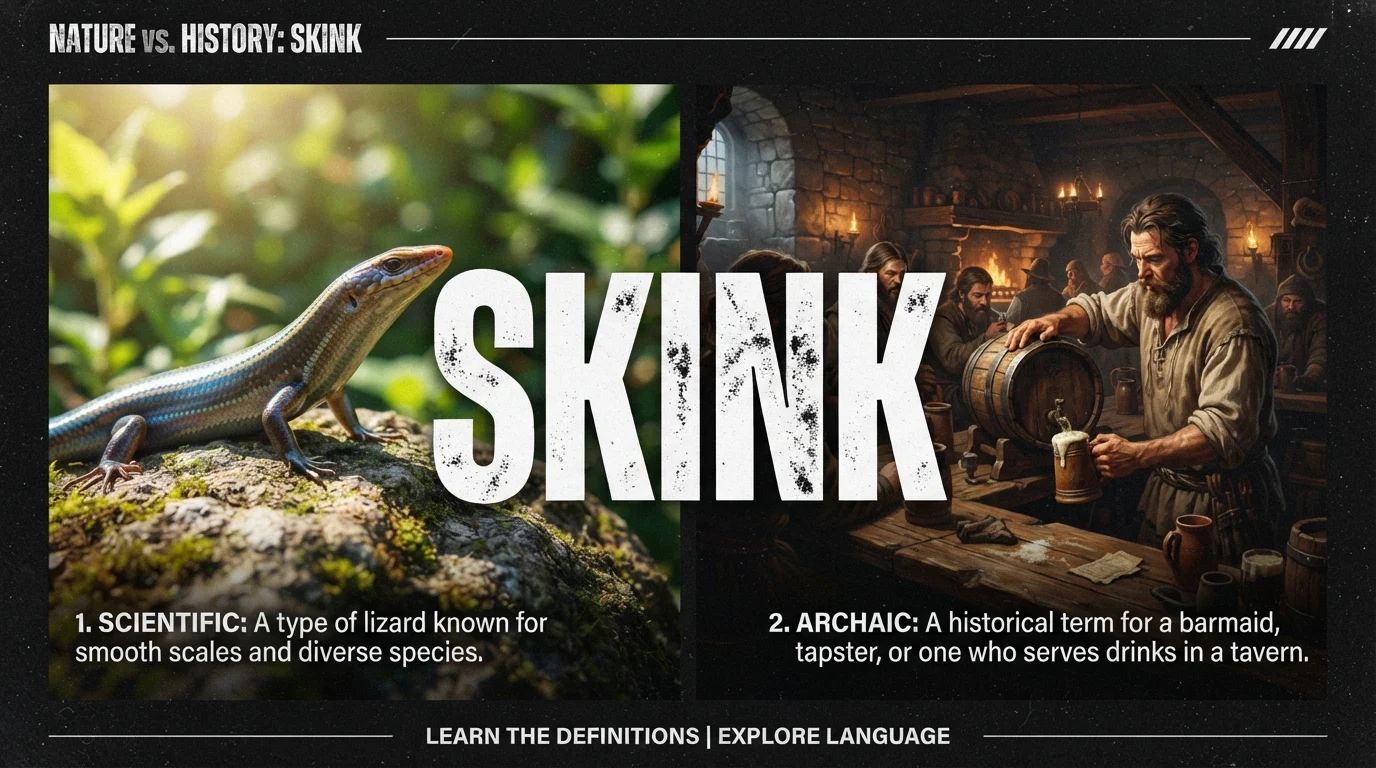
At its core, a skink is a lizard. But not just any lizard. According to biology, skinks belong to the family Scincidae . These reptiles are characterized by their smooth, shiny, overlapping scales that often give them a polished, almost metallic appearance .
They usually have a long, tapering tail that they can detach to escape predators (a process called autotomy), and their legs tend to be relatively small, sometimes even completely absent . This makes them look like a cross between a typical lizard and a snake.
The Slang Definition
If you are in the UK, specifically within Black British slang, calling someone a “skink” is not a compliment about their agility. It is a derogatory term used for a white person . Green’s Dictionary of Slang records it as a term of abuse, placing it in a category alongside other harsh insults . This usage is a stark contrast to the neutral, scientific definition.
The Archaic Definition
Here is a weird twist. Long before the Greeks named the lizard, the English had their own word “skink.” It comes from an Anglo-Saxon root meaning “to pour liquor” . It was used to describe a tapster or bartender. In fact, Geoffrey Chaucer used it in his famous Canterbury Tales: “Bacus the wyn hem skynketh all aboute” (Bacchus pours the wine all around) .
The Zoological Skink: 1,500+ Species of Survivors
If you want to understand the primary skink meaning, just look at the numbers. There are over 1,500 species of skinks, making them one of the most diverse families of lizards on Earth . They are found on every continent except Antarctica .
Physical Description and Behavior
Skinks are generally “alert, agile lizards” . Most species are medium-sized, typically growing up to 12 centimeters from snout to vent, though giants like the Solomon Islands skink (Corucia) can reach over 30 centimeters .
They are “cryptic” creatures, meaning they are often secretive and spend their time hiding under rocks, logs, or leaf litter . Here are some fascinating behaviors:
- Diet: They are generally carnivorous, feasting on insects like crickets, beetles, and caterpillars. However, some species enjoy a mix of meat and vegetables .
- Movement: Skinks are ground-dwellers and often appear to slither, especially species with tiny legs. Some, like the sand skinks, even “swim” through the desert sand .
- Reproduction: Unlike many lizards that just lay eggs, a significant number of skink species (about 45%) give birth to live young .
Relationship to Humans
Skinks generally do not pose a threat to humans. They are small, non-venomous, and prefer to run rather than fight. In many cultures, they are even kept as pets. The “Blue-Tongued Skink” is a popular example, prized for its docile nature and distinctive blue mouth.
However, the term “skink” can also refer to the British slang insult, which would be a different kind of bite altogether.
Key Takeaways: The Many Faces of Skink
Frequently Asked Questions
What is a skink?
A skink is a type of lizard. It is a reptile that typically has a long body, smooth and shiny scales, and short limbs .
Where does the word skink come from?
The zoological term comes from the Latin scincus and the Greek skinkos . There is also an older, unrelated English word “skink” meaning to pour drink .
Is a skink a snake?
No, a skink is a lizard. While some species have very small legs or no legs at all, they are distinct from snakes and often have moveable eyelids and external ear openings .
Why do people call each other “skink”?
In some parts of the UK, particularly within Black British communities, “skink” is used as a derogatory slang term for a white person .
Conclusion: The Linguistic Shapeshifter
The word “skink” is a brilliant example of how language never sits still. It is a zoological term recognized in the hallowed halls of science, a slur used in the gritty corners of urban slang, and a dusty artifact from the age of Chaucer. Ultimately, understanding the skink meaning is a lesson in context.
Most of the time, if you see one in the wild, you are looking at a fascinating lizard. It is a survivor, a master of camouflage, and a vital part of its ecosystem. But if you hear someone using the word, listen closely. They could be describing a reptile, serving a drink, or throwing a punch.