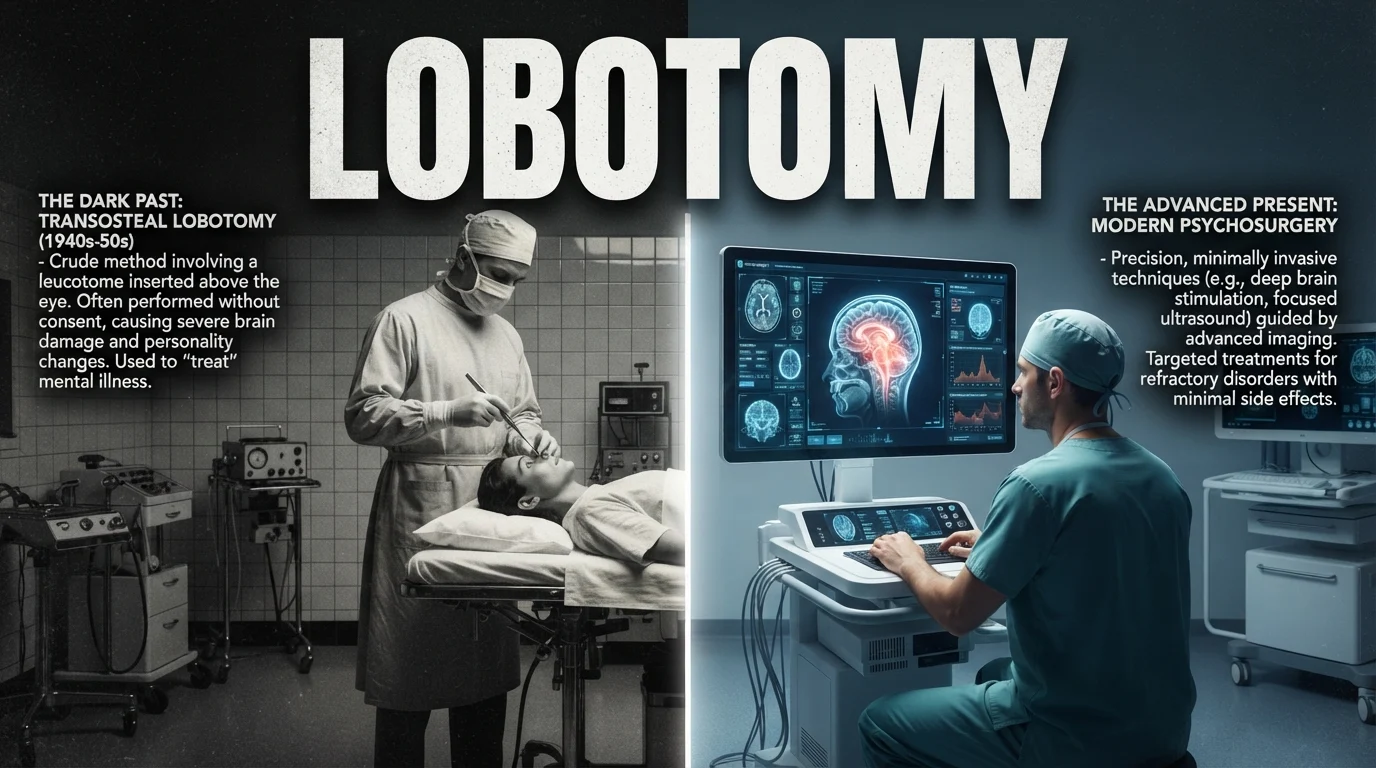
Quick Answer: A lobotomy is a surgical procedure that involves cutting or destroying connections in the brain’s frontal lobe to treat mental illness. Pioneered in the 1930s by Portuguese neurologist António Egas Moniz, it was performed on tens of thousands of patients worldwide before being abandoned in the 1950s with the arrival of effective antipsychotic medications. The procedure often caused devastating side effects including apathy, personality changes, intellectual impairment, seizures, and death, turning the term “lobotomy” into a symbol of medical barbarism .
Few medical terms carry the same chilling weight as “lobotomy.” Mention it, and people picture ice picks through eye sockets, zombies shuffling through institutions, and the tragic story of Rosemary Kennedy. It’s a word that makes us shudder.
But here’s the uncomfortable truth: at the time, lobotomies were seen as a breakthrough. Before effective medications existed, mental asylums were overflowing with patients suffering from schizophrenia, severe depression, and psychosis. Doctors were desperate. Families were desperate. And into this desperation stepped a procedure that promised relief, even if it came at a terrible cost.
Understanding the lobotomy meaning isn’t just about knowing a definition. It’s about understanding a cautionary tale of what happens when medical ambition outruns ethics, when we treat symptoms without understanding causes, and when society’s desire to manage “difficult” people overrides compassion. Let’s dive into this complicated history.
What Is a Lobotomy? The Basic Definition
The Simple Explanation
A lobotomy is a surgical procedure that involves cutting into or destroying part of the brain, specifically the connections within the frontal lobe. The procedure aims to sever the nerve fibers connecting the frontal lobe to the thalamus, which doctors believed would calm patients suffering from severe mental disturbances .
The term “lobotomy” comes from the Greek lobos (lobe) and tomē (cutting). In British and European contexts, you’ll also hear “leucotomy,” which means “white matter cutting” .
What Does a Lobotomy Actually Do?
To understand the lobotomy meaning, you need to understand its purpose. The frontal lobe, located just behind the forehead, is responsible for personality, social behavior, planning, motivation, and complex decision-making. Doctors believed that severing connections between this area and the thalamus would reduce the “abnormal stimuli” causing impulsive and violent behavior .
In practice, this often meant the patient became calmer but also lost much of what made them who they were. Many became apathetic, disinterested, and passive. They lost their drive, their emotions, and sometimes their ability to function .
The History: How Lobotomies Became a Global Phenomenon
Early Experiments: The Swiss and Russian Pioneers
The story begins earlier than you might think. In 1890, Swiss physician Gottlieb Burckhardt performed the first psychosurgery procedures on mental patients, removing parts of the brain cortex to address symptoms like agitation and hallucinations. The results were mixed: one patient died, another took one’s life, but others were pacified .
In 1910, Russian surgeon Ludvig Puusepp began operating on frontal lobes to treat excited-depressive psychosis, but concluded the dangerous procedure wasn’t worth the risks .
These early experiments didn’t inspire widespread imitation the world wasn’t ready.
1935: Egas Moniz and the Birth of the Modern Lobotomy
Everything changed in 1935. Two things happened that year. First, American scientists removed the frontal lobes of chimpanzees and observed changes in their behavior. Second, Portuguese neurologist António Egas Moniz performed the first human prefrontal leukotomy .
Moniz, working with surgeon Pedro Almeida Lima, drilled holes on each side of the patient’s head near the frontal areas. They then inserted a leukotome a needle with a small circular wire that could be deployed. Once positioned, they twisted the instrument to cut the white matter of the brain .
By 1937, Moniz and Lima had performed nearly 40 lobotomies. His results seemed promising enough that in 1949, he received the Nobel Prize for Physiology or Medicine for “his discovery of the therapeutic value of leucotomy in certain psychoses” .
Walter Freeman: The Showman Who Made It Horrifying
If Moniz was the inventor, American neurologist Walter Jackson Freeman II was the promoter and the man responsible for the most disturbing chapter in lobotomy history .
Freeman, described as “equal parts physician and showman,” initially worked with surgeon James Watts to develop the Freeman-Watts standard lobotomy. This procedure involved drilling holes on each side of the head near the temples and using a blunt spatula to sever connections .
But Freeman wasn’t satisfied. Surgery was too slow, too expensive, and required an operating room. So in 1946, he introduced the transorbital lobotomy.
Here’s how it worked: Freeman would place a sharp metal instrument initially an actual ice pick, later a specialized orbitoclast under the patient’s eyelid. Then, using a mallet, he’d tap it through the thin bone behind the eye socket, insert it a couple of inches into the brain, and move it back and forth to destroy tissue .
The entire procedure took about ten minutes. No operating room required. No sterile conditions, often. Just Freeman, his ice pick, and a stream of patients .
| Procedure | Method | Time | Notable Features |
|---|---|---|---|
| Prefrontal lobotomy | Drill holes in skull, cut tissue with leukotome | Longer | Developed by Moniz, performed in operating room |
| Freeman-Watts standard | Drill holes near temples, sever with spatula | Moderate | More precise, still required surgery |
| Transorbital lobotomy | Insert instrument through eye socket, tap with mallet | ~10 minutes | Developed by Freeman, no operating room needed |
The Scale: Tens of Thousands of Patients
The numbers are staggering. Freeman personally performed or supervised over 3,500 lobotomies. In total, more than 50,000 lobotomies were performed in the United States alone, most between 1949 and 1952 .
In Sweden, over 4,500 lobotomies were performed between 1944 and 1966, and most patients were women. France reported at least 1,340 cases between 1935 and 1985 .
Patients ranged from children to the older people. Freeman famously lobotomized 19 children, including 12-year-old Howard Dully, who underwent the procedure on his stepmother’s orders. Dully wasn’t even aware of his surgery until decades later. “I’ll never know what I lost in those 10 minutes with Dr. Freeman and his ice pick,” he later told NPR .
What Conditions Were Treated?
Lobotomies were performed for a wide range of conditions, many of which we now treat with medication and therapy :
Mental Health Conditions:
- Schizophrenia
- Severe depression
- Obsessive-compulsive disorder (OCD)
- bipolar disorder
- Chronic neurosis
- Toxic personality
- Dementia
Physical Conditions (rare cases):
- Peptic ulcers
- Ulcerative colitis
- Gastrointestinal bleeding
The rationale, however shocking today, was that if the brain’s connections were “malfunctioning,” severing them might stop the problem. It was crude, but in an era with few alternatives, it seemed like hope .
Side Effects and Consequences
The Immediate Risks
Brain surgery is always dangerous, and lobotomies were especially risky :
- Bleeding and infection: Common immediate risks
- Brain abscess: A serious infection risk
- Epilepsy: Freeman himself reported over a quarter of patients developed seizures after lobotomy
- Death: Estimated at about 2-5% of patients
The Long-Term Devastation
The side effects that followed many lobotomies were horrifying :
- Apathy and passivity: Patients became completely disinterested in their own lives, described as “zombies”
- Intellectual impairment: Many were reduced to the mental capacity of children
- Personality changes: The core of who they were was destroyed
- Disinhibition: Inappropriate social behavior
- Incontinence
- Obesity
- Dementia
One of the most famous cases is Rosemary Kennedy, sister of President John F. Kennedy. In 1941, she underwent a lobotomy to treat seizures and extreme mood shifts. The result was catastrophic: she lost her ability to walk and talk, her personality was permanently altered, and she was left with a physical disability .
Why Lobotomies Were Abandoned
The Arrival of Thorazine
The beginning of the end came in 1952 with the introduction of chlorpromazine, sold under the brand name Thorazine . This antipsychotic medication was the first truly effective treatment for schizophrenia and psychosis.
An estimated 2 million people were prescribed Thorazine in its first year on the market . Suddenly, mental asylums that had been packed with patients began to empty. The desperate need for a surgical “fix” vanished almost overnight.
Growing Criticism
Even before Thorazine, criticism was mounting. Many neurosurgeons had resisted the procedure from the start, citing its lack of research and low success rate. By the late 1950s, the medical community had largely turned against it .
The Soviet Union actually banned lobotomies in the 1950s, decades before the rest of the world followed .
Are Lobotomies Still Performed Today?
The Short Answer: Not Classical Lobotomies
Classical lobotomies the ice pick through the eye socket, the blind severing of brain tissue are no longer performed in the United States or most Western countries .
The Nuanced Answer: Psychosurgery Continues
However, psychosurgery surgery on the brain to treat psychological conditions has not disappeared entirely. It has evolved into something vastly different .
Modern procedures are precise, targeted, and based on detailed brain imaging like CT and MRI scans. Surgeons can identify specific malfunctioning areas rather than destroying massive sections of the brain .
Modern psychosurgical procedures include :
- Cingulotomy: Treats severe OCD, chronic anxiety, and treatment-resistant depression
- Anterior capsulotomy: Used for severe OCD
- Subcaudate tractotomy: Treats mood disorders and OCD
- Limbic leucotomy: Combination procedure for mood disorders and OCD
- Corpus callosotomy: Severs connections between brain hemispheres, often for severe epilepsy
These procedures are extremely rare and are only considered when all other treatments medication, therapy, and more have failed. A 2019 review found that 73% of people who received anterior capsulotomy for OCD responded to the surgery .
Frequently Asked Questions
What is a lobotomy? A lobotomy is a surgical procedure that cuts or destroys connections in the brain’s frontal lobe, historically used to treat mental illness .
Does a lobotomy change your personality? Yes, often dramatically. Many patients became apathetic, passive, and lost their emotional depth and motivation .
What is the difference between a lobotomy and a leucotomy? They are essentially the same procedure. “Leucotomy” (or leukotomy) is the British and European term, referring to cutting white matter in the brain .
Why did people get lobotomies? Before effective medications existed, lobotomies were a last-resort treatment for severe mental illness like schizophrenia, depression, and OCD .
Are lobotomies still performed today? Classical lobotomies are no longer performed, but modern psychosurgery much more precise and targeted is occasionally used for severe, treatment-resistant conditions .
How many people died from lobotomies? Estimates suggest death rates of 2-5% of patients, with many more suffering severe side effects like epilepsy, personality changes, and intellectual impairment .
Who invented the lobotomy? Portuguese neurologist António Egas Moniz is credited with pioneering the procedure in 1935 and received the Nobel Prize for it in 1949 .
Key Takeaways
| Aspect | Key Point |
|---|---|
| Core Meaning | Surgical cutting of brain connections to treat mental illness |
| Origin | Pioneered by Egas Moniz in 1935 |
| Peak Era | 1940s-1950s, over 50,000 performed in the U.S. |
| Notable Promoter | Dr. Walter Freeman, who performed 3,500+ lobotomies |
| Common Side Effects | Apathy, personality changes, seizures, intellectual impairment, death |
| Notable Case | Rosemary Kennedy (1941), lost ability to walk and talk |
| Why It Stopped | Antipsychotic medications (Thorazine, 1952) and growing criticism |
| Modern Equivalent | Psychosurgery (rare, precise, imaging-guided) |
Conclusion: A Cautionary Tale
The lobotomy meaning is more than a dictionary definition. It’s a warning about the dangers of medical arrogance, of treating patients like problems to be solved rather than people to be helped. It’s a reminder that for every success story and there were some, people who genuinely benefited there were many more whose lives were destroyed.
What makes the story even darker is that the procedure was rarely done with malice. Moniz believed he was helping. Freeman believed he was saving lives. Families consented because they were desperate. The psychiatric system was overcrowded and out of options. It was a perfect storm of good intentions, bad science, and societal pressure.
Today, lobotomies serve as a benchmark for medical ethics. They remind us that a procedure can be popular, accepted, and even Nobel Prize-winning and still be deeply wrong. They remind us to ask: “What are we doing today that future generations will look back on with horror?”
The lobotomy era ended because science advanced. Medication replaced surgery. Understanding replaced superstition. The tragedy is that it took so long, and so many lives were altered or destroyed along the way.
Howard Dully, lobotomized as a child, spoke for many when he said, “By some miracle it didn’t turn me into a zombie, crush my spirit, or kill me. But it did affect me. Deeply. Ever since my lobotomy I’ve felt like a freak, ashamed” .
His story is a reminder that behind every statistic is a human being a lesson we should never forget.