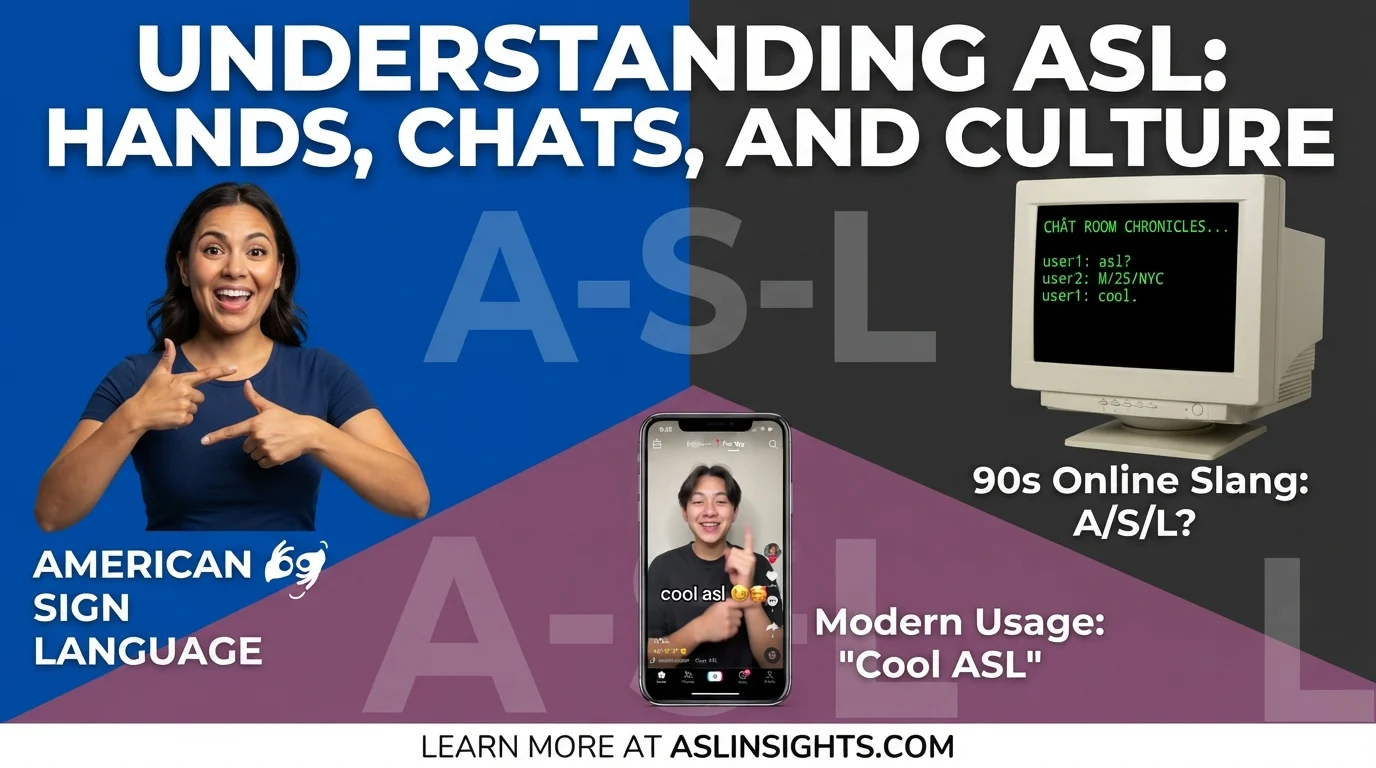
Quick Answer: ASL has three completely different meanings. It’s American Sign Language, the visual language used by the Deaf community in North America. It’s also the old internet chat room question Age/Sex/Location. And on TikTok and social media today, Gen Z uses “asl” as a casual abbreviation for “as hell.” The meaning depends entirely on the context, so knowing which version someone’s using is key to understanding them.
You see “ASL” pop up, and your brain has to decide: is this about the Deaf community, a creepy chat room question, or someone saying something is “cute asl”? The answer could be any of these, and getting it wrong leads to some awkward misunderstandings.
This abbreviation lives in three different worlds at once. It’s a legitimate language recognized by linguists and governments. It’s a relic of the early internet that shaped how we connected with strangers online. And it’s a piece of modern slang that’s been redefined by a generation that likes to keep things short. Let’s break down all three ASL meanings so you’ll never be confused again.
American Sign Language: A Complete Visual Language
What Is American Sign Language?
American Sign Language (ASL) is a complete, complex visual language that uses hand signs, facial expressions, and body movements to communicate. It’s the primary language for many Deaf people in the United States and English-speaking parts of Canada. With up to two million people using ASL in North America, it’s one of the most commonly used languages in the U.S. after Spanish and English.
ASL isn’t just “English on the hands.” It has its own grammar, syntax, and rules that are completely distinct from spoken English. In the 1960s, linguist William Stokoe proved that ASL was a genuine language with its own structure, leading to its widespread acceptance and use in education.
How Did ASL Originate?
The story of ASL goes back to 1817, when Thomas Hopkins Gallaudet and Laurent Clerc founded the American School for the Deaf in Hartford, Connecticut. Clerc came from France and brought French Sign Language (LSF) with him. This French influence mixed with home-signing systems already used in America to create something new ASL.
A large Deaf community on Martha’s Vineyard also played a role, as signing was common there among both Deaf and hearing residents. All these influences combined to form the distinct language we know as ASL today.
How Does ASL Work?
ASL uses hand shapes, movements, and positions to represent concepts rather than individual words. Facial expressions aren’t just emotional they’re a core part of the grammar. Raising your eyebrows, tilting your head, or shifting your body can change the meaning of a sign completely.
The language also uses “fingerspelling,” where you spell out words using the 26 signs for each letter of the alphabet. This is mostly used for proper nouns or for asking about a sign you don’t know.
| Aspect | ASL Characteristics |
|---|---|
| Type | Complete visual language |
| Users | ~2 million in North America |
| Origins | French Sign Language + American home-signing (1817) |
| Key Feature | Independent grammar and syntax |
| Key Device | Fingerspelling for proper nouns |
The Sociolinguistic Side of ASL
ASL, like spoken languages, has regional dialects and variations. Linguists have studied how factors like age, socioeconomic class, gender, and region affect the way people sign. Certain signs vary from city to city, and the signing style can differ between generations or ethnic groups.
The Internet Classic: Age/Sex/Location
What Did ASL Mean in Chat Rooms?
Before social media profiles displayed everything about you, there was the chat room. And the first question anyone asked was “ASL?” meaning Age, Sex, Location. It was the ultimate icebreaker in a world where profiles were basically empty.
The Rise and Fall of A/S/L
The initialism likely started in IRC chat rooms in the 1980s and became huge on AOL Instant Messenger (AIM) and MSN Messenger in the 90s. It was how you figured out who you were talking to. People would reply with something like “14/F/Cali” (14-year-old female from California).
Why did it die out? A few reasons: social media now shows age, gender, and location on profiles, so asking is redundant. People are also more cautious about sharing personal info online. And let’s be honest, “ASL?” also became associated with creepy or superficial interactions.
The ASL Legacy
Today, “ASL” used as a question is a clear signal that someone is stuck in the 90s or trying to be ironic. It’s a nostalgic relic of a time when the internet felt like the Wild West and everyone you met online was a mystery. But it’s also a reminder of how much online culture has changed.
The TikTok Twist: “As Hell”
How Did ASL Become “As Hell”?
Here’s where it gets tricky. Gen Z has taken the old ASL and given it a new meaning: “as hell.” Instead of asking for personal info, they use it as emphasis. “That’s cool asl” means “that’s really cool.” “I’m tired asl” means “I’m exhausted.”
The change started appearing around 2018, with complaints from older internet users who were confused. By the early 2020s, it had exploded on TikTok, where it’s now just a normal part of the vocabulary.
Why Did This Happen?
Gen Z loves abbreviations, but they also love remixing older slang to make it their own. The irony of turning an acronym that meant “Age/Sex/Location” into a casual intensifier is probably part of the appeal. It’s a way of saying, “This is ours now, not yours.”
How to Tell Which ASL Someone Means
Context is everything. ” If someone randomly says “ASL?” in a message, they’re either asking for your age/sex/location (or making a joke about the old days). If they use it like “cute asl,” they just mean “as hell.” Pay attention to the conversation and you’ll figure it out.
Frequently Asked Questions
What does ASL stand for in texting? It depends on the context. It can mean “American Sign Language,” “Age/Sex/Location,” or on TikTok, “as hell.”
Is American Sign Language the same as English? No. ASL has its own grammar, syntax, and vocabulary that are completely distinct from English.
Why did people stop using “ASL” for Age/Sex/Location? Social media profiles made asking redundant, and privacy concerns made it less acceptable. It also picked up negative associations with predatory online behavior.
What does “asl” mean on TikTok? On TikTok, “asl” is Gen Z slang for “as hell,” used for emphasis.
Is ASL a real language? Yes. It’s a fully developed, complex language recognized by linguists and used by millions of people.
Key Takeaways
| Aspect | Key Point |
|---|---|
| American Sign Language | Visual language used by Deaf community in North America |
| Age/Sex/Location | Old chat room question, popular in 90s/00s |
| “As Hell” | Gen Z slang on TikTok, used as an intensifier |
| ASL Origin | Developed in 1817 at the American School for the Deaf |
| Why ASL? on Chat | Quick way to get basic info before social profiles |
| Why “as hell”? | Gen Z remixing older slang to create new meanings |
Conclusion: The Three Lives of ASL
Three letters. Three completely different worlds. ASL started as a language for the Deaf community, became a weird internet ritual, and is now a TikTok catchphrase. That’s a lot of ground for one abbreviation.
Understanding ASL means understanding context. You can’t just read the letters you have to read the room. Is it a serious conversation about education and accessibility? That’s American Sign Language. Is it someone asking about your age? That’s a throwback to internet history. Is it a teenager saying something is “cool asl”? That’s just casual slang.
The journey of ASL is a great example of how language never sits still. Words evolve. Their meanings shift. And sometimes, like “ASL,” they take on completely new lives.