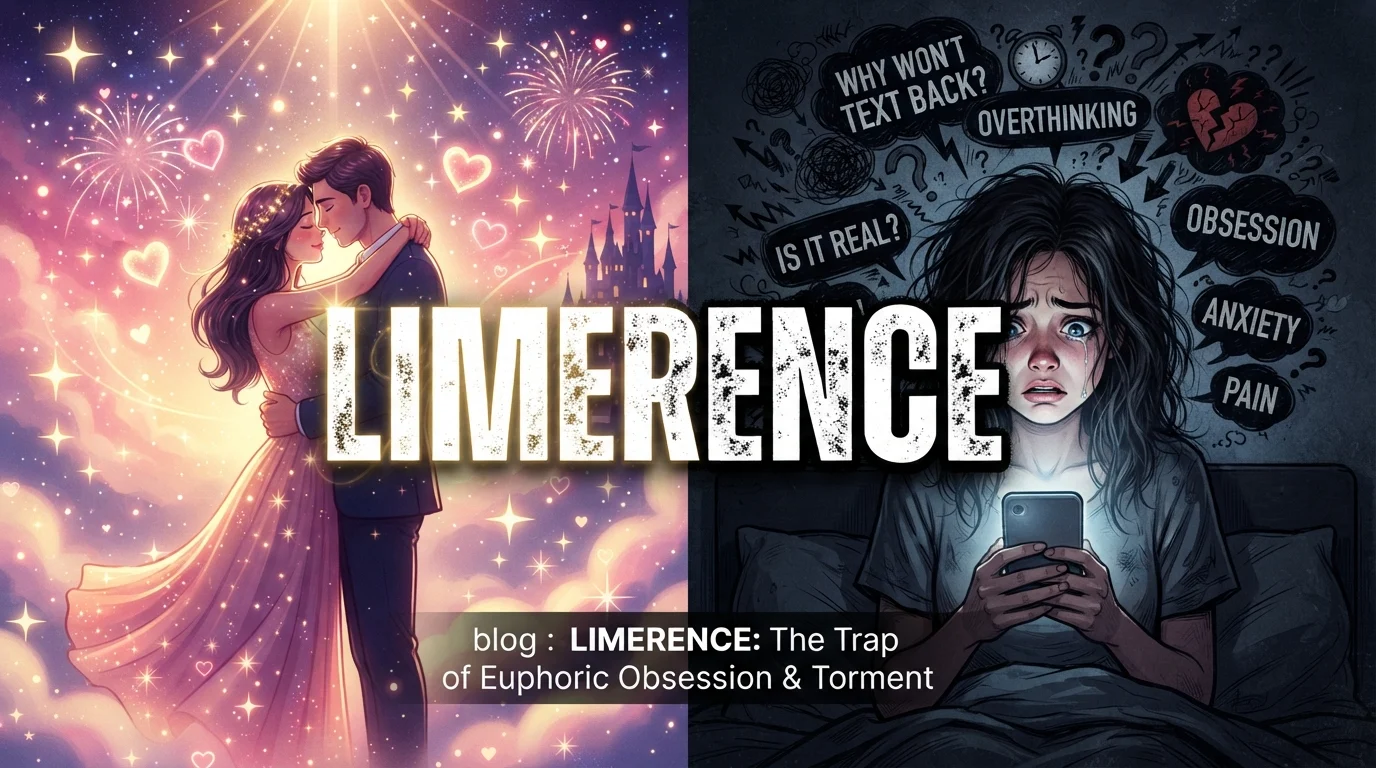
Quick Answer: Limerence is an involuntary state of intense, obsessive infatuation with another person known as the “limerent object” or LO characterized by intrusive thoughts, emotional dependency, and a desperate longing for reciprocation . Coined by psychologist Dorothy Tennov in her 1979 book Love and Limerence, it’s often one-sided and driven by uncertainty rather than genuine connection . Unlike love, which involves mutual respect and acceptance of flaws, limerence is a rollercoaster of euphoria and despair based on perceived signs of interest .
You’ve been dating someone for a few weeks, and you can’t stop thinking about them. You re-read their texts obsessively, analyze every emoji for hidden meaning, and feel like you’re walking on air when they respond only to crash into despair when they don’t reply quickly enough. Sound familiar?
There’s a name for this. It’s not love. It’s limerence.
The term has exploded on TikTok and social media, with creators using it to describe everything from toxic crushes to full-blown obsessions. But limerence is more than just a buzzword. It’s a psychological phenomenon that explains why some of us get stuck in painful, one-sided attractions that feel impossible to escape .
Let’s dive into the real limerence meaning and understand why it hurts so much and how to break free.
Limerence Meaning: What Does It Actually Mean?
The Basic Definition
Limerence (pronounced LIM-er-ence) is a state of deep infatuation or obsessive romantic desire for someone. Dictionary.com defines it as “the state of being obsessively infatuated with someone, usually accompanied by delusions of or a desire for an intense romantic relationship with that person” .
But the term goes much deeper than a simple crush. Psychologist Dorothy Tennov, who coined the word in 1979, described limerence as “an involuntary interpersonal state that involves an acute longing for emotional reciprocation, obsessive-compulsive thoughts, feelings, and behaviors, and emotional dependence on another person” .
The person you’re fixated on is called the “limerent object” or LO. And here’s the kicker they might not even know you exist .
Love vs. Limerence: What’s the Difference?
This is the million-dollar question. How do you know if you’re in love or trapped in limerence?
The early stages of falling in love can feel similar to limerence. The difference? Love grows into something real and reciprocal. Limerence stays stuck in fantasy .
The Role of Uncertainty
Here’s something fascinating: uncertainty actually fuels limerence . When you don’t know how your LO feels about you, your brain goes into overdrive trying to figure it out. Every interaction becomes a puzzle to solve. Every glance or text gets analyzed for hidden meaning.
This is why limerence often thrives on mixed signals or distance. The less you know, the more you obsess. Tennov described limerence as “an interpretation of events, rather than the events themselves” . You’re not in love with a real person you’re in love with a projection, a fantasy version you’ve created in your mind.
The Origins of Limerence: A Term Born from Research
Dorothy Tennov’s Groundbreaking Work
The word “limerence” didn’t exist before 1979. Dorothy Tennov, a behavioral psychologist, coined it while researching how people experience love . She interviewed hundreds of people and noticed that some described something that wasn’t quite love something more intense, more obsessive, and often more painful .
Tennov’s book Love and Limerence: The Experience of Being in Love laid out the framework still used today. She described limerence as “an uncontrollable, biologically determined, inherently irrational, instinct-like reaction” .
Why the Word Matters
Before “limerence,” people struggled to describe this experience. They’d call it “being lovesick” or “having a crush that got out of hand.” But those terms didn’t capture the intensity, the intrusive thoughts, or the involuntary nature of the obsession .
Having a name for it matters. It validates what you’re going through and helps you recognize it for what it is not a grand romance, but a psychological state that can be understood and managed.
The Science Behind Limerence: What’s Happening in Your Brain
Dopamine and the Reward System
Limerence shares surprising similarities with addiction. When you interact with your LO or even just think about them, your brain releases dopamine the “happy hormone” associated with pleasure and reward . This creates a positive reinforcement loop: you keep seeking out that “high” just like an addict chasing a fix .
Serotonin and OCD Parallels
Some researchers have noted parallels between limerence and obsessive-compulsive disorder (OCD). During limerence, serotonin levels appear to drop, similar to what happens in OCD . This might explain why limerent thoughts feel so intrusive and uncontrollable.
The Neurobiological Argument
Recent research has begun exploring the neurobiological features of limerence, arguing that it may deserve recognition as a distinct psychological condition given the psychological distress and social disruption it can cause . However, limerence is not currently a formal diagnosis in the DSM-5 .
Signs You’re Experiencing Limerence
How do you know if what you’re feeling is limerence and not just a strong crush? Here are the telltale signs :
Cognitive Signs
- Intrusive thoughts: You can’t stop thinking about your LO, whether you want to or not. They pop into your head constantly.
- Rumination: You replay every interaction, analyzing each word and gesture for hidden meaning.
- Idealization: You see your LO as perfect, overlooking or minimizing their flaws the “halo effect” .
- Fantasy: You create elaborate scenarios in your mind where they reciprocate your feelings.
Emotional Signs
- Extreme mood swings: Euphoria when your LO shows interest, despair when they don’t .
- Fear of rejection: You’re terrified of being rejected or abandoned.
- Desperate longing: You feel lonely and anxious when they’re unavailable.
- Emotional dependency: Your self-worth depends on their attention and validation .
Behavioral Signs
- Sacrificing your needs: You prioritize your LO’s needs over your own.
- Obsessive behaviors: Constantly checking texts, social media, and looking for updates.
- Neglect: You’re neglecting work, school, family, and friends .
- Changing routines: You rearrange your schedule to increase chances of encountering your LO .
Physical Signs
You might also experience physical symptoms when thinking about or encountering your LO :
- Racing heart and palpitations
- Flushed face
- Trembling or jitters
- Loss of appetite
- Difficulty sleeping
- Nausea or weakness
The Stages of Limerence
Limerence doesn’t just appear out of nowhere and then vanish. It tends to follow a pattern :
Stage 1: Infatuation
This is the beginning. You notice someone and feel an instant connection like love at first sight. You start fantasizing about them and interpreting their behavior as signs of interest. Positive interactions feel euphoric; negative ones bring despair .
Stage 2: Crystallization
This is the peak. Your infatuation intensifies into full-blown limerence. You base your actions around your obsession, neglecting your own needs. You become desperate for reciprocation, and fantasies consume large parts of your day . People around you might notice you’ve changed.
Stage 3: Deterioration
Eventually, the intensity fades. This might happen because:
- You’re clearly rejected
- Your LO starts dating someone else
- You realize the relationship won’t happen
- (Rarely) you enter a genuine, healthy relationship with your LO and the obsession fades
The Pre-Limerence and Post-Limerence Phases
Some researchers add two additional phases :
- Pre-limerence: A general longing for love or connection, without a specific person in mind. You’re ready to become limerent.
- Post-limerence: The obsession has faded completely, and you can form more balanced, healthy relationships again.
Who Is Prone to Limerence?
Anyone can experience limerence, but certain factors make it more likely :
Attachment Styles
People with anxious or avoidant attachment styles are more susceptible. Those who tend to fear abandonment or struggle with emotional closeness may find themselves stuck in limerent patterns .
Mental Health Conditions
- ADHD: The tendency toward hyperfocus can make limerence more intense .
- Depression: People with depression may be more vulnerable to feelings of rejection and despair when limerence isn’t reciprocated .
- Borderline Personality Disorder (BPD): The symptom of “splitting” (seeing only positives or only negatives) can fuel idealization of an LO .
- Trauma: Past trauma can manifest as obsessive attachments .
Low Self-Esteem
If you struggle with low self-worth, you may seek validation from others and become dependent on an LO’s attention .
Excessive Social Media Use
Modern technology makes limerence easier than ever. You can access someone’s entire digital history, see their pictures, and know what they’re doing every day. Dating apps and social media make it easy to feel connected to someone you barely know .
How to Cope with Limerence
Recognize What’s Happening
The first step is awareness. Naming the experience as limerence not love can help you see it more objectively. If you’re in limerence, you’re not experiencing a deep, mutual connection. You’re stuck in a fantasy driven by uncertainty and a need for validation .
Reduce Contact with Your LO
This is often the hardest step, but it’s crucial. Limit or eliminate contact with your LO to break the feedback loop. Unfollow them on social media. Stop checking their profiles .
Challenge Your Idealization
Your LO isn’t perfect. Write down their flaws and the real reasons why a relationship might not work. Remind yourself that you’re in love with a projection, not a real person .
Practice Mindfulness
Acceptance and Commitment Therapy (ACT) techniques can help you change your relationship with intrusive thoughts. Instead of fighting the obsessions, learn to notice them without acting on them. Let the thoughts come and go without engaging .
Seek Professional Help
Therapists can help you work through limerence using approaches like :
- Cognitive Behavioral Therapy (CBT) for identifying and challenging thought patterns
- Mindfulness and meditation
- Attachment-focused therapy
Ask Yourself These Questions
If you’re wondering whether you’re in limerence, consider :
- Are you constantly thinking about this person to the point of obsession?
- Do you idealize them, seeing only their positive qualities?
- Are you emotionally dependent on them for your happiness?
- Have your relationships with family and friends suffered?
Frequently Asked Questions
What does limerence mean? Limerence is an involuntary state of obsessive infatuation with another person, characterized by intrusive thoughts, emotional dependency, and a desperate longing for reciprocation .
Who coined the term “limerence”? Psychologist Dorothy Tennov coined the term in her 1979 book Love and Limerence .
How long does limerence last? Limerence typically lasts anywhere from a few weeks to several years, with an average of 1.5 to 3 years . It often fades when uncertainty about reciprocation resolves.
Is limerence a mental illness? Limerence is not currently a formal diagnosis in the DSM-5. Some researchers argue it should be considered a distinct condition, while others view it as a normal (though intense) human experience .
Can you fall in love with your limerent object? Yes, in rare cases. Some people have been able to move past the obsessions to establish an honest, healthy relationship. However, this is the exception, not the norm .
What’s the difference between limerence and love? Love involves mutual respect, emotional connection, and acceptance of flaws. Limerence is obsessive, often one-sided, and driven by uncertainty and a need for validation .
Is limerence more common now? The term has become a TikTok trend, but the experience itself isn’t new. Social media and dating apps may make it easier to develop limerent fixations because they provide constant access to information about the LO .
Key Takeaways
| Aspect | Key Point |
|---|---|
| Meaning | An involuntary, obsessive infatuation with another person |
| Coined By | Psychologist Dorothy Tennov in 1979 |
| Limerent Object (LO) | The person you’re fixated on |
| Duration | Weeks to 1.5–3 years on average |
| Key Drivers | Uncertainty, insecurity, unmet emotional needs |
| Brain Chemistry | Involves dopamine and serotonin similar to addiction and OCD |
| Common Signs | Intrusive thoughts, mood swings, idealization, neglect of life |
| Is It Healthy? | Can be highly distressing; seek help if it impacts daily functioning |
Conclusion: From Obsession to Freedom
Limerence is a powerful and often painful experience. It can make you feel like you’re losing your mind, obsessing over someone who might not even know you exist. But understanding the limerence meaning is the first step toward freedom.
You can work through it with a combination of self-awareness, mindfulness, limiting contact with the LO, and professional support. The fantasies and obsessive thoughts don’t have to run your life.
Remember, limerence isn’t a sign that you’re broken or unlovable. It’s a sign that you’re human with needs, desires, and vulnerabilities. The journey from limerence to freedom is a journey back to yourself.