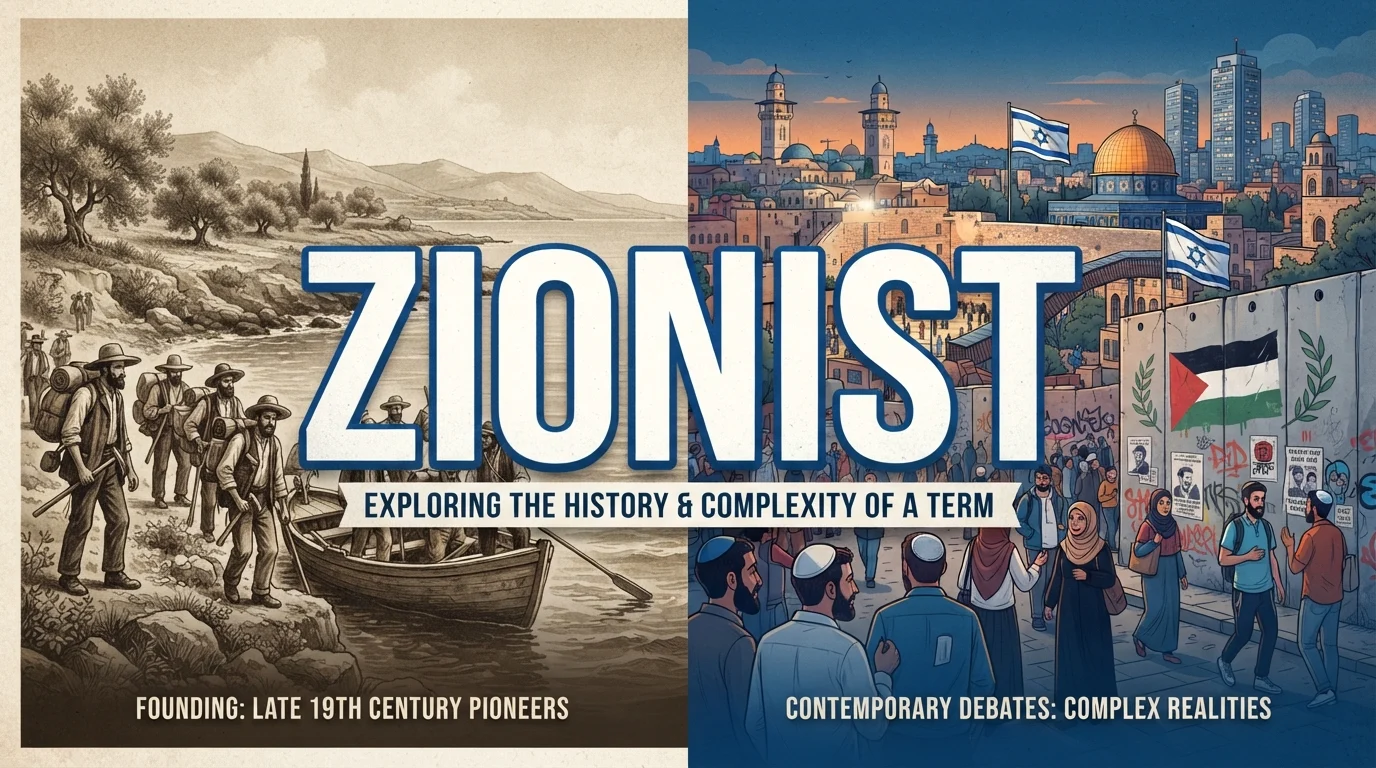
Quick Answer: A Zionist is a supporter of Zionism, the national movement of the Jewish people to return to their historical homeland the Land of Israel (Zion) and reestablish sovereign Jewish life there . The term comes from “Zion,” a biblical word for Jerusalem and the Promised Land . While modern political Zionism emerged in the late 1800s under Theodor Herzl, the yearning to return to Zion has been central to Jewish identity for over 2,500 years . Today, the word carries complex meanings for some, it represents Jewish self-determination and statehood; for others, it has become a contested term tied to debates about Israeli policies and the Israeli-Palestinian conflict .
You’ve probably heard “Zionist” used in news headlines, political debates, or social media arguments. Maybe someone called themselves a Zionist with pride. Maybe someone else used it as an insult. The word seems to carry completely different meanings depending on who’s speaking and what context they’re in.
So what does “Zionist” actually mean?
At its most basic, a Zionist supports the Jewish people’s right to a homeland in their ancient ancestral land. But that simple definition barely scratches the surface. The term has evolved over more than a century, accumulating layers of religious, political, and emotional weight. Understanding the full zionist meaning means looking at history, religion, politics, and the very human stories behind the word.
Zionist Meaning: The Core Definition
The Basic Definition
A Zionist is a person who supports Zionism the political, cultural, and social movement that calls for the return of Jewish people to their homeland and the resumption of sovereign Jewish life there . The American Heritage Dictionary defines Zionism as “a political movement that supports the maintenance and preservation of the state of Israel as a Jewish homeland, originally arising in the late 1800s with the goal of reestablishing a Jewish homeland in the region of Palestine” .
The term is both a noun and an adjective. You can be “a Zionist” or talk about “Zionist policies” or “the Zionist movement” .
The Meaning of “Zion”
The word “Zionism” comes from “Zion,” a biblical term often used as a synonym for Jerusalem and the Land of Israel . The connection goes back to the Book of Psalms: “By the waters of Babylon, there we sat down and wept when we remembered Zion” (Psalms 137:1) . For thousands of years, “Zion” has represented the Jewish people’s spiritual and ancestral homeland a place they longed to return to during centuries of exile.
The Difference Between a Zionist and a Jew
This distinction matters. Not all Jews are Zionists, and not all Zionists are Jewish (though the vast majority are). Zionism is a specific political and ideological movement. Judaism is a religion and culture. A person can be Jewish without supporting political Zionism, just as a person can support Israel’s existence without being Jewish.
| Aspect | Zionist | Jew (non-Zionist) |
|---|---|---|
| Definition | Supporter of Jewish national homeland in Israel | Person of Jewish religion or ethnicity |
| Political Stance | Supports Jewish statehood | May or may not support Zionism |
| Religious Status | Can be any religion | Jewish by religion, ethnicity, or culture |
| Connection to Israel | Affirms political connection | May view connection differently |
The Origins of Zionism: A 2,500-Year-Old Dream Meets Modern Politics
The Ancient Yearning
Jewish connection to the Land of Israel isn’t new. It stretches back almost 4,000 years to when Abraham settled in Canaan, later known as the Land of Israel . After the Romans conquered Jerusalem and destroyed the Second Temple in 70 CE, most Jews were forced into exile a scattering known as the Diaspora .
But they never gave up hope. Throughout their dispersion, Jews kept faith with their land, praying daily for their return. They ended every Passover Seder with “Next year in Jerusalem.” They faced Jerusalem when praying. This wasn’t just nostalgia it was a living, breathing connection sustained over millennia .
When the Word “Zionism” Was Coined
The actual word “Zionism” wasn’t created until 1890, when a Jewish journalist named Nathan Birnbaum coined it to describe the growing movement for Jewish return . But the movement itself had been building for decades.
Theodor Herzl and Political Zionism
Theodor Herzl changed everything. A Jewish journalist from Vienna, Herzl witnessed the Dreyfus affair in Paris a French army officer falsely accused of treason because he was Jewish . The antisemitic mobs screaming “Death to the Jews” convinced Herzl that Jews would never be safe in Europe, no matter how assimilated they became.
In 1896, Herzl published The Jewish State, arguing that the only solution to antisemitism was a Jewish homeland. The next year, he organized the First Zionist Congress in Basel, Switzerland . The conference produced the Basel Program, which declared Zionism’s goal: “a national home for the Jewish people in the Land of Israel” .
This was political Zionism. Herzl didn’t invent the yearning for Zion he transformed it from a religious dream into a modern political movement. He gave it organization, diplomacy, and a strategy. As one source puts it, Zionism “appropriated an ancient idea and an ongoing active movement, and adapted them to meet the needs and spirit of the times” .
Why Zionism Emerged When It Did
Zionism didn’t appear in a vacuum. Several factors converged in the 19th century:
| Factor | Impact |
|---|---|
| Modern Nationalism | European nations were forming around ethnic identities; Jews wanted the same |
| Emancipation | Some Jews gained rights, leading to questions about identity and belonging |
| Antisemitism | Persecution continued, climaxing with the Dreyfus affair and pogroms |
| The Holocaust | Proved the ultimate case for Jewish self-defense and statehood |
The Diverse Streams of Zionism
Political Zionism
The movement Herzl founded. Political Zionism focused on diplomacy, international recognition, and securing a state through legal means. Herzl negotiated with the Ottoman Empire and European powers, believing that a Jewish state would benefit everyone by bringing civilization to the region .
Socialist Zionism
Some Zionist pioneers believed the new society should be socialist. Figures like Moses Hess, shaken by the Damascus blood libel of 1844, became “the father of Zionist socialism” . These visionaries built kibbutzim collective farming communities and created labor unions that became pillars of Israeli society.
Religious Zionism
Religious Zionists saw the return to Israel as fulfilling biblical prophecy. They combined religious observance with political activism, believing that God had promised the Land of Israel to the Jewish people. Today, Religious Zionism is a major political force in Israel, advocating for settlement in the West Bank.
Revisionist Zionism
Vladimir Ze’ev Jabotinsky led a more militant faction called Revisionist Zionism. His followers believed in Jewish strength, self-defense, and a Jewish state on both sides of the Jordan River. Revisionists broke away from the main Zionist movement in 1935 . Their ideas later influenced Israeli right-wing parties.
Key Events in Zionist History
The Balfour Declaration (1917)
Britain’s foreign secretary, Arthur Balfour, declared that the British government “views with favour the establishment in Palestine of a national home for the Jewish people” . This statement, later incorporated into the League of Nations Mandate, gave Zionism crucial international legitimacy.
The British Mandate and Growing Conflict
From 1920 to 1948, Britain governed Palestine under a mandate from the League of Nations . Jewish immigration grew, especially during the 1930s when Jews fled Nazi persecution. Arab leaders opposed this influx, leading to violence that culminated in the Arab Revolt of 1936–1939 .
The Holocaust and Its Aftermath
The murder of six million Jews by Nazi Germany transformed Zionism from a dream into a moral imperative. If Jews couldn’t be safe anywhere, they needed their own state. Western nations, guilt-ridden and politically pressured, dropped their opposition to a Jewish homeland .
The UN Partition Plan and Israel’s Independence
On November 29, 1947, the United Nations voted to partition British-ruled Palestine into Jewish and Arab states . The Jews accepted; the Arabs rejected. Israel declared independence on May 14, 1948, and was immediately attacked by five Arab armies .
The war ended with Israel victorious but with hundreds of thousands of Palestinian Arabs displaced a tragedy Palestinians call the Nakba (“catastrophe”). This conflict, and the ones that followed, created the political fault lines that still shape how people understand the zionist meaning today .
The Controversy: Why “Zionist” Is a Contested Word
The Rise of Anti-Zionism
Zionism was once celebrated by the political left as “an organic movement of national return and a model for national liberation” . But as Israel aligned with the West during the Cold War, Soviet propaganda turned anti-Zionism into a weapon . Soviet media depicted “bloated, hook-nosed Jewish bankers” and “all-consuming serpents embossed with the Star of David” . Anti-Zionism, critics argue, became virtually indistinguishable from antisemitism .
Zionism and the Palestinian Question
For Palestinians and their supporters, Zionism represents a colonial project that displaced them from their homeland. They point to the 1948 Nakba, the ongoing occupation of the West Bank, and the blockade of Gaza as evidence of Zionist oppression . This perspective frames Zionism as a movement of ethnic cleansing and land theft.
The UN Conference Controversy (2001)
At a UN conference on racism in September 2001, Arab states led by Syria proposed language equating Zionism with racism . Israel and the United States withdrew from the conference in protest, and the motion was defeated . But the debate continues. Are these anti-Zionist positions legitimate criticism, or are they modern forms of antisemitism?
Is Anti-Zionism Antisemitism?
There’s fierce debate over this question. The Anti-Defamation League argues that opposing Zionism “can have the effect of rejecting the fundamental legitimacy of Jewish statehood and those who feel a connection to it, including most Jewish people” .
Others argue that criticizing Israeli policies isn’t inherently antisemitic, just as criticizing any country’s government isn’t bigotry. The line, they say, is crossed when criticism uses antisemitic tropes or denies the Jewish people’s right to self-determination.
The Contemporary Meaning Shift
Today, “Zionist” is used in wildly different ways:
- Some Jews wear “Zionist” as a badge of pride, affirming their connection to Israel.
- Some critics use “Zionist” as a shorthand for “supporter of Israeli oppression.”
- Some antisemites use “Zionist” as a code word for “Jew,” hiding their hatred behind political language .
This ambiguity makes the term explosive. It can mean everything from “supporter of Jewish self-determination” to “oppressor of Palestinians” to “Jew” depending on who’s speaking and what context.
Zionist Today: The Modern Landscape
Zionism Within Israel
In Israel, “Zionist” is less a political label than a baseline identity. Almost all Israeli Jews support the state’s existence that’s the definition of Zionism. The real divisions are over specific policies:
- Right-wing Zionists support expanding settlements, opposing a Palestinian state, and taking a hard line on security.
- Left-wing Zionists support two-state solutions, territorial compromise, and more dovish policies.
- Post-Zionists challenge the foundational myths of Zionism, arguing for a more pluralistic vision of Israel.
The American Jewish Context
American Jews are deeply divided on Zionism. Most support Israel’s existence, but many criticize specific policies. Surveys show younger American Jews are less attached to Israel and more critical of its treatment of Palestinians. Some even identify as anti-Zionists while remaining Jewish.
The “Zionist” Slur Debate
In recent years, “Zionist” has increasingly been used as a slur in anti-Israel circles. Some argue this is legitimate political speech; others see it as antisemitic dog-whistling. The debate intensifies on college campuses, in left-wing political spaces, and on social media.
Frequently Asked Questions
What is a Zionist? A Zionist is someone who supports Zionism the movement for a Jewish homeland in the Land of Israel, now embodied by the state of Israel .
What does the word “Zionist” mean literally? The term comes from “Zion,” a biblical word for Jerusalem and the Land of Israel, symbolizing the Jewish people’s ancestral homeland .
When did Zionism start? The yearning for Zion goes back over 2,500 years. Modern political Zionism began in the late 19th century, especially with Theodor Herzl’s First Zionist Congress in 1897 .
Is being a Zionist the same as being Jewish? No. Many Jews are Zionists, but not all. Zionism is a political movement, while Judaism is a religion and ethnicity .
Why is “Zionist” such a controversial term? The word is contested because it’s tied to the Israeli-Palestinian conflict. Some see Zionism as Jewish self-determination; others see it as colonialism or oppression .
Can you criticize Israel and still be a Zionist? Yes. Many Zionists criticize specific Israeli policies while supporting the state’s existence. Criticism of government policy isn’t automatically anti-Zionist .
Is anti-Zionism antisemitism? This is debated. Some argue denying Jewish self-determination is antisemitic; others distinguish between antisemitism and legitimate political criticism of Israel .
Key Takeaways
| Aspect | Key Point |
|---|---|
| Basic Meaning | Supporter of Jewish national homeland in the Land of Israel |
| Word Origin | “Zion,” a biblical term for Jerusalem and the Promised Land |
| Movement Started | Modern political Zionism emerged in the 1890s under Theodor Herzl |
| Key Event | First Zionist Congress, 1897, established the Basel Program |
| Israel Established | 1948, following UN Partition Plan |
| Diversity | Multiple streams: Political, Socialist, Religious, Revisionist |
| Controversy | Contested term tied to Israeli-Palestinian conflict |
| Modern Usage | Ranges from badge of pride to political slur |
Conclusion: A Word That Refuses to Be Simple
“Zionist” is one of those words that defies easy definition. It’s a political label, a religious aspiration, a modern movement, and an ancient dream all rolled into one. For some, it represents the fulfillment of a 2,500-year-old promise Jews returning home after centuries of persecution. For others, it represents a colonial project that displaced another people from their land.
Understanding the zionist meaning requires holding both perspectives in mind. The ancient connection of Jews to Zion is undeniable it’s documented in history, archaeology, and the Jewish prayer book. So is the displacement of Palestinians in 1948 and the ongoing occupation that followed. These aren’t contradictory facts; they’re both parts of a painful, contested history.
The word “Zionist” today is a Rorschach test. How you define it reveals more about your worldview than about the term itself. If you support Jewish self-determination, you’re likely to see Zionism positively. If you focus on Palestinian suffering, you’re likely to see it negatively. Both views contain truth.
What’s certain is this: Zionism changed the world. It gave a scattered, persecuted people a state and a measure of security. It also created a conflict that has killed tens of thousands and displaced millions. The zionist meaning will continue to evolve as the conflict evolves, but the word itself isn’t going anywhere. It’s too central to Jewish identity and Middle Eastern politics to fade away.