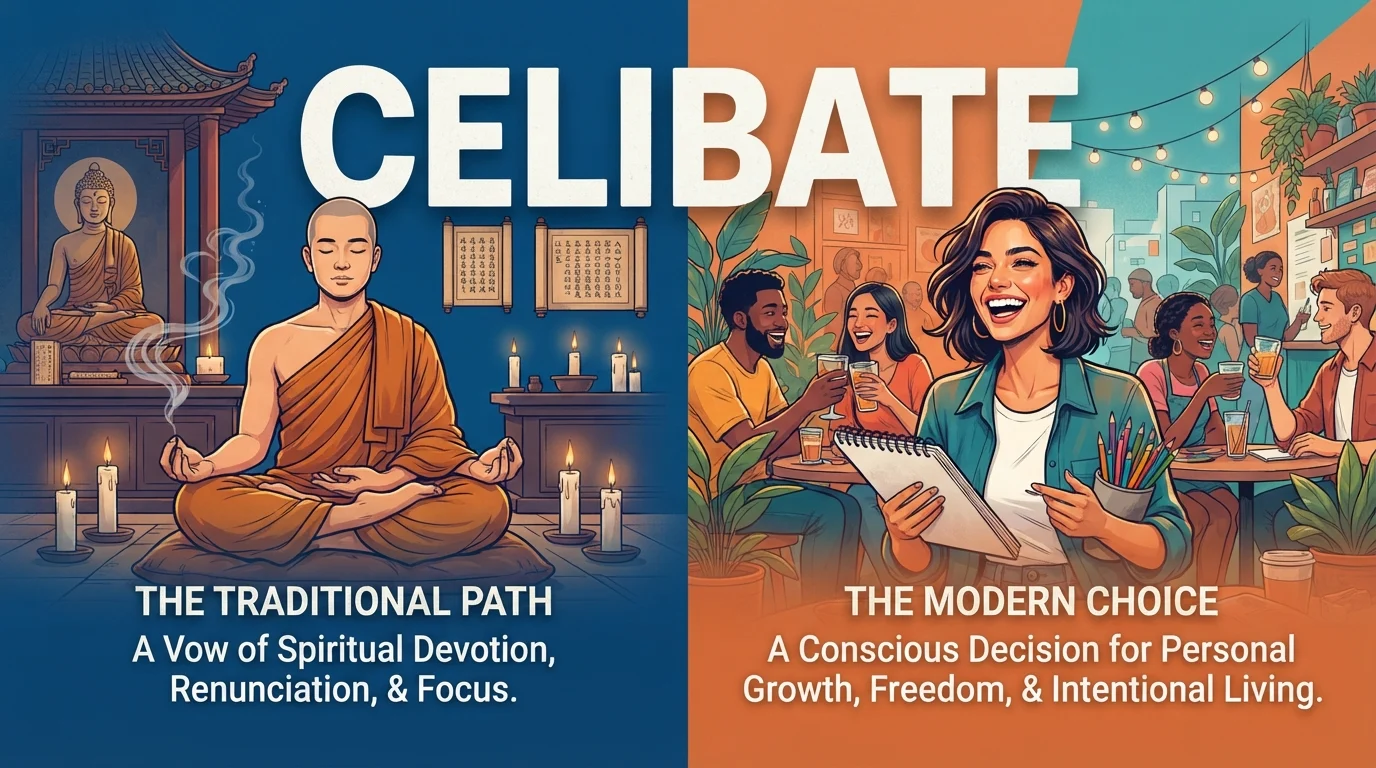
Quick Answer: Celibate means abstaining from sexual activity, often because of a religious vow or a personal choice. The word comes from the Latin caelibatus, meaning “unmarried state.” A celibate person chooses not to have sex, but this doesn’t always mean they avoid romantic relationships entirely. Celibacy is different from abstinence, which is usually temporary, and from asexuality, which is a sexual orientation. People choose celibacy for religious reasons, personal growth, healing from trauma, or simply because they want to focus on other parts of life. It’s a deliberate choice, not a punishment or a sign of dysfunction.
Tell someone you’re celibate, and watch their face. You’ll see confusion, curiosity, maybe a little pity. “But why?” they’ll ask. “Don’t you miss it?” “Is something wrong?”
The celibate meaning is simple on the surface no sex but it carries a truckload of assumptions and misunderstandings. People assume celibacy is about repression, religious extremism, or some kind of tragic circumstance. They rarely consider that it might be a positive, intentional choice.
Celibacy has been practiced for thousands of years. It’s been revered in some cultures, mocked in others, and misunderstood in almost all of them. Today, a growing number of people are choosing celibacy for non-religious reasons. They’re discovering that stepping away from sexual activity can bring clarity, focus, and a deeper connection to themselves.
Understanding what celibacy really means requires looking past the stereotypes. It means exploring the history, the psychology, and the personal stories of people who’ve made this choice. And it means recognizing that celibacy isn’t one thing it’s many different things to many different people.
Celibate Meaning: What Does It Actually Mean?
The Core Definition
The Cambridge Dictionary defines celibate as “not having sexual activity, especially because of a religious promise.” Merriam-Webster adds that it means “abstaining from sexual intercourse” and is often associated with “a vow to remain unmarried.”
The key elements are: abstaining from sex, often for religious or personal reasons, and a deliberate, ongoing commitment rather than a temporary state.
The Latin Origin
The word “celibate” comes from the Latin caelibatus, which means “unmarried state.” It’s related to caelebs, meaning “unmarried” or “single.” Interestingly, the original meaning didn’t necessarily imply sexual abstinence. It was about marital status, not sexual activity.
Over time, the meaning shifted. In the Christian tradition, celibacy became closely tied to the priesthood and monastic life, where abstaining from sex was seen as a way to devote oneself fully to God.
Celibacy vs. Abstinence
These two terms are often used interchangeably, but they’re not the same. Abstinence is typically temporary and situation-specific. Someone might abstain from sex until marriage, or abstain for a period of time while healing from a breakup.
Celibacy is usually a longer-term commitment. It’s a lifestyle choice, not just a pause. A celibate person isn’t waiting for the right time or the right person they’ve decided that sex isn’t part of their life right now, or possibly ever.
| Aspect | Celibacy | Abstinence |
|---|---|---|
| Duration | Long-term or permanent | Temporary or situational |
| Motivation | Religious, personal, philosophical | Often practical or health-related |
| Scope | A lifestyle choice | A period of refraining |
| Example | A monk who vows never to marry or have sex | A teenager who decides to wait until marriage |
Celibacy vs. Asexuality
This is another crucial distinction. Asexuality is a sexual orientation. Asexual people experience little or no sexual attraction. It’s not a choice it’s who they are.
Celibacy is a behavior. A celibate person may experience sexual attraction but chooses not to act on it. An asexual person may not experience attraction at all. A celibate person can be asexual, but the two are not the same.
Celibacy vs. Chastity
Chastity is another related term. In religious contexts, chastity means purity of thought and behavior. For unmarried people, chastity often means abstinence. For married people, it means fidelity.
Celibacy is specifically about not having sex. Chastity is about sexual morality more broadly. A celibate person is chaste, but a chaste person isn’t necessarily celibate.
The History of Celibacy: From Ancient Rituals to Modern Choices
Ancient Roots
Celibacy isn’t a Christian invention. Ancient cultures practiced it for various reasons. In some traditions, priests and priestesses abstained from sex before performing sacred rituals. The idea was that sexual activity could interfere with spiritual purity.
In ancient Greece and Rome, some philosophers advocated for celibacy as a way to focus the mind on higher pursuits. The idea that sexual desire distracts from intellectual and spiritual growth has deep roots.
Celibacy in Christianity
Christianity elevated celibacy to a sacred vocation. The Apostle Paul wrote that celibacy allowed for undivided devotion to God. Jesus himself is often interpreted as having been celibate. By the Middle Ages, the Catholic Church required celibacy for priests and monks and nuns.
The reasoning was practical as well as spiritual. A celibate priest wouldn’t have a family to support, so church property wouldn’t be inherited by his children. He could focus entirely on his pastoral duties.
Celibacy in Eastern Religions
Celibacy is also central to several Eastern traditions. Hindu sadhus and swamis often take vows of celibacy. Buddhist monks and nuns follow strict rules about sexual conduct. Jain monks and nuns practice complete celibacy as part of their commitment to non-violence and detachment.
In these traditions, celibacy is seen as a way to conserve vital energy, reduce attachment, and accelerate spiritual progress.
The Modern Celibacy Movement
In recent years, celibacy has found new life outside of religious contexts. A growing number of people are choosing celibacy for secular reasons. Some are exhausted by hookup culture. Some are healing from trauma.
Online communities have sprung up around celibacy. People share their experiences, offer support, and challenge the assumption that everyone should be having sex all the time.
Why People Choose Celibacy
Religious and Spiritual Reasons
For many people, celibacy is a sacred calling. They believe that abstaining from sex brings them closer to God, purifies their spirit, or allows them to serve others more fully. This is the traditional understanding of celibacy, and it remains powerful for millions of people around the world.
Personal Growth and Self-Discovery
Some people choose celibacy as a form of personal development. By stepping away from sexual relationships, they create space to understand themselves better. They explore their interests, heal old wounds, and build a life that isn’t defined by romantic or sexual partnerships.
Healing from Trauma
For survivors of sexual trauma, celibacy can be a way to reclaim control over their bodies. After experiencing violation, choosing not to have sex can be empowering. It’s a way of saying, “My body is mine, and I decide what happens to it.”
Focusing on Other Goals
Some people find that sexual relationships take up too much time and energy. They want to focus on their careers, their art, their studies, or their friendships. Celibacy frees them from the distractions and complications of sex.
Disillusionment with Hookup Culture
Modern dating can be exhausting. Hookup culture leaves many people feeling empty, used, or burned out. Some choose celibacy as a break from the pressure to be sexually active. It’s a way of opting out of a game they never wanted to play.
| Reason for Celibacy | Key Motivation |
|---|---|
| Religious calling | Devotion to God or spiritual practice |
| Personal growth | Self-discovery and clarity |
| Healing from trauma | Reclaiming bodily autonomy |
| Focus on goals | Career, art, studies, friendships |
| Disillusionment | Escape from hookup culture |
Celibate Life: What It’s Actually Like
Emotional and Psychological Effects
Celibate people report a range of experiences. Some feel liberated, clear-headed, and more in touch with themselves. Others struggle with loneliness, frustration, or social pressure.
The emotional effects depend on why someone chose celibacy and how they feel about it. A person who feels called to celibacy by God may experience deep peace. A person who is celibate because of trauma may experience relief mixed with grief.
Social Pressure and Misunderstanding
Society assumes everyone wants sex. When you don’t, people get uncomfortable. They may assume you’re repressed, broken, or lying.
Celibate people often face intrusive questions. “But what about your needs?” “Don’t you get lonely?” “How long do you think you can keep this up?” These questions reflect a culture that can’t imagine sex as anything other than mandatory.
Relationships and Intimacy
Celibacy doesn’t mean a life without intimacy. Celibate people can have deep friendships, romantic partnerships, and fulfilling emotional connections. Some celibate people are in romantic relationships where both partners agree not to have sex. Others build chosen families and close friendship networks that meet their needs for connection.
Intimacy isn’t just about sex. It’s about vulnerability, trust, and shared experience. Celibate people find intimacy in many different ways.
Misconceptions About Celibacy
There are countless myths about celibacy. Here are a few:
| Myth | Reality |
|---|---|
| Celibate people are broken | Celibacy is often a healthy, intentional choice |
| Celibacy means no intimacy | Celibate people can have rich, intimate relationships |
| Celibacy is always religious | Many people choose celibacy for secular reasons |
| Celibacy is permanent | Some people are celibate for a season, not forever |
| Celibate people are miserable | Many report greater clarity and satisfaction |
Celibacy in the Modern World
The Rise of “Voluntary Celibacy”
Voluntary celibacy is a growing trend. People are choosing to abstain from sex for personal, political, or practical reasons. Some are protesting the commodification of sex.
This movement is diverse. It includes people of all genders, ages, and backgrounds. What they share is a belief that sex isn’t obligatory and that a life without it can be full and meaningful.
Celibacy and Feminism
Some feminist thinkers have embraced celibacy as a radical act. By refusing to have sex, they reject a culture that expects women’s bodies to be available to men. They reclaim their time, energy, and autonomy.
Others are critical of this framing. They argue that true sexual liberation means the freedom to have sex or not, without judgment either way.
Celibacy and Mental Health
For some people, celibacy is a mental health strategy. It reduces anxiety, removes relationship drama, and creates space for therapy and self-care. For others, celibacy is a symptom of depression or trauma that needs professional attention.
The key is intention. If celibacy feels like a choice, it can be empowering. If it feels like a prison, it might be worth exploring with a therapist.
The Role of Technology
Technology has changed the celibacy landscape. Online communities connect celibate people who might otherwise feel isolated. Apps offer support, accountability, and resources. Social media gives celibate people a platform to share their stories and challenge stereotypes.
At the same time, technology can be a source of pressure. Dating apps and social media constantly remind users of what they’re “missing.” For celibate people, navigating these spaces requires boundaries and self-awareness.
Frequently Asked Questions
What does celibate mean? Celibate means abstaining from sexual activity, often because of a religious vow or a personal choice.
Is celibacy the same as abstinence? No. Abstinence is usually temporary. Celibacy is a longer-term commitment or lifestyle.
Is celibacy the same as asexuality? No. Asexuality is a sexual orientation. Celibacy is a behavior or choice.
Can celibate people have relationships? Yes. Celibate people can have romantic relationships, friendships, and deep emotional connections. They just don’t have sex.
Why do people choose celibacy? Reasons include religious calling, personal growth, healing from trauma, focus on goals, and disillusionment with hookup culture.
Is celibacy unhealthy? Not inherently. Celibacy can be healthy if it’s a choice. If it’s driven by trauma or shame, therapy can help.
How do I know if celibacy is right for me? Consider your motivations. If celibacy feels empowering and peaceful, it might be right. If it feels like punishment or avoidance, explore the underlying reasons.
Key Takeaways
| Aspect | Key Point |
|---|---|
| Core Meaning | Abstaining from sexual activity, often as a deliberate choice |
| Origin | Latin caelibatus, meaning “unmarried state” |
| Key Distinction | Celibacy is a behavior; asexuality is an orientation |
| Common Reasons | Religion, personal growth, healing, focus, disillusionment |
| Not the Same As | Abstinence (temporary), asexuality (orientation), chastity (moral purity) |
| Social Challenge | Facing pressure and misunderstanding from a sex-saturated culture |
| Modern Trend | Growing interest in voluntary celibacy for secular reasons |
| Mental Health | Can be empowering or a sign of distress, depending on intention |
Conclusion: The Freedom to Choose
Celibacy is one of the most misunderstood choices a person can make. In a culture that treats sex as essential, the decision to abstain is radical. It challenges assumptions about what makes life meaningful and what makes relationships valid.
But celibacy isn’t a rejection of life. It’s a reorientation. It’s a way of saying that intimacy has many forms, that connection doesn’t require sex, and that a person can be whole without being sexually active.
Some people are celibate for a season. What matters is that the choice is honored, not judged.
The celibate meaning is ultimately about freedom. The freedom to say no. The freedom to prioritize other things. The freedom to define your own life on your own terms. In a world that constantly tells us what we should want, that freedom is precious.