Quick Answer: An enigma is something that is mysterious, puzzling, or difficult to understand. It can refer to a person whose behavior is hard to explain, a situation that defies logic, or a riddle that requires clever thinking to solve. The word comes from the Greek ainigma, meaning “riddle” or “dark saying.” In modern usage, an enigma is anything that challenges our understanding whether it’s a historical mystery, a complex personality, or a cryptographic code. The most famous historical use was the German Enigma machine, an encryption device that Allied codebreakers famously cracked during World War II.
The human mind is wired for curiosity. When we encounter something we cannot explain, it pulls at our attention. An enigma is precisely that a puzzle that refuses to be solved, a person who defies easy categorization, or a situation that leaves us scratching our heads.
Think about the last time you met someone who completely baffled you. They said one thing but their actions told a different story. They seemed contradictory, elusive, and utterly fascinating. You wanted to figure them out, to crack the code of who they really were. That pull, that irresistible urge to understand, is what an enigma does to us.
But the meaning of enigma goes far beyond everyday mystery. Understanding what an enigma truly means helps us appreciate not just the mysteries of the world, but our own endless curiosity about them.
Enigma Meaning: What Does It Actually Mean?
The Core Definition
At its simplest, an enigma is something that is mysterious, puzzling, or difficult to understand. It’s a problem that challenges our ability to comprehend, a situation that defies easy explanation, or a person whose motives remain hidden.
The Oxford English Dictionary defines it as “a person or thing that is mysterious or difficult to understand.” Merriam-Webster offers a similar definition: “something hard to understand or explain.”
The Riddle Connection
The word has a more specific meaning too. In its original sense, an enigma is a type of riddle one expressed in obscure or allegorical language that requires clever thinking to decipher. Think of the Sphinx’s riddle in Greek mythology: “What walks on four legs in the morning, two legs at noon, and three legs in the evening?” That’s an enigma, a puzzle that demands both wit and wisdom.
Today, we use the word more broadly for anything that presents a challenge to our understanding. From a puzzling friendship to a cryptic political strategy, if it makes you wonder “why?”, it’s an enigma.
The Greek Origins
The word “enigma” comes from the Greek ainigma, which itself comes from ainissesthai, meaning “to speak obscurely” or “to speak in riddles.” The ancient Greeks loved riddles and puzzles, and they had a specific word for the kind of dark, ambiguous saying that required interpretation.
The Greek root is also connected to ainos, meaning “fable” or “story.” This suggests that an enigma isn’t just a puzzle it’s a story that contains a deeper truth, waiting to be discovered.
Enigma vs. Mystery vs. Riddle: What’s the Difference?
The Subtle Distinctions
While these words are often used interchangeably, there are important differences:
An enigma is something that’s obscure, puzzling, and challenges our ability to understand. It can be resolved through reasoning, but the answer is never straightforward.
A mystery is something that is inexplicable or unknowable, often with supernatural or spiritual overtones. Mysteries often remain unsolved, or their answers lead to more questions.
A riddle is a specific type of puzzle, often a question with a clever or unexpected answer.
Consider the Sphinx’s question. It’s a riddle because it has a specific answer. But it’s also an enigma because interpreting it requires deep thought. The difference between an enigma and a mystery is often one of degree. A mystery may be unsolvable.
The Criminal Connection
In true crime and detective fiction, an enigma often describes a case that defies easy explanation. A locked-room mystery, for example, is an enigma. How did the killer escape without leaving a trace? The answer, when revealed, seems obvious in retrospect but that’s the beauty of a good enigma.
Enigma in History and Technology
The Enigma Machine
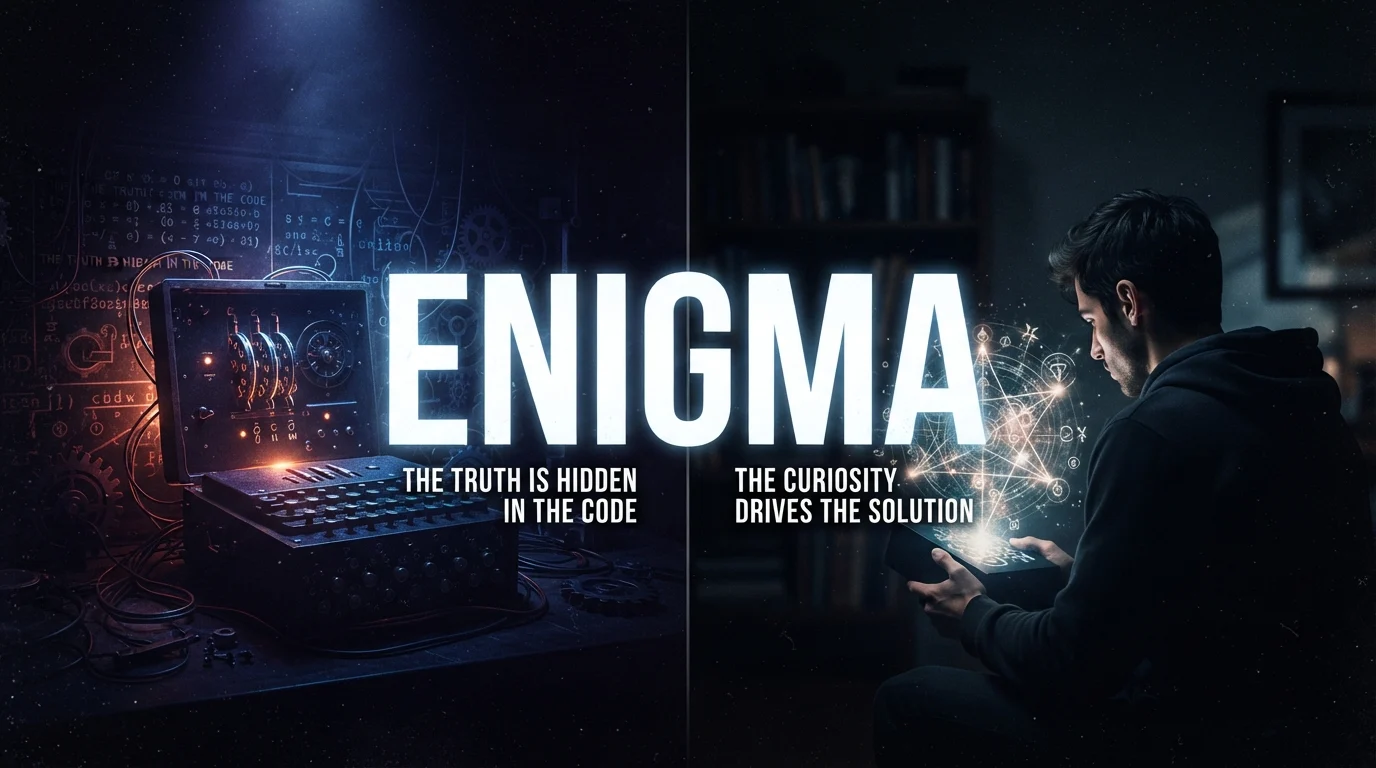
When most people hear “Enigma,” they think of the German cipher machine used during World War II. The Enigma machine was a complex encryption device that used rotating rotors to scramble messages into virtually unbreakable codes.
The machine’s genius lay in its complexity. Each time an operator pressed a key, the rotors would advance, changing the encryption for the next letter. This created billions of possible combinations.
Alan Turing and Bletchley Park
The codebreakers at Bletchley Park, led by the brilliant mathematician Alan Turing, cracked the Enigma code in 1941. This breakthrough is widely credited with shortening World War II by two to four years and saving countless lives.
The cracking of Enigma wasn’t just a technical achievement it was an existential challenge to the very idea of an unbreakable code. The machine that was meant to be the perfect enigma was finally solved.
The Enigma of the Voynich Manuscript
Beyond the machine, there’s the famous Voynich Manuscript, a mysterious text from the 15th century written in an unknown script. It contains strange illustrations of plants, astronomical diagrams, and astrological charts.
Despite decades of study, the Voynich Manuscript remains an enigma to scholars today. No one knows who wrote it, what language it’s in, or what it means. It’s a mystery that has defied all attempts at explanation, a perfect example of an enigma in its truest sense.
Enigma in Pop Culture and Media
Music and Art
The term “enigma” has a powerful resonance in pop culture. The band’s name evokes the sense of mystery and the unknown that its music seeks to create.
Film and Literature
In movies and books, enigmatic characters are often the most compelling. They keep us guessing, reveal their true natures slowly, and challenge our assumptions. Think of the mysterious stranger in a Western, the elusive spy in a thriller, or the misunderstood genius in a biopic.
Social Media and Texting
In modern digital communication, people sometimes use “enigma” to describe themselves or others. Calling someone an enigma is a way of saying they’re interesting and complex, that they don’t reveal everything about themselves right away.
Frequently Asked Questions
What does enigma mean? An enigma is something that is mysterious, puzzling, or difficult to understand. It can be a person, a situation, or a riddle.
What is the difference between enigma and mystery? An enigma is a puzzle that can be solved with reasoning, while a mystery often deals with the unknowable or supernatural.
Where does the word enigma come from? From the Greek ainigma, meaning “riddle” or “dark saying.”
What was the Enigma machine? A German cipher machine used during World War II to encrypt military messages, famously cracked by Alan Turing and the codebreakers at Bletchley Park.
What is the Voynich Manuscript? A 15th-century text written in an unknown language that remains undeciphered, one of history’s most famous enigmas.
Can a person be an enigma? Yes, someone whose behavior is difficult to understand or whose motives are hidden is often called an enigma.
Key Takeaways
| Aspect | Key Point |
|---|---|
| Core Meaning | Something mysterious, puzzling, or hard to understand |
| Greek Origin | Ainigma (riddle or dark saying) |
| Related Words | Mystery, riddle, puzzle |
| Key Difference | Enigmas can be solved with reasoning; mysteries are often unknowable |
| Famous Example | The Enigma machine used by Germany in WWII |
| Modern Usage | Refers to mysterious people, situations, or concepts |
| Cultural Impact | Used in music, film, literature, and everyday language |
Conclusion: The Enduring Allure of the Unknown
What is it about an enigma that draws us in? Why do we spend hours trying to solve a puzzle, even when we know the answer might not change anything?
The answer lies in the human mind’s deepest instinct: the need to know, to understand, and to make sense of the world around us. An enigma is a challenge to our intelligence, a test of our reasoning, and an invitation to explore the unknown.
But isn’t that the beauty of it? The world is full of things we cannot fully understand. People surprise us. Situations defy our expectations. And the more we learn, the more we realize how much we don’t know. That’s the true meaning of enigma a reminder that curiosity is the engine of human progress, and mystery makes life worth living.