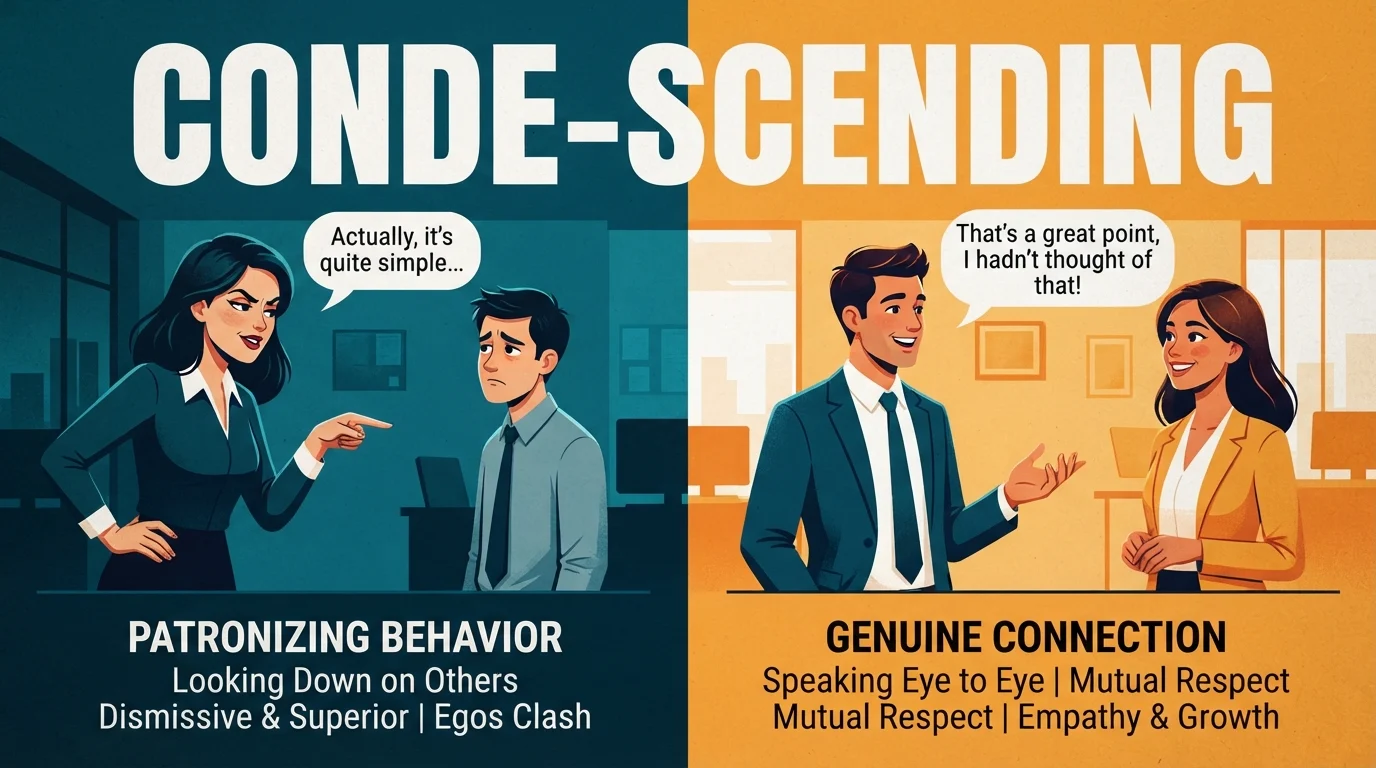
Quick Answer: Condescending describes behavior that treats others as inferior, less intelligent, or less capable. A condescending person talks down to others, often with a tone of superiority, patronizing kindness, or barely concealed disdain. The word comes from the Latin condescendere, meaning “to descend together” but its modern meaning has flipped. Today, being condescending means acting like you’re above someone else. It’s a form of disrespect that damages relationships, undermines trust, and creates resentment. Unlike simple rudeness, condescension often masquerades as helpfulness, making it harder to call out and more corrosive over time.
Some insults are obvious. Someone yells at you, and you know exactly where you stand. Condescension is different. It comes wrapped in a smile.But underneath, there’s a clear message: “I’m better than you, and you’re too foolish to realize it.”
You’ve felt it.Maybe a stranger offered “helpful advice” in a tone that made you feel two inches tall. That feeling a mix of anger, embarrassment, and disbelief is the hallmark of condescension.
The condescending meaning is worth understanding because it’s one of the most common and most damaging forms of disrespect. It’s subtle enough to be denied, but powerful enough to poison relationships, workplaces, and entire communities. Let’s unpack what it really means, where it comes from, and how to handle it.
Condescending Meaning: What Does It Actually Mean?
The Core Definition
The Cambridge Dictionary defines condescending as “treating someone as if you are more important or more intelligent than they are.” Merriam-Webster adds that it means “showing or characterized by a patronizing or superior attitude toward others.”
The key elements are: a sense of superiority, a patronizing tone, and the treatment of others as lesser. Condescension isn’t just about what you say it’s about the attitude behind it.
The Surprising Latin Origin
Here’s a fascinating twist. The word “condescending” comes from the Latin condescendere, which literally means “to descend together.” In its original sense, it meant stooping to someone’s level but in a positive way.
In medieval and early modern English, “condescend” could mean to be gracious, to put aside your own dignity to help someone else. It was a virtue. A king might condescend to speak with a peasant, not to mock him, but to show kindness.
Over time, the meaning shifted. The same behavior stooping to someone’s level began to look like an insult. Why would you need to “descend” to talk to someone unless you thought you were above them? The word absorbed that implication and became a criticism rather than a compliment.
Condescending vs. Patronizing
These two words are often used interchangeably, and they’re very close in meaning. Patronizing comes from the Latin patronus, meaning “protector” or “father figure.” It originally meant acting like a protector, but it evolved to mean treating someone as if they need protection as if they’re helpless or incompetent.
The difference is subtle. Condescension often focuses on intellectual or social superiority. Patronizing behavior often focuses on caretaking or protection. A condescending person makes you feel ignorant. A patronizing person makes you feel weak.
In practice, the two overlap so much that most people use them as synonyms. Both describe the same basic attitude: “I am above you, and I will treat you accordingly.”
Condescending vs. Arrogant
Arrogance is loud. It brags, boasts, and demands attention. Condescension is quieter. It doesn’t need to announce its superiority it assumes it.
An arrogant person might say, “I’m the smartest person in this room.” A condescending person might say, “Let me explain this in a way you’ll understand.” The arrogant person is annoying. The condescending person is infuriating.
| Aspect | Arrogant | Condescending |
|---|---|---|
| Tone | Loud, boastful | Quiet, patronizing |
| Message | “I’m great” | “You’re beneath me” |
| Effect | Annoyance | Humiliation |
| Example | “I’m the expert here” | “Don’t worry, I’ll simplify it for you” |
The Psychology Behind Condescension
Why People Are Condescending
Condescension is rarely about the person on the receiving end. It’s almost always about the person dishing it out. Here are some of the most common reasons:
Insecurity. People who feel inadequate often try to elevate themselves by pushing others down. Condescension is a way to feel powerful when you feel powerless.
Fear of irrelevance. If someone knows something you don’t, they might feel threatened. Condescension is a way to reassert control by implying that their knowledge is trivial.
Habit. Sometimes, condescension is learned. People who grew up in environments where belittling was normal may not even realize they’re doing it.
Cultural conditioning. In some circles, condescension is a way of signaling status. It’s a subtle form of “punching down” that reinforces social hierarchies.
Lack of self-awareness. Some people genuinely believe they’re helping. They don’t realize that their “help” feels like an insult.
The Emotional Impact
Condescension is uniquely damaging because it attacks a person’s sense of competence and worth. It says, “You’re not capable. You’re not smart enough. You need me to guide you.”
This can lead to feelings of humiliation, anger, and self-doubt. People who are regularly condescended to may start to question their own abilities. They may withdraw from conversations, avoid asking questions, or stop sharing ideas. In workplaces, condescension kills psychological safety and stifles innovation.
Condescension in Real Life: Common Scenarios
The Workplace
Workplace condescension is rampant. A manager who explains a basic task to a seasoned employee. A colleague who “mansplains” a topic you’re an expert in. A team member who uses jargon to make others feel ignorant.
One common form is the “compliment sandwich” that starts with condescension: “That’s a really interesting idea maybe not quite ready for prime time, but cute.” Another is the “I’ll take it from here” dismissal, where your contribution is acknowledged just enough to be taken over.
| Scenario | Condescending Behavior |
|---|---|
| Meeting | “Let me explain that in simpler terms for everyone.” |
| “As I mentioned before…” (when they didn’t) | |
| Feedback | “That’s a good start for someone at your level.” |
| Collaboration | “Why don’t you let me handle the talking?” |
In Relationships
Condescension in personal relationships is often disguised as care. A partner who says, “You’re so cute when you’re confused.” A parent who tells their adult child, “You’ll understand when you’re older.” A friend who “explains” your own experiences to you.
This kind of condescension erodes intimacy. It creates a dynamic where one person is always the “adult” and the other is always the “child.” Over time, it breeds resentment and distance.
In Social Interactions
Condescension happens in everyday interactions too. The barista who speaks to you like you’ve never ordered coffee before. The tech support person who asks if you’ve tried turning it off and on. The stranger who “corrects” your pronunciation of a word you’ve been saying your whole life.
Sometimes, it’s unintentional. Someone might genuinely be trying to help. But even unintentional condescension carries the same sting.
Condescension in Language and Pop Culture
Famous Examples
The history of literature and film is full of condescending characters. From the aristocratic villains of Victorian novels to the smug intellectuals of modern sitcoms, condescension is a reliable way to create a character the audience loves to hate.
Consider the “well-actually” guy the character who interrupts every conversation to correct a minor fact. Or the “tone policer” who tells you to “calm down” while dismissing your legitimate concerns. These characters are comedic because they’re exaggerated versions of people we all know.
Memes and Internet Culture
The internet has a field day with condescension. Memes like “Wow, you’re so smart” and “Tell me more” are used sarcastically to call out condescending behavior. The “This You?” meme calls out hypocrites who condescend while making the same mistakes.
The rise of “mansplaining” as a term explaining something to a woman in a condescending way, often when she knows more than the man has become a cultural shorthand for a specific kind of gendered condescension.
How to Recognize Condescension (Including Your Own)
Red Flags
How do you know when someone is being condescending? Look for these signs:
- Tone: A slow, patient voice usually reserved for children or pets
- Phrasing: “Let me explain,” “Actually,” “Just so you know,” “With all due respect”
- Body language: Raised eyebrows, a slight smile, a tilt of the head
- Dismissal: “That’s nice, but…” or “You’ll understand someday”
Self-Reflection
It’s hard to admit, but many of us have been condescending without realizing it. Maybe we corrected someone unnecessarily.
A quick self-check: When you help someone, are you lifting them up or putting them down? Are you sharing knowledge or asserting superiority? Are you listening or waiting for your turn to talk?
How to Respond to Condescension
Stay Calm
The first instinct is to get angry or defensive. That’s understandable, but it plays into the condescending person’s narrative. Staying calm keeps you in control.
Call It Out
Sometimes, the best response is to name the behavior. “That felt a little condescending. Did you mean it that way?” This can be risky, but it can also be effective. It forces the other person to acknowledge their behavior.
Use Humor
A light, witty response can defuse condescension. “Thanks for the explanation. I’ll be sure to let you know when I need the beginner’s version.” Humor can also highlight the absurdity of their behavior without escalating conflict.
Set Boundaries
If condescension is a pattern, boundaries are necessary. “I appreciate your input, but I don’t need to be talked down to. Let’s keep this respectful.” If the behavior continues, it may be time to limit contact.
How to Avoid Being Condescending
Assume Competence
Start with the assumption that the other person is intelligent and capable. You might be surprised by how much this changes your tone.
Ask Permission
Before explaining or correcting, ask if the other person wants your help. “Would you like me to walk you through this, or do you have it handled?” This respects their autonomy and avoids the implied insult.
Watch Your Tone
Tone matters more than words. A helpful sentence delivered in a superior tone becomes an insult. Practice speaking to others as equals, regardless of their knowledge or experience.
Apologize When You Catch Yourself
If you realize you’ve been condescending, apologize. “I’m sorry, that came out more condescending than I intended.” Self-awareness and humility go a long way.
Frequently Asked Questions
What does condescending mean in simple terms? Condescending means treating someone as if they are less important, less intelligent, or less capable than you are.
Is condescending a bad word? Yes, “condescending” is generally used as a criticism. Calling someone condescending means they’re being patronizing or superior.
What is the difference between condescending and patronizing? The two are very similar. Condescension often focuses on intellectual superiority. Patronizing behavior often focuses on caretaking or protection. Both imply a superior attitude.
Where does the word condescending come from? It comes from the Latin condescendere, meaning “to descend together.” Its original meaning was positive stooping to help someone but it evolved into a negative term for talking down to others.
Why do people act condescending? Common reasons include insecurity, fear of irrelevance, habit, cultural conditioning, and lack of self-awareness.
How do I deal with a condescending person? Stay calm, call out the behavior if appropriate, use humor, and set boundaries. If the behavior is persistent and harmful, limit contact.
Am I being condescending without knowing it? It’s possible. To find out, pay attention to your tone, ask others for feedback, and assume competence in the people you interact with.
Key Takeaways
| Aspect | Key Point |
|---|---|
| Core Meaning | Treating others as inferior, less intelligent, or less capable |
| Origin | Latin condescendere (to descend together), originally positive |
| Connotation | Negative patronizing, superior, disrespectful |
| Similar Terms | Patronizing, arrogant, supercilious |
| Common Settings | Workplace, relationships, social interactions |
| Root Causes | Insecurity, fear, habit, cultural conditioning |
| Emotional Impact | Humiliation, anger, self-doubt, resentment |
| How to Respond | Stay calm, call it out, use humor, set boundaries |
| How to Avoid | Assume competence, ask permission, watch your tone, apologize |
Conclusion: The Cost of Talking Down
Condescension is a small word with a big impact. It’s the eye-roll in verbal form, the sigh that says “you wouldn’t understand,” the smile that hides a sneer. It’s a way of asserting superiority without saying a word.
The irony is that true superiority of knowledge, wisdom, or character never needs to condescend. People who are genuinely secure in themselves don’t need to make others feel small.
Understanding the condescending meaning helps us recognize it when we see it and when we do it. It helps us navigate a world where status and ego often get in the way of genuine connection. And it helps us choose a different path.
The next time you’re tempted to explain something obvious, to correct a minor mistake, or to use that patient, measured tone you reserve for children, pause. Ask yourself: Am I helping, or am I condescending? The answer might surprise you.