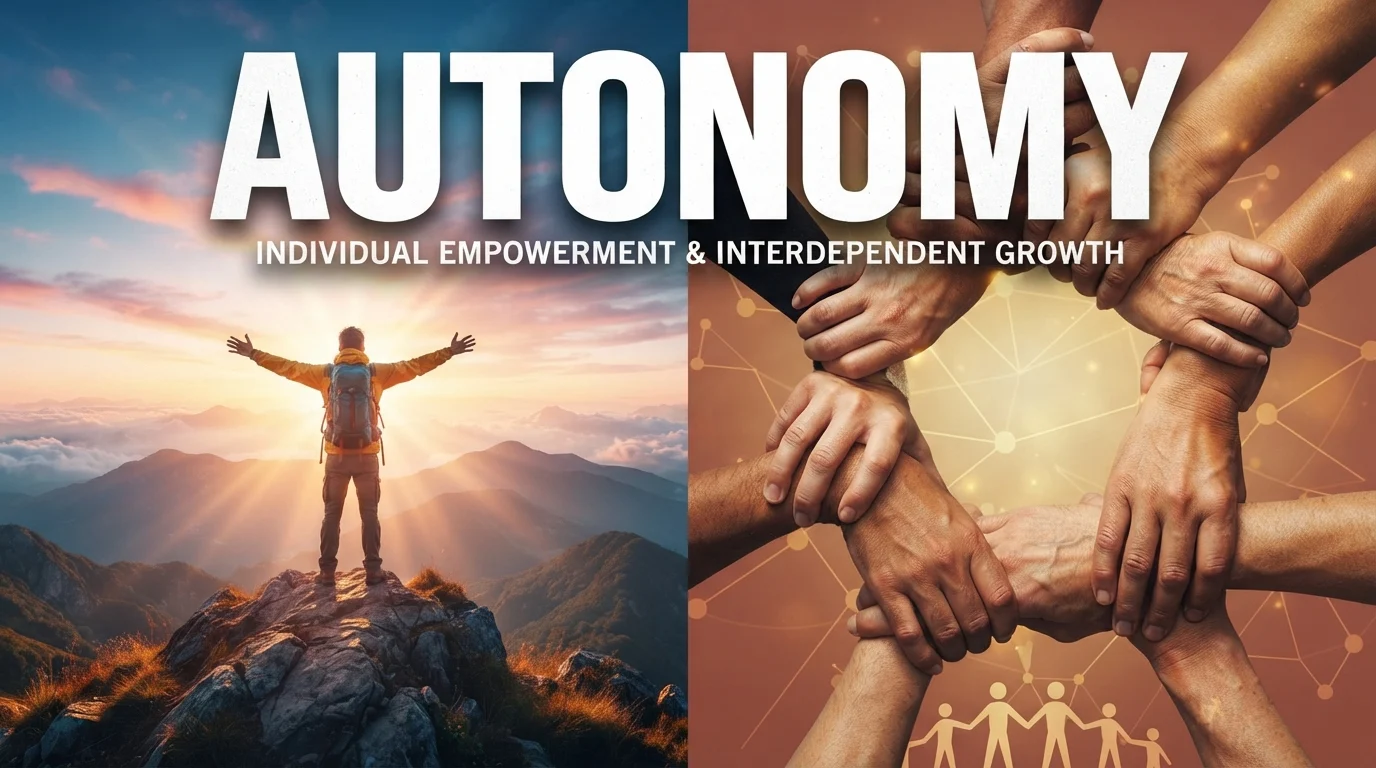
Quick Answer: Autonomy means “self-law” or “self-rule.” It comes from the Greek words autos (self) and nomos (law) . In practical terms, autonomy is the ability to govern yourself, make your own informed decisions, and act according to your own reasoning—free from outside control or coercion . The concept applies to nations (self-government), organizations (operational independence), and individuals (personal freedom and moral independence) . True autonomy goes beyond mere freedom to act; it requires rational decision-making and the capacity to evaluate your own values without external interference .
You’ve heard the word thrown around in political debates about regional independence. Maybe your boss mentioned giving you more autonomy at work. Or perhaps you’ve wrestled with the idea of personal autonomy in your own life. But what does autonomy really mean, and why does it matter so much?
At its heart, autonomy is about being the author of your own life. It’s the capacity to make decisions based on your own reasoning, values, and priorities not because someone told you to, not because you’re afraid of consequences, but because you’ve genuinely chosen a path for yourself . The word itself comes from two Greek roots: autos meaning “self” and nomos meaning “law” . Put them together, and you get “self-law.”
But autonomy isn’t just a philosophical luxury. It’s a fundamental human need that shapes how we develop, how we relate to others, and how societies function. Understanding the autonomy meaning can help you navigate everything from parenting decisions to career choices to political debates about freedom and control.
Autonomy Meaning: What Does It Actually Mean?
The Basic Definition
Autonomy refers to the state of being self-governing or self-directing . It’s the power or right of a person, group, or nation to govern itself without outside interference . In practical terms, autonomy means having the freedom to make your own choices and act on them.
The Merriam-Webster dictionary defines autonomy in three key ways :
- The quality or state of being self-governing, especially the right of self-government
- Self-directing freedom and especially moral independence
- A self-governing state
The Greek Roots: Self-Law
The word comes from the Greek autonomos, which breaks down into autos (self) and nomos (law or custom) . This etymology captures the essence: autonomy means being a law unto yourself.
But this doesn’t mean living without rules. Instead, it means generating your own principles and governing yourself according to them. As one scholar puts it, “Autonomy is the condition through which principles used to govern oneself can be generated” . In this sense, autonomy is the foundation of individualism the condition that allows self-definition to take place .
Autonomy vs. Freedom: What’s the Difference?
Many people use “autonomy” and “freedom” interchangeably, but philosophers draw important distinctions . Freedom typically refers to the absence of constraints on action. Autonomy goes deeper it also requires freedom from constraints on desires, biases, and even access to information that can distort the decision-making process .
Consider a smoker. They might be free to choose whether to buy cigarettes (freedom), but their nicotine addiction constrains their desires in a way that undermines their autonomy regarding that decision . Similarly, someone might be technically free to make a choice but lack the information or capacity to make a truly autonomous decision.
| Aspect | Freedom | Autonomy |
|---|---|---|
| Focus | Absence of external constraints | Self-governance and self-direction |
| Requires | Ability to act | Rationality, information, and authentic values |
| Concerned with | External limitations | Internal and external limitations |
| Example | Being allowed to choose | Choosing based on your own reasoned values |
The Opposite: Heteronomy
The opposite of autonomy is heteronomy being governed by someone or something else . In a heteronomous state, you’re controlled by external forces rather than self-generated principles. This could mean following others’ directions without question, conforming to social pressures, or being driven by unconscious impulses rather than conscious choice .
Autonomy and heteronomy exist on a spectrum. Few people are entirely autonomous or entirely heteronomous. The transition from heteronomy to autonomy is, in fact, one of the defining characteristics of modern Western societies .
Autonomy in Politics and Society
National and Regional Self-Government
In political terms, autonomy refers to the right of self-government. This can apply to entire nations or to regions within larger countries that retain some powers of self-determination . Puerto Rico is a prime example of an autonomous region within the United States it’s part of the country but maintains significant self-governing powers .
When a region seeks autonomy, it’s asking for the right to make its own decisions about internal affairs. This might mean control over local laws, cultural preservation, or economic policies. The Catalan region of Spain, for instance, has long sought greater autonomy an outward indication of “their distinction from the rest of Spain” .
The Connection to Democracy
Autonomy requires a political structure like democracy to be fully realized . Democratic governments guarantee rights and freedoms such as freedom of speech and religion that are essential for individual autonomy. Without these protections, people can’t truly govern themselves.
Scholars argue that autonomy was “an underlying factor in political rights such as the freedoms of speech and religion” . The transition from feudal to democratic societies was, in essence, a transition from heteronomy to autonomy from being ruled by others to having a say in how you’re governed.
Nationalism and Independence Movements
When nationalist movements demand independence, they’re fundamentally demanding autonomy. They want the right to self-determination, to govern themselves according to their own values and priorities. The rebels demanding “autonomy from Spain” are seeking the right of self-government .
This political use of autonomy is one of the most visible applications of the concept. It connects directly to the Greek root meaning the right to be one’s own lawgiver at the level of nations and states.
Autonomy in Personal Development
The Developmental Timeline
Autonomy doesn’t appear fully formed. It develops over time, with critical periods in childhood shaping the capacity for self-governance. Psychologist Erik Erikson identified a crucial crisis of “autonomy versus shame and doubt” occurring between roughly 18 months and 4 years of age .
During this period, children gain control over their muscles and want to exercise their newfound powers in their own way. Defiance, stubbornness, and resistance are common and they’re actually signs of healthy development . If a child’s autonomy is prevented or punished during this stage, rage may result. If it’s supported and guided, the rudiments of self-control and willpower begin to develop .
Other researchers extend the critical period for developing autonomy into the first 12 years of life . During these years, basic orientations toward self-direction form, which are later subject only to modifications. The most important stages include :
| Stage | Key Development |
|---|---|
| Amorphous (Emergence) | Foundations laid in preschool; adult support is crucial |
| “Freedom From” | Occurs during adolescence; establishing independence from parents |
| “Freedom To” | Mature autonomy; acting from one’s own values and interests |
The Connection to Trust
Interestingly, autonomy development depends on an earlier developmental step: trust. Psychologists note that developing autonomy is much easier if you’ve already established trust for yourself, for your parents, and for others . Trust provides the security needed to explore independence confidently.
This connection makes sense. If you don’t trust that the world is basically safe, taking independent action feels risky. If you don’t trust your own judgment, you’ll seek external validation. Trust and autonomy work together: trust makes autonomy possible, and autonomy reinforces trust in yourself.
Autonomy as Agency
At its core, personal autonomy is about agency the sense that “what I do makes a difference” . This feeling begins in infancy, when a child learns that their actions produce predictable outcomes. When a baby cries and gets fed, or shakes a rattle and hears a sound, they’re learning that they can influence their environment.
As children grow, this sense of agency expands. They learn to act on their predictions, to communicate emotions, and to experience appropriate emotional replies. An autonomous person “thinks for himself (but not only about himself), decides himself what is right, and acts out of choice” .
Adolescence: The Crucible of Autonomy
Adolescence is a particularly important period for autonomy development. This is when young people must navigate the tension between establishing independence from parents and maintaining relationships with them. Some psychologists describe adolescence as the “freedom from” stage when individuals test boundaries and establish themselves as separate selves .
But autonomy in adolescence isn’t just about rebellion. It’s about developing the capacity to make genuine choices. This includes choosing a life partner, a career path, or a spiritual belief system . Making these choices autonomously means choosing based on your own research and values, not rebellion against parents or conformity to their expectations .
Moral Autonomy: Kant and the Ethics of Self-Rule
Immanuel Kant’s Contribution
When philosophers talk about autonomy, they often start with Immanuel Kant. For Kant, autonomy was central to morality. He argued that rational people generate rules, principles, and maxims for themselves, even if they’re not aware of doing so .
Kant’s Categorical Imperative is the ultimate expression of moral autonomy: “I ought never to act except in such a way that I can also will that my maxim should become a universal law” . In other words, an autonomous person governs themselves by rules they could logically will to apply to everyone.
This is radical because it means moral rules aren’t imposed from outside they’re generated by the individual’s own reason. Morality is, in Kant’s view, a form of self-legislation. You’re not just following rules; you’re creating them through rational reflection .
Moral Autonomy vs. Personal Autonomy
Philosophers distinguish between different types of autonomy :
- Moral autonomy refers to an individual’s capacity to judge their own actions according to objective moral law and make decisions accordingly. This is Kant’s concept.
- Personal autonomy is broader, not limited to moral decision-making. It doesn’t require belief in objective moral law.
- Freedom is distinct from both, focusing primarily on the capacity to act rather than self-governance.
Each type of autonomy is important in different contexts. Moral autonomy matters for ethics and responsibility. Personal autonomy matters for everyday decision-making. Freedom matters for action.
Autonomy and Responsibility
There’s a strong connection between autonomy and responsibility . If you’re truly autonomous if you make decisions based on your own reasoning and values then you’re responsible for those decisions. You can’t blame external forces or claim you were forced to act.
This connection explains why autonomy is so important in ethics and law. When we hold someone responsible, we’re implicitly acknowledging their autonomy. When someone lacks autonomy due to mental illness, coercion, or impairment we’re less likely to hold them morally or legally responsible.
Autonomy in Bioethics and Medicine
Informed Consent
One of the most important applications of autonomy in modern life is in medical ethics. The doctrine of informed consent means that patients must understand the information relevant to their medical decisions . Doctors can’t simply make decisions for patients; they must provide the information needed for patients to make autonomous choices.
This was a dramatic shift from earlier medical practice. In the nineteenth century and much of the twentieth, doctors often made decisions based on what they thought was best without consulting patients. Today, patient autonomy is a fundamental principle of bioethics .
The Limits of Medical Autonomy
But autonomy in medicine has limits. Patients may lack the capacity to make informed decisions due to illness, medication, or cognitive impairment. In these cases, autonomy is temporarily or permanently compromised. The challenge for medical ethics is balancing respect for autonomy with the duty to protect vulnerable patients.
Some philosophers discuss “global condition” autonomy versus “specific” autonomy . A patient might be generally autonomous but lack autonomy regarding a specific medical decision due to pain, fear, or medication side effects. This distinction helps clinicians navigate complex situations where patients’ decision-making capacity is impaired.
Relational Autonomy: The Cultural Dimension
Challenging the Western View
Mainstream psychology’s definition of autonomy has been heavily influenced by Western cultural values, particularly individualism. This approach often equates autonomy with separation and independence from others .
But this isn’t the only way to understand autonomy. In many cultures, autonomy and relatedness are seen as complementary, not conflicting. People can be autonomous while maintaining close relationships and interdependence with others . This perspective has led to the concept of the autonomous-related self a healthy self-construal that balances agency with connection.
Culture and Autonomy
Different cultures place different values on autonomy. Some, like ancient Sparta or contemporary China, place “the value of homogeneity and adherence to a firm code of social conduct above the value of autonomy” . Others, particularly in the Western world, prioritize individual choice and self-direction.
This cultural variation matters because it shapes expectations about autonomy in families, schools, and workplaces. A parent who expects a child to make their own decisions might be seen as supportive in one culture and neglectful in another. A manager who gives employees autonomy might be seen as empowering or as abandoning their responsibilities.
The Autonomous-Related Self
Research from several cultural contexts supports the idea that autonomy and relatedness can coexist . People can be self-governing while also being deeply connected to others. They can make decisions based on their own values while considering the impact on family, community, and relationships.
This balanced perspective offers a more nuanced understanding of autonomy. It recognizes that self-rule doesn’t mean isolation. Indeed, meaningful autonomy often requires supportive relationships that enable self-exploration and growth.
Frequently Asked Questions
What does autonomy mean? Autonomy means “self-law” or self-governance. It’s the capacity to make rational, informed decisions free from coercion, and to act according to your own reasoning and values .
Where does the word autonomy come from? It comes from the Greek words autos (self) and nomos (law), meaning “self-law” or “self-rule” .
What is the difference between freedom and autonomy? Freedom means the absence of external constraints on action. Autonomy goes deeper it requires freedom from constraints on desires, biases, and access to information that can distort decision-making .
What is the opposite of autonomy? Heteronomy being governed by someone or something else .
How does autonomy develop in children? Autonomy develops through critical periods, particularly between 18 months and 4 years (autonomy versus shame and doubt), and continues through adolescence. Trust and supportive relationships are essential for healthy autonomy development .
Is autonomy only an individual concept? No. Autonomy applies to nations (self-government), regions (autonomous regions), organizations, and individuals .
Who is Kant and what does he have to do with autonomy? Immanuel Kant was an 18th-century philosopher who made autonomy central to his moral philosophy. He argued that moral autonomy means governing yourself by rules you could rationally will to be universal laws .
What is informed consent? Informed consent is the principle that individuals must understand the information relevant to their decisions, particularly in medical contexts. It’s based on respect for patient autonomy .
Key Takeaways
| Aspect | Key Point |
|---|---|
| Meaning | Self-law, self-governance, the capacity to make rational, informed decisions |
| Origins | Greek autos (self) and nomos (law) |
| Opposites | Heteronomy (being governed by others) |
| Political | Self-government, independence, regional autonomy |
| Personal | Self-direction, moral independence, responsible choice-making |
| Developmental | Critical periods in childhood and adolescence; trust is foundational |
| Philosophical | Kant’s Categorical Imperative, moral self-legislation |
| Bioethics | Informed consent, patient decision-making |
| Cultural | Autonomous-related self balances agency and connection |
Conclusion: The Future of Autonomy
Autonomy is more than a philosophical concept it’s a fundamental human need that shapes our development, our relationships, and our societies. From the toddler learning to say “no” to the nation demanding self-determination, autonomy is about being the author of your own life.
But autonomy isn’t simple. It requires trust, support, and the right conditions to flourish. It balances independence with connection, self-rule with responsibility, and freedom with the capacity to make genuinely informed choices. True autonomy isn’t just about doing what you want it’s about having the reasoning, information, and self-awareness to choose wisely.
As our world becomes more complex, autonomy matters more than ever. We’re constantly making decisions about our health, our careers, our relationships, and our place in society. The more autonomous we are, the more we can navigate these choices with clarity and purpose. But autonomy also requires responsibility the willingness to own our decisions and their consequences.
The word “autonomy” has come a long way from its Greek roots, but its essential meaning remains: the power to govern yourself according to your own laws and values. Whether you’re fighting for political independence, striving for personal growth, or simply trying to make a difficult decision, autonomy is at the heart of the matter. It’s the condition that makes individualism possible, the foundation of democracy, and the key to a meaningful life.