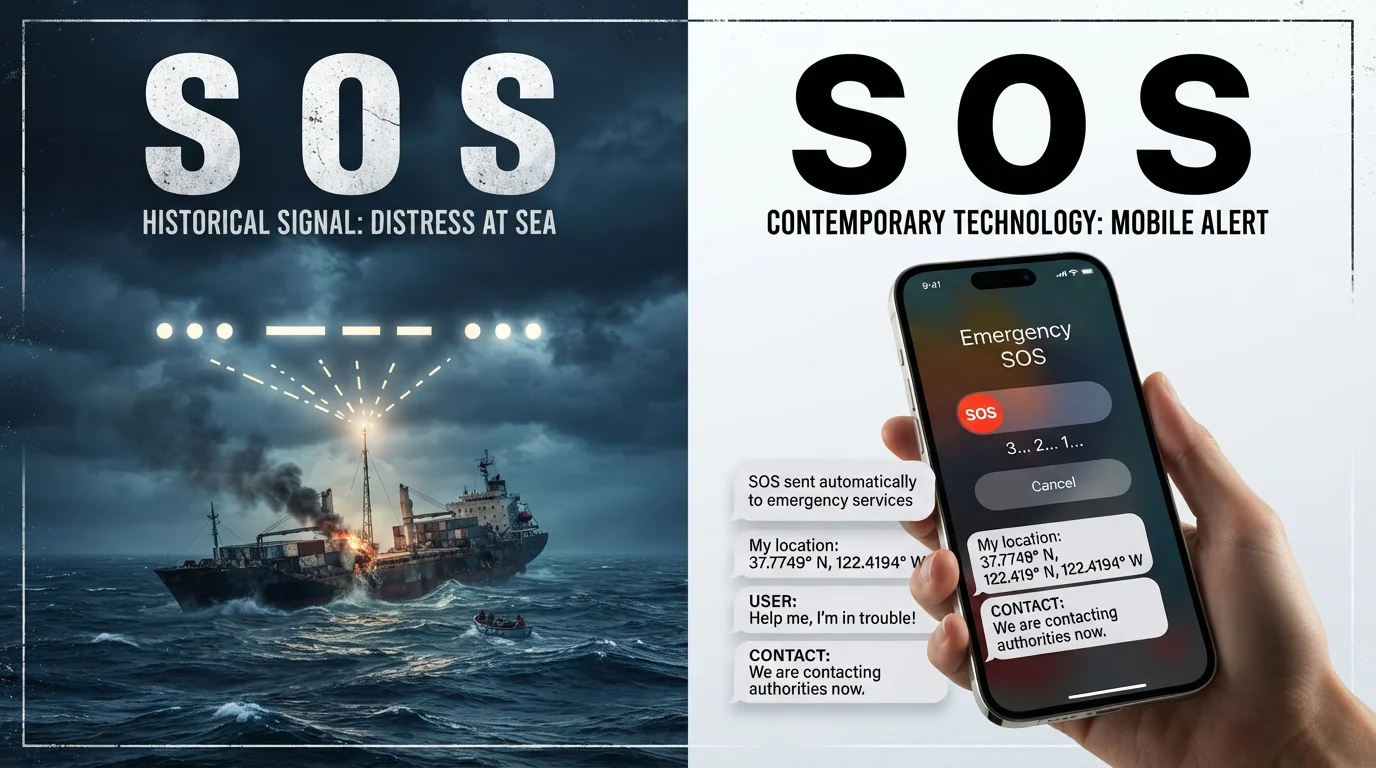
Quick Answer: SOS is a universal distress signal, but contrary to popular belief, it doesn’t actually stand for “Save Our Souls” or “Save Our Ship.” The letters were chosen simply because they’re easy to transmit in Morse code: three dots, three dashes, three dots . Today, SOS has evolved beyond maritime emergencies into everyday slang for any urgent call for help whether serious or joking. It also appears as a smartphone emergency feature that can alert authorities even without cell service.
You’ve seen it in movies a ship sinking, someone tapping out in Morse code, desperately calling for rescue. You’ve probably also received a text from a friend that just says “SOS” with a bunch of crying emojis after an awkward date. So what does the same three letters mean in these completely different situations?
The answer is surprisingly layered. SOS started as a practical maritime distress signal, but over more than a century, it’s grown into something far bigger. It’s a cultural icon, a smartphone feature, and a piece of everyday slang. And here’s the wild part: despite what almost everyone thinks, it doesn’t actually stand for anything at all.
What Does SOS Actually Mean?
The Morse Code Reality
In International Morse Code, the letter “S” is three dots (···), and the letter “O” is three dashes . Put them together, and you get the unmistakable sequence .
The sequence was chosen for one reason: it’s incredibly easy to remember and almost impossible to confuse with any other signal. No spaces between the letters just a continuous, distinctive pattern that cuts through static and noise.
It Doesn’t Stand for Anything!
Here’s the truth that surprises most people: SOS does not stand for “Save Our Souls,” “Save Our Ship,” or any other phrase. Those are “backronyms” meanings people assigned later to help remember the sequence.
The confusion is understandable. When a ship is sinking, “Save Our Souls” fits perfectly. But the official SOS meaning is simply the signal itself. The letters were chosen for their practical value, not as an acronym.
The “Save Our Souls” Myth
Despite the reality, “Save Our Souls” and “Save Our Ship” remain the most common interpretations. They’ve become so ingrained in popular culture that many dictionaries now include them as secondary meanings. It’s a classic case of a backronym taking on a life of its own.
The History of SOS: From German Regulations to Titanic
Before SOS: CQD and Other Signals
Before SOS became the standard, different countries and companies used different distress signals. The Marconi Company, which operated wireless telegraphy on many ships, used “CQD”. This didn’t stand for anything either, though people later assigned “Come Quick Distress” or “Come Quick Drowning” to it.
The British used various signals. The Americans used “NC,” which meant “call for help without delay.” The Germans used “SOE”. This patchwork of signals created confusion at sea when ships from different nations needed to communicate an emergency.
The German Proposal and International Standard
The turning point came in 1905 when the German government introduced “SOS” in its maritime radio regulations. The signal officially became the international standard on July 1, 1908, after being included in the second International Radiotelegraphic Convention.
The signal’s simplicity and distinctiveness gave it a clear advantage over alternatives. One signal, instantly recognizable across language barriers.
The First SOS Broadcast
The first SOS ever broadcast in the United States came in August 1909, when the American steamer Arapahoe became disabled with a broken propeller shaft. The crew sent the signal, and help arrived.
The Titanic Connection
When the Titanic sank in 1912, the ship’s operators initially sent the older CQD signal. As the situation grew more desperate, they also began sending SOS making it one of the most famous uses of the signal in history. After the Titanic disaster, the U.S. officially adopted SOS as its distress signal.
From 1999: The Replacement by GMDSS
In 1999, the traditional SOS was officially replaced as the primary maritime distress signal by the Global Maritime Distress and Safety System (GMDSS). The system uses satellite and digital technology, making distress calls more reliable and providing more information than a simple Morse code pattern.
Despite this, SOS remains legally recognized as a distress signal. Its cultural power ensures it will never be forgotten.
SOS on Your Smartphone: Emergency Features
Apple Emergency SOS
Modern smartphones have transformed SOS from a Morse code signal into a powerful safety tool. Apple’s Emergency SOS feature lets users quickly call emergency services or send alerts to emergency contacts. The function works even without cellular service or Wi-Fi, using satellite connectivity in some cases.
Users can set up the feature in their iPhone’s Settings. Options include pressing and holding the power and volume buttons to bring up an emergency slider, or rapidly pressing the side button five times to initiate a call. Car crash detection is also available, automatically calling for help after a severe accident.
Android and Wearable SOS
Google has included similar functionality in Android devices. Features are also available on wearables like Apple Watches and Garmin devices, and on smartphones in India through the 112 emergency number. Press the power button three times in a row to activate it sends your location, camera photos, and voice samples to your chosen emergency contacts.
SOS in Everyday Language: What It Means in Texts and Slang
The Joking Distress Call
When someone texts “SOS,” they’re rarely in a life-or-death situation. Instead, they’re usually saying “I need backup right now” in a half-joking, half-serious way.
Examples include:
- “SOS, this date is going terribly. Call me with a fake emergency.”
- “SOS, what’s the name of that restaurant we went to last week? I need to impress someone.”
- “SOS, I’m stuck in a meeting that should’ve been an email.”
Social Media Usage
On social media, you’ll see “SOS” used dramatically for relatable situations. A photo of a massive pile of laundry might be captioned “SOS send help.” A video of someone’s cat destroying their apartment gets flooded with “SOS” comments from people who relate. The word adds humor and exaggeration to otherwise mundane situations.
The Pop Culture Connection
Artists have picked up on the term’s emotional power. ABBA sang “S.O.S.” in the ’70s. Rihanna had a hit with “SOS” in 2006. SZA named a song “SOS” in 2022. The signal’s association with desperation and need has made it a perfect metaphor in music and pop culture.
The Latin “SOS” and Other Meanings
Si Opus Sit
In a completely different context, “s.o.s.” (lowercase, with periods) has a medical meaning. It stands for the Latin phrase si opus sit, which means “if necessary”. This abbreviation appears in prescription instructions, telling a patient to take medication only when needed.
Other Slang Meanings
There’s even a vulgar slang term: “Shit on a Shingle” a euphemistic initialism that refers to creamed chipped beef on toast, a dish served in the U.S. military. This has nothing to do with distress signals and everything to do with military humor.
How Context Changes Everything
Between Close Friends
Among people who know each other well, “SOS” is almost always playful. A best friend texting “SOS I’m dying” about running out of coffee clearly isn’t serious. Shared history makes the joke obvious.
In Professional Settings
Using “SOS” in work contexts is risky. Texting a boss “SOS need that file” might come across as unprofessional like the sender doesn’t take their job seriously. It’s better to use clear, professional language in workplace communication.
When There’s No Shared Context
Someone who sends “SOS” without context especially to someone they barely know creates real concern. The recipient can’t tell if the sender is being dramatic or actually needs help. This ambiguity can cause unnecessary worry or, in the worst case, make someone ignore a genuine emergency.
The Snapchat SOS
On platforms like Snapchat, “SOS” can have a specific meaning: “Someone’s Over my Shoulder.” It’s a warning to a friend that a parent or other authority figure is watching the screen, and they should avoid saying anything compromising. Miss that signal, and you could accidentally share something you shouldn’t.
Frequently Asked Questions
What does SOS actually stand for? It doesn’t stand for anything. The letters were chosen because they’re easy to transmit in Morse code: three dots, three dashes, three dots.
Why do people think SOS means “Save Our Souls”? That’s a backronym a meaning assigned later to help remember the sequence. It became popular because it fits the context of emergencies.
When did SOS become the international distress signal? It was introduced by Germany in 1905 and became a worldwide standard on July 1, 1908.
Is SOS still used today? Ships now use the Global Maritime Distress and Safety System (GMDSS), but SOS remains legally recognized and culturally iconic.
What does SOS mean in texting? It usually means “I need help with this situation” or “I need backup.” It’s often used humorously for minor problems, not life-or-death emergencies.
What is Emergency SOS on iPhone? A feature that lets you quickly call emergency services or send alerts to emergency contacts, even without cell service or WiFi.
Key Takeaways
| Aspect | Key Point |
|---|---|
| True Meaning | A Morse code distress signal that doesn’t stand for anything |
| Common Misconceptions | “Save Our Souls” and “Save Our Ship” are backronyms, not the original meaning |
| Historical Standard | Became international on July 1, 1908 after Germany introduced it in 1905 |
| Notable First Use | Arapahoe in August 1909; famously used by Titanic in 1912 |
| Modern Maritime | Replaced by GMDSS in 1999 but still recognized |
| Smartphone Feature | Emergency SOS on Apple and Android works without cell service |
| Slang Usage | “I need help” or “I need backup,” often used jokingly in texts and social media |
Conclusion: From Morse Code to Meme
What started as a practical solution to a communication problem has become one of the most recognized symbols in human history. Three simple letters, chosen because they were easy to tap out in Morse code, have transcended their original purpose to become a cultural shorthand for “help me.”
The journey of SOS tells us something fascinating about how language works. A signal created for maritime safety became a backronym, then a slang term, then a smartphone feature, and finally, a pop culture reference. Through all these transformations, the core meaning has remained: someone needs help, or at least wants you to think they do.
Understanding the real SOS meaning means understanding that words evolve. They pick up layers of meaning, acquire myths, and adapt to new contexts. “Save Our Souls” might not be historically accurate, but it’s emotionally true. And that’s why SOS isn’t just a signal anymore it’s a feeling, a joke, and a lifeline all at once.