Quick Answer: A martyr is a person who is killed or suffers greatly for their beliefs, principles, or cause. The word comes from the Greek word martys, which simply means “witness.” Originally, it referred to someone who testified to their faith, but over centuries, the meaning shifted to describe those who die for their convictions. Today, “martyr” can describe anyone who sacrifices their life, reputation, or well-being for a cause they believe in. The term carries immense power it can inspire movements, fuel revolutions, and create enduring legacies. It’s also used more loosely to describe someone who exaggerates their suffering for sympathy.
The Word That Turns Death into Legacy
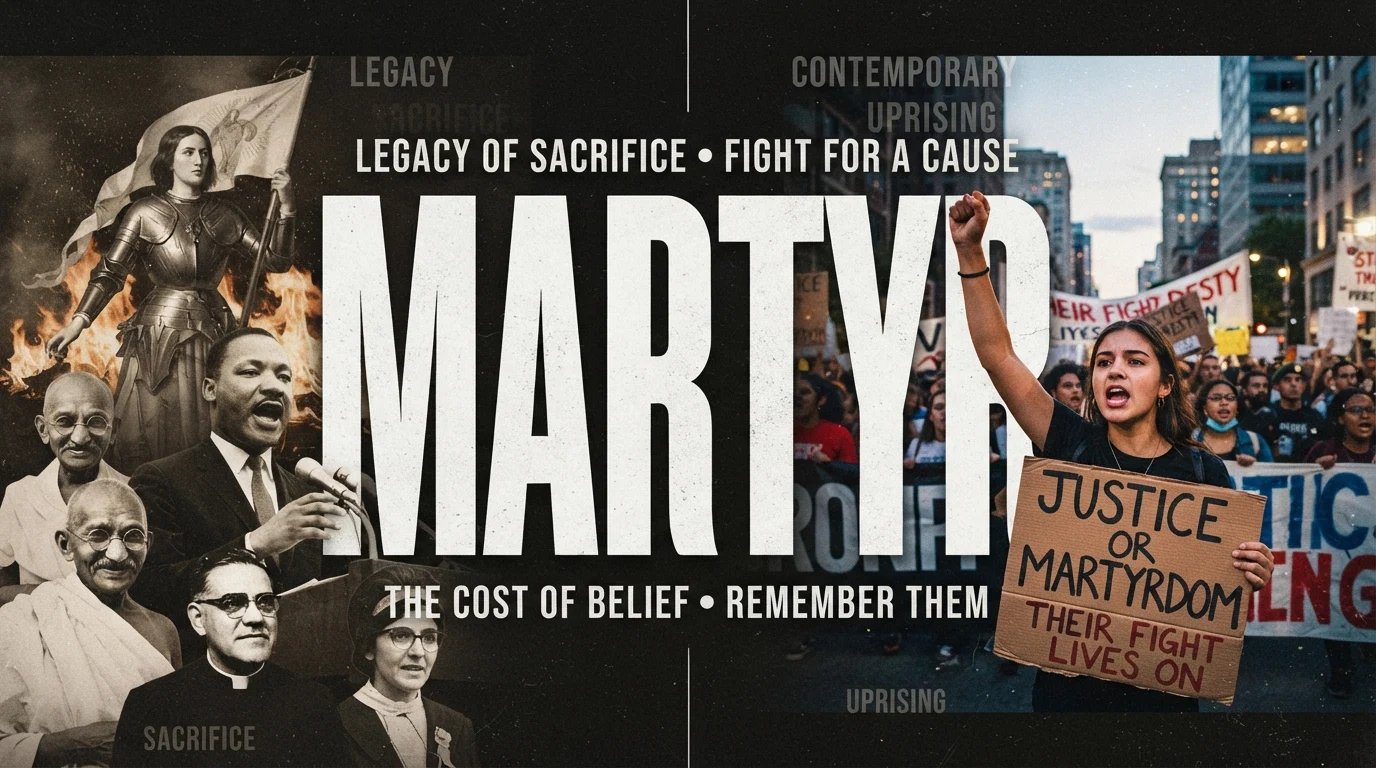
Throughout history, certain names echo across generations. Joan of Arc. Martin Luther King Jr. Mahatma Gandhi. What do these figures have in common? They all died for what they believed in. They are martyrs.
But the meaning of martyr goes far beyond a simple definition of someone who dies for a cause. It’s a word loaded with emotion, history, and cultural weight. It speaks to the deepest human questions about sacrifice, meaning, and what we’re willing to give up for what we believe.
It means understanding how beliefs can become more important than life itself. And it means confronting the uncomfortable truth that martyrdom can be both a force for profound good and a tool for manipulation and violence.
Martyr Meaning: What Does It Actually Mean?
The Core Definition
The dictionary defines a martyr as “a person who voluntarily suffers death as the penalty of witnessing to and refusing to renounce a religion” or “a person who sacrifices something of great value and especially life itself for the sake of principle.”
Breaking this down, a martyr is someone who:
- Dies or suffers for a belief or cause
- Has the option to recant or escape but chooses not to
- Values their conviction more than their own life
The term can also apply more broadly to anyone who makes a great sacrifice for a cause. A whistleblower who loses their career. An activist who faces imprisonment. A soldier who gives their life for their country.
The Greek Origin: “Witness”
The word “martyr” comes from the Greek martys (μάρτυς), which means “witness.” In its original context, a martyr was simply someone who testified to something they had seen or experienced. There was no inherent connection to death or suffering.
This original meaning is crucial to understanding how the term evolved. In the early Christian church, martyrs were those who bore witness to their faith often at the cost of their lives. The word “witness” and “martyr” became intertwined because the ultimate witness was one who refused to deny their faith even when threatened with death.
Martyr vs. Confessor
In early Christian tradition, a distinction emerged between a “martyr” and a “confessor.” A martyr was someone who died for their faith. A confessor was someone who suffered for their faith imprisonment, torture, exile but survived.
This distinction shows that the early church understood martyrdom as something specific. It wasn’t just about suffering. It was about the ultimate sacrifice.
The History of Martyrdom: From Ancient Times to Today
Early Christian Martyrs
The concept of martyrdom is most closely associated with early Christianity. For the first three centuries after Christ, Christians faced sporadic but often brutal persecution from Roman authorities.
Saint Stephen is traditionally considered the first Christian martyr. According to the Acts of the Apostles, he was stoned to death for his preaching around 34 CE.
The Roman persecutions produced thousands of martyrs. The accounts of their trials and deaths, called “acts of the martyrs,” became foundational texts for the early church.
Martyrdom in Islam
Islam also has a rich tradition of martyrdom. The Quran praises those who sacrifice their lives for faith.
Classical Islamic scholars distinguished between different types of martyrs, including those who die in battle, those who die defending their faith, and those who die in accidents or from illness.
This represents a distortion of classical Islamic teachings, which strictly regulate the conditions under which armed struggle is permissible.
Martyrdom in Judaism
Judaism has its own tradition of martyrdom, known as Kiddush Hashem (sanctification of God’s name). The most famous example is the story of the Ten Martyrs, rabbis executed by the Romans, commemorated in the Yom Kippur liturgy.
During the Crusades and the Holocaust, countless Jews chose death rather than convert to Christianity or abandon their faith. These martyrs are remembered in Jewish communities around the world.
Political and Secular Martyrs
Martyrdom isn’t limited to religious contexts. Political movements have their own martyrs figures who died for freedom, equality, or national liberation.
| Martyr | Cause | Year of Death |
|---|---|---|
| Socrates | Philosophical integrity | 399 BCE |
| Joan of Arc | Religious and national | 1431 |
| Abraham Lincoln | Union and emancipation | 1865 |
| Mahatma Gandhi | Indian independence | 1948 |
| Martin Luther King Jr. | Civil rights | 1968 |
| Malcolm X | Black empowerment | 1965 |
| Nelson Mandela (figurative) | Anti-apartheid | 2013 (natural causes) |
What Makes a Martyr?
Voluntary Sacrifice
A key component of martyrdom is voluntariness. The martyr chooses death over recantation. This choice transforms the death from tragedy into something else a statement, a testimony, a sacrifice.
This doesn’t mean the martyr wants to die. Most would prefer to live. But they value their principles more than their survival. They choose death as the only path that preserves their integrity.
Witness to Truth
The original meaning of “witness” remains central. A martyr testifies to something they believe is true. Their death is a statement: “This truth is more important than my life.”
This is why martyrs are so powerful. They don’t just die; they die for something. Their death becomes evidence of their conviction.
The Role of the Persecutor
Martyrdom requires a persecutor. Someone must be willing to kill the martyr for their beliefs. Without persecution, there is no martyrdom.
This creates a paradox. The persecutor intends to silence the martyr, but often achieves the opposite. The death becomes a rallying cry, inspiring others to take up the cause.
The Community’s Response
Martyrs are created by communities, not just by individuals. The death of a person only becomes martyrdom when a community remembers, honors, and interprets that death.
The Power of Martyrdom
Inspiration and Motivation
Martyrs inspire. Their willingness to die for a cause proves that the cause is worth dying for. This can motivate others to make sacrifices they wouldn’t otherwise make.
The death of Martin Luther King Jr. didn’t end the civil rights movement. It energized it. His martyrdom became a powerful symbol that fueled the fight for equality.
The Creation of Movements
Many social and political movements trace their origins to a martyr. The American Revolution had its martyrs, including Crispus Attucks, killed in the Boston Massacre. The anti-apartheid movement had Steve Biko, who died in police custody.
These deaths become foundational stories. They provide a rallying point, a symbol of injustice, and a reason to keep fighting.
The Power of Memory
The early Christian church grew partly because of the witness of the martyrs. As the second-century theologian Tertullian wrote, “The blood of the martyrs is the seed of the church.”
The Dark Side of Martyrdom
Manipulation and Recruitment
Martyrdom can be weaponized. Extremist groups often use the promise of martyrdom to recruit followers and justify violence. They promise paradise, honor, and eternal memory to those who die for the cause.
This is a dangerous distortion. It exploits the natural human desire for meaning and belonging. It turns vulnerable people into tools of destruction.
Martyrdom and Suicide
There’s a critical distinction between martyrdom and suicide. A person who takes their own life is not, by traditional definitions, a martyr.
However, the line can become blurred. Some individuals intentionally provoke their own deaths, seeking martyrdom. These gray areas raise profound ethical questions.
The Glorification of Suffering
Martyrdom can lead to a glorification of suffering that becomes unhealthy. Some people may seek out persecution or sacrifice when it’s not necessary or wise. The desire to be a martyr can become a form of ego or self-destruction.
True martyrdom, at its best, is a last resort.
Martyr in Modern Usage
Figurative and Casual Use
In everyday language, “martyr” is often used more loosely. A person who constantly complains about their suffering might be called a “martyr.”
This casual usage dilutes the word’s power, but it also reflects its cultural resonance.
The “Martyr Complex”
In psychology, a “martyr complex” describes a pattern of behavior where someone consistently sacrifices their own needs for others and then feels resentful or unappreciated. This is martyrdom in a negative, self-defeating form.
People with a martyr complex often feel trapped in their role. They may feel that no one else will do what needs to be done, or they may fear that setting boundaries will lead to rejection.
Martyrdom in Pop Culture
The concept of martyrdom appears frequently in film, literature, and television. From Jesus Christ Superstar to The Hunger Games, stories often feature characters who sacrifice themselves for a greater good.
These stories resonate because they speak to something deep in the human psyche. We admire those who give everything. We wonder if we would do the same.
Frequently Asked Questions
What does martyr mean? A martyr is a person who is killed or suffers greatly for their beliefs, principles, or cause.
Where does the word martyr come from? It comes from the Greek word martys, which means “witness.”
What is the difference between a martyr and a confessor? In early Christian tradition, a martyr died for their faith, while a confessor suffered but survived.
Who was the first Christian martyr? Saint Stephen, who was stoned to death around 34 CE, is traditionally considered the first Christian martyr.
What is a martyr complex? A martyr complex is a psychological pattern where someone sacrifices their own needs for others and then feels resentful or unappreciated.
Is martyrdom always religious? No. Political and secular movements also have martyrs figures who died for freedom, equality, or national liberation.
Can someone be a martyr without dying? The term is sometimes used more broadly for those who make great sacrifices. However, the traditional definition requires death.
Key Takeaways
| Aspect | Key Point |
|---|---|
| Core Meaning | A person killed or suffering for their beliefs |
| Origin | Greek martys meaning “witness” |
| Key Components | Voluntary sacrifice, witness to truth, persecution |
| Religious Examples | Saint Stephen, early Christian martyrs, Islamic shahid |
| Political Examples | Gandhi, MLK Jr., Joan of Arc |
| Power | Inspires movements, creates lasting legacies |
| Dark Side | Manipulation, glorification of suffering, martyr complex |
| Modern Usage | Casual for those who exaggerate suffering |
Conclusion: The Weight of Witness
Martyrdom is one of humanity’s most powerful concepts. It creates heroes, inspires movements, and shapes history.
But it’s also a concept that demands careful thought. It requires a cause worth dying for and a persecutor willing to kill for it.
The martyrs throughout history from Saint Stephen to Martin Luther King Jr. remind us that some things are worth more than life itself. They challenge us to ask what we would be willing to sacrifice for what we believe in.
At its best, martyrdom is a witness to truth. It says, “This is what I believe. This is what I stand for. This is what I am willing to give my life for.” That’s a powerful statement. It’s a statement that echoes through the ages.
Understanding the true martyr meaning helps us appreciate both the heroism and the tragedy of those who give everything for their convictions. It reminds us that beliefs matter. Principles matter. And sometimes, the price of integrity is the highest price of all.