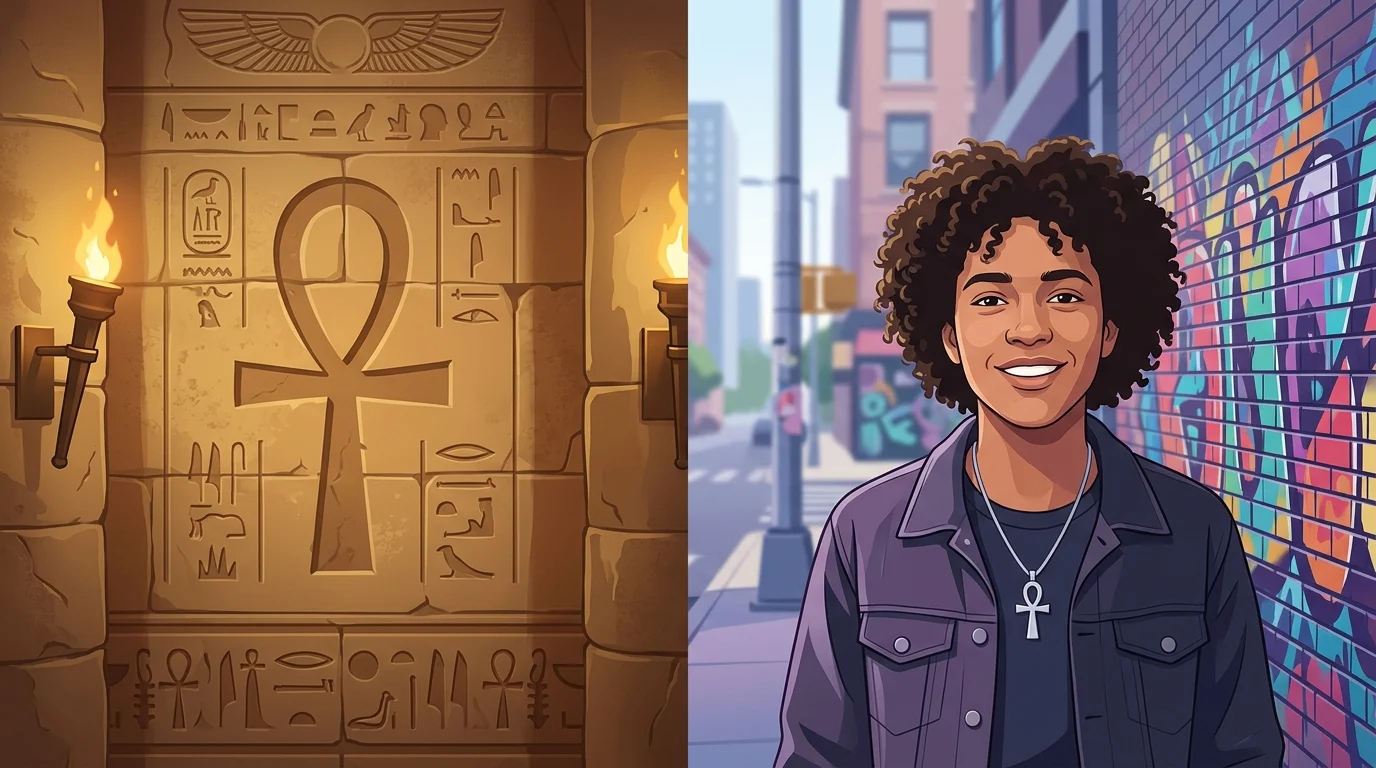
Quick Ans: The ankh meaning depends entirely on context, yet unlike many slang terms, this ancient Egyptian symbol carries millennia of spiritual, cultural, and modern weight. It can point to the key of life, a hieroglyph for existence, a Christian cross adaptation, or a powerful symbol of Black identity. This guide breaks down every major meaning so you can understand the symbol no matter where you encounter it.
Understanding symbols with layered histories has become a daily necessity for anyone navigating a multicultural world. New slang appears every week; consequently, older symbols accumulate fresh meanings as they travel across centuries and communities. The ankh is a perfect example of this evolution. It started as a hieroglyph in ancient Egypt, became a Coptic Christian emblem, and now functions as a talisman, a fashion statement, and a marker of African heritage. Some meanings are religious. Some are cultural. One is purely phonetic. Knowing which one applies can save you from an awkward misunderstanding.
The Core Ankh Meaning
In historical and spiritual discussions, the ankh most often carries one primary meaning. It describes a symbol of life itself.
The most widespread definition is “life” or “to live.” This phrase captures a state of vital existence. You are not merely talking about survival. You are completely pointing to the force that animates all living things . The Egyptian word ankh literally means “life” and “to live,” which explains its profound symbolic value across Pharaonic culture .
A secondary definition is the “key of life” or “crux ansata.” This version expresses the symbol’s role as a tool for unlocking eternal existence. Ancient Egyptians believed the ankh offered protection and represented the key to the afterlife . People use it in jewelry, art, and spiritual practice to invoke vitality and divine favor.
Both meanings share a common thread. They describe the essence of existence. One is life in the present. The other is life that continues beyond death.
Ankh in Ancient Egyptian Culture
The ankh takes on a rich historical life in ancient Egypt. There, it functioned as both a written word and a sacred emblem.
As a hieroglyph, the ankh appeared in monumental writing as well as cursive scripts like hieratic and demotic, carrying the phonetic value *ankh . Scribes used it in wishes and oaths, writing phrases like “might you live” or “as Pharaoh lives for me” .
As a religious symbol, the ankh appeared in temple scenes and funerary texts from the early third millennium onward. Gods were depicted presenting the ankh to Pharaoh’s nose, symbolizing life as a gift from the divine to mankind . The concept was not restricted to any single deity, and some gods bore the title “lord of life” .
Thousands of representations survive, not only in writing and pictures but also as ankh-shaped objects. Mirrors and mirror-cases shaped like the ankh, such as those found in Tutankhamun’s tomb, transformed a daily grooming tool into a symbol of eternal vitality .
Ankh in Christianity and Coptic Tradition
The ankh takes on a transformed life in Christian contexts. There, it became a bridge between ancient Egyptian religion and the new faith.
Coptic Christians in Egypt adopted the ankh as a symbol of supernatural life that Christ merited by his cross . The Coptic Church describes its members as modern “Sons of Pharaohs,” explaining that the Egyptian mind was already absorbed in the world to come and the resurrection, which made conversion easier .
Christian graves at the Bagawat Necropolis in the Kharga Oasis, dating from the 2nd through 7th centuries AD, exhibit the ankh as a symbol of Christian hope in resurrection . Some scholars have gone so far as to suggest that early Christians in Egypt reasoned that Christ was the “true ankh” .
The visual similarity between the ankh and the Christian cross facilitated this adaptation. The Catholic Encyclopedia describes the ankh as a pagan emblem that Christians later made a symbol of supernatural life .
Ankh in Modern Culture and Black Identity
The ankh takes on a powerful life in modern culture. There, it functions as a symbol of African heritage, Black identity, and spiritual reclamation.
During the 1980s and 1990s, the ankh became a recurring element of Afrocentrism in American hip-hop culture . Artists placed the symbol on album covers, wore it on hats and pendants, and used it to assert a shared African-American heritage . The ankh appeared on covers for artists like MC Breed and groups like Bossman And The Blakjak, becoming a national trend across different regions of the United States .
Tupac Shakur planned to use the ankh as the logo for his proposed restaurant, “Powamekka Café,” envisioned as a creative sanctuary . Erykah Badu incorporated the ankh into her artistic and spiritual identity, referencing it in lyrics and album imagery . Beyoncé wore an ankh charm on gold chains in her 2020 song “Black Parade,” singing about her “Oshun energy” .
This cultural weight has made the ankh a contested symbol. Iggy Azalea faced accusations of cultural appropriation after posting a selfie wearing an ankh pendant, sparking ongoing debates about whether white individuals can wear the symbol without disrespecting its Black cultural associations .
How to Tell Which Ankh Meaning Is Being Used
Context is everything with this symbol. The setting and presentation reveal the intended meaning before the shape does.
If the discussion involves ancient Egypt or hieroglyphs, the “life” meaning is likely. References to Pharaohs, temples, or funerary texts point to the original definition . These conversations often appear in historical discussions, museum exhibits, or academic texts.
When the ankh appears in a Christian context, the Coptic meaning usually applies. References to Coptic churches, graves, or the crux ansata clearly point to this usage .
A hip-hop album cover or a Black cultural discussion that features the ankh likely uses the African heritage meaning. The placement within music, fashion, or identity discourse is the giveaway .
If the symbol appears in jewelry or spiritual practice, the talisman meaning becomes possible. This usage often follows a reference to vitality, protection, or eternal life .
When Not to Use the Ankh Casually
The ankh does not belong in every conversation. Its cultural meaning carries deep significance for Black communities and Egyptian heritage. Using it casually as a fashion accessory without understanding its weight can come across as appropriative or disrespectful .
There is also a religious sensitivity to consider. The ankh appears in Coptic Christian contexts as a symbol of resurrection and supernatural life. Treating it as mere decoration in religious discussions can seem dismissive of real faith .
Other professional contexts use the symbol differently. In jewelry design, the ankh carries commercial value. In art history, it demands academic respect. Each field has its own conventions, and casual usage rarely crosses into these spaces.
The safest approach is to match the register of the conversation. Cultural symbols belong in cultural discussions. When in doubt, learning before wearing is better than guessing.
Ankh vs Similar Symbols
Several other symbols overlap with the ankh in meaning. Understanding the differences helps avoid confusion.
The Christian cross shares visual similarities but carries distinct theological meaning. The ankh predates Christianity and originally symbolized life, while the cross symbolizes sacrifice and redemption .
The tau cross is a T-shaped symbol that some scholars associate with the ankh’s development. The ankh adds a loop to the tau, transforming a simple cross into a symbol of eternal life .
The Eye of Horus is another Egyptian symbol, but it represents protection, healing, and royal power rather than life itself. The ankh and the Eye of Horus often appear together but carry different meanings .
The djed pillar symbolizes stability and endurance in Egyptian tradition. The ankh is about vitality, while the djed is about permanence.
Why the Ankh Endures as a Symbol
The ankh endures because it names something universal. Every culture seeks to understand life, death, and what comes after. Every person wants to feel connected to something eternal.
The symbol also adapts. It works as a hieroglyph, a religious emblem, a fashion accessory, and a marker of identity. It appears in temples, churches, album covers, and jewelry stores. Few symbols travel so far while remaining so rooted.
Its survival also reflects a human longing. People want to believe that life has meaning beyond the physical. The ankh names that longing. It reminds wearers that vitality is both a gift and a responsibility.
Regional and Platform Variations
The ankh does not mean the same thing everywhere. Culture and platform shape how the symbol is understood.
In Egypt, the ankh carries national pride and historical continuity. It appears in tourism, art, and modern Egyptian identity.
In Coptic Christian communities, the ankh remains a living religious symbol, used in church decoration and personal devotion .
In Black American culture, the ankh signals African heritage, spiritual reclamation, and resistance .
On social media, the ankh appears in jewelry posts, tattoo inspiration, and cultural discussions. Debates about appropriation surface regularly.
FAQs
What does the ankh mean?
The ankh means “life” and symbolizes eternal existence, vitality, and divine protection.
Is the ankh a bad symbol?
No, the ankh is not evil, though its cultural weight requires respect.
What does the ankh mean in ancient Egypt?
In ancient Egypt, the ankh was the hieroglyph for life and a sacred emblem of eternal existence.
What does the ankh mean in Christianity?
In Coptic Christianity, the ankh symbolizes supernatural life and resurrection through Christ.
Can the ankh mean something modern?
Yes, the ankh symbolizes Black identity and African heritage in modern culture.
What is the difference between the ankh and a cross?
The ankh predates the Christian cross and originally meant life, while the cross symbolizes sacrifice.
Does the ankh have a literal meaning?
Yes, the Egyptian word ankh literally means “life” and “to live.”
Is the ankh safe to wear?
Wearing the ankh requires respect for its African and Egyptian cultural significance.
Why do people say ankh on TikTok?
On TikTok, the ankh appears in jewelry hauls, tattoo tours, and cultural education content.
How do I know which ankh meaning is being used?
Look at the platform, the context, and the surrounding symbols to determine the intended meaning.
Conclusion
The ankh meaning shifts with every context. In an ancient temple, it means life itself. On a Coptic grave, it means resurrection and on a hip-hop album cover, it means African heritage. On a jewelry pendant, it means vitality and protection. The only way to know which meaning applies is to read the setting, the culture, and the relationship between the symbol and its wearer. When in doubt, learning the history clears up any confusion faster than guessing.
Symbols evolve quickly, and the ankh may take on new shades of meaning in the coming years. For now, these definitions cover almost every situation you will encounter. Learn them once, and you will never be lost when this ancient symbol appears in your feed.