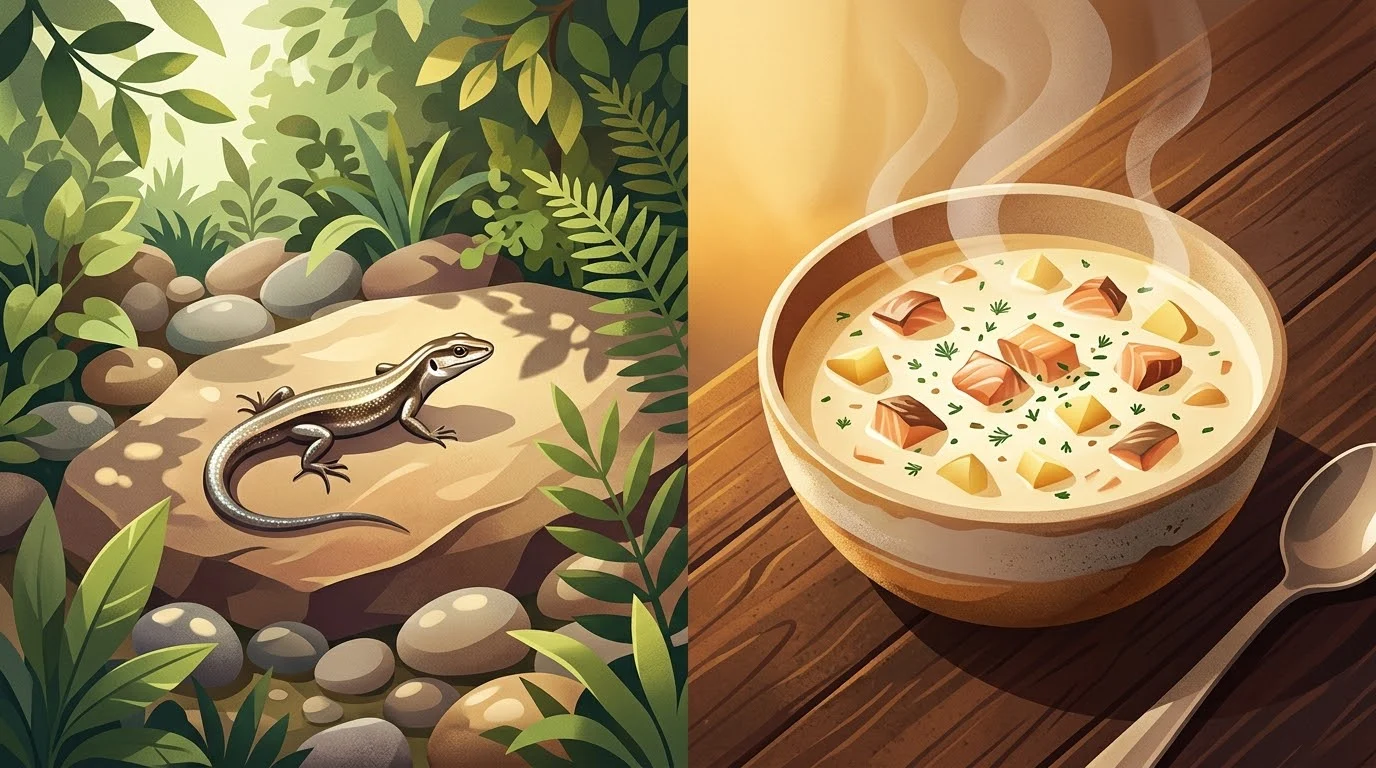
Quick Answer: The skink meaning depends entirely on context, yet unlike many slang terms, this small word carries remarkable versatility across biology, Scottish cuisine, and even historical slang. It can point to a shiny lizard, a bowl of smoked fish soup, a verb for pouring drinks, or a derogatory label. This guide breaks down every major meaning so you can decode the word no matter where you encounter it.
Understanding words with multiple identities has become a daily necessity for anyone navigating language across cultures. New slang appears every week; consequently, older words accumulate layers of significance as they spread across regions and communities. Skink is a perfect example of this evolution. It started as a Greek term for a lizard, expanded into Scottish kitchens and taverns, and now functions as everything from a biological classification to a slang insult. Some usages are scientific. Some are culinary. One is purely dialectal. Knowing which one applies can save you from an awkward misunderstanding.
The Core Skink Meanings
In everyday conversation, skink most often carries one of two meanings. The first is biological and precise. The second is Scottish and culinary.
The most widespread definition is any of a family (Scincidae) of typically small insectivorous lizards with long tapering bodies . This phrase captures a state of reptilian distinctiveness. You are not merely talking about a lizard. You are completely identifying a specific family known for smooth, shiny scales and reduced limbs . People use it in biology, herpetology, and nature discussions. The word says more than “lizard” ever could.
A regional alternative in Scottish cuisine is Cullen Skink, a thick soup made with smoked haddock, potatoes, and onions . This version expresses a hearty comfort food, often with a warm tone. If someone mentions skink on a menu in Scotland, they are not talking about reptiles. The humor comes from how unexpected the shift is. One word replaces an entire dish description.
Both usages share a common thread. They describe something distinctive. One is distinctive in the natural world. The other is distinctive in the kitchen.
Skink in Biology and Nature
Skink takes on a precise life in scientific contexts. There, it refers to one of the most diverse families of lizards on Earth.
With more than 1,500 described species, the family Scincidae ranks among the most varied groups of reptiles . Skinks appear on every continent except Antarctica, occupying habitats from deserts to rainforests . Many species have evolved reduced limbs or even lost them entirely, a phenomenon that has occurred independently dozens of times . Some skinks are “sand swimmers,” burrowing through desert dunes with serpentine grace.
Their scales are smooth and glossy, giving them a polished appearance. Beneath those scales, bony plates called osteoderms provide armor-like protection . Most skinks are diurnal, basking on rocks and logs during the day. They feed primarily on insects, though some larger species incorporate plants into their diet .
The name itself traces back to the Greek word skinkos, which referred to a specific kind of lizard . Latin adopted it as scincus, and English inherited it through Old French. The word has remained remarkably stable in its biological meaning for centuries.
Skink in Scottish Culture and Cuisine
Skink takes on a warm life in Scottish tradition. There, it connects to both food and drink.
Cullen Skink is the most famous culinary usage. This thick soup originated in the fishing town of Cullen on Scotland’s northeast coast. Smoked haddock, known locally as finnan haddie, forms the base. Potatoes and onions add body. Cream or milk finishes the dish. The result is a hearty, smoky soup that warms against cold coastal winds .
Beyond the soup, skink carries older meanings in Scottish dialect. As a verb, it meant to draw, pour out, or serve drink . A skink was a person who served liquor, essentially a bartender or tapster . Chaucer used the word in this sense in “The Merchant’s Tale,” writing of Bacchus who “skynketh” wine for all around . This usage has largely faded, surviving only in historical texts and dialect dictionaries.
Another Scottish meaning refers to thin gruel or a weak drink . This usage reflects the word’s association with liquids, whether served in a tavern or a humble kitchen.
Skink as Slang and Derogatory Label
Skink takes on a darker life in certain slang contexts. There, it functions as an insult with specific racial or social weight.
In UK Black slang, skink serves as a term of abuse for a white person . This usage appears in lists of derogatory terms, alongside words like “orangutan” and “gutter dingo.” The label carries hostility and reflects tensions in specific communities.
In other contexts, skink has been used as a general insult for someone considered contemptible or insignificant. The word’s association with a small, secretive lizard may fuel this usage. A skink is low on the food chain, cryptic, and easily overlooked. Calling someone a skink implies they are similarly unimportant or slippery.
These slang usages carry real weight. Using skink as an insult in the wrong context can cause genuine offense. The word belongs to specific communities and historical moments, not to casual conversation.
How to Tell Which Skink Meaning Is Being Used
Context is everything with this word. The setting and tone reveal the intended meaning before the letters do.
If the discussion involves reptiles, scales, or habitats, the biological meaning is likely. Phrases like “five-lined skink” or “blue-tongued skink” point to the lizard definition . These conversations often appear in nature forums, biology textbooks, or wildlife documentaries. The tone is usually factual or appreciative.
When skink appears on a Scottish menu or in a recipe, the culinary meaning usually applies. References to “Cullen Skink” or “smoked haddock soup” clearly point to the dish . The tone is warm or practical.
A historical text that mentions “skinking” or a “skink” in a tavern likely uses the pouring-drinks meaning. The placement within older literature or dialect discussions is the giveaway .
If the message sounds hostile and appears in specific slang contexts, the derogatory meaning becomes possible. The placement within insult lists or community-specific discussions is the signal .
When Not to Use Skink Casually
Skink does not belong in every conversation. Its slang meaning carries racial hostility and expresses genuine contempt. Using it casually, even in jest, can come across as offensive or ignorant of its weight.
There is also a scientific precision to consider. Skink refers to a specific family of lizards with distinct characteristics. Using it loosely for any small lizard can seem dismissive of real biological classification.
Other contexts use the word differently. In Scottish cuisine, Cullen Skink is a point of regional pride. In historical linguistics, skink as a verb for pouring is a curiosity. Each field has its own conventions, and the casual versions rarely cross into these spaces.
The safest approach is to match the register of the conversation. Scientific words belong in scientific discussions. Regional foods belong in culinary contexts. When in doubt, clarity beats casualness.
Skink vs Similar Words
Several other words overlap with skink in meaning. Understanding the differences helps avoid confusion.
Gecko is another small lizard, but it belongs to a different family. Geckos have distinct toe pads and often lack eyelids. Skinks have smooth scales and reduced limbs. The two are often confused by casual observers.
Salamander is an amphibian, not a reptile. It has moist skin and typically lives near water. Skinks are dry-scaled and fully terrestrial or burrowing. The distinction matters in biology.
Chowder is a thick soup, similar to Cullen Skink. Chowder typically contains clams or corn and has a cream base. Cullen Skink uses smoked haddock. The two dishes share texture but differ in ingredients.
Skunk looks similar in spelling but has no relation. A skunk is a mammal known for its spray. Skink is a lizard. The confusion arises only in writing.
Why Skink Endures as a Word
The word skink endures because it attaches to things that matter. The lizard family continues to fascinate biologists with its diversity and evolutionary adaptations. Cullen Skink remains a beloved Scottish dish, served in pubs and homes. The historical verb survives in dialect dictionaries and literary footnotes.
Each meaning has its own trajectory. The biological term has grown as scientists describe new species. The culinary term has spread as Scottish cuisine gains international attention. The slang usage persists in specific communities, carrying weight and history.
Regional and Platform Variations
Skink does not mean the same thing everywhere. Region and context shape how the word is understood.
In Australia and Southeast Asia, the biological meaning dominates. These regions host remarkable skink diversity, including the blue-tongued skink and the prehensile-tailed skink .
In Scotland, Cullen Skink appears on menus and in homes. The word carries warmth and regional identity.
In UK Black communities, the slang meaning carries hostility. Outsiders should approach with caution and respect .
In historical and literary circles, the pouring-drinks meaning appears in older texts. Chaucer and other writers used skink in this sense .
FAQs
What does skink mean?
Skink most commonly refers to a family of smooth-scaled lizards or a Scottish smoked fish soup called Cullen Skink.
Is skink a bad word?
Skink is not inherently profane, but its UK Black slang usage as a racial insult carries real offense.
What does skink mean on Instagram?
On Instagram, skink usually refers to the lizard, often in nature photography or pet content.
What does skink mean in texting?
In texting, skink usually means the lizard or a reference to Cullen Skink soup.
Can skink mean something Scottish?
Yes, skink appears in Cullen Skink and in older Scottish dialect for pouring drinks.
What is the difference between skink and gecko?
Skinks have smooth scales and reduced limbs, while geckos have toe pads and often lack eyelids.
Does skink have a slang meaning?
Yes, in UK Black slang, skink is a derogatory term for a white person.
Is skink safe to use in professional settings?
The biological and culinary meanings are safe, but the slang usage is not.
Why do people say skink on TikTok?
On TikTok, skink appears in reptile content, cooking videos, and occasionally as slang.
How do I know which skink meaning is being used?
Look at the platform, the tone, and the surrounding words to determine the intended meaning.
Conclusion
The skink meaning shifts with every context. In a biology textbook, it means a smooth-scaled lizard. On a Scottish menu, it means smoked fish soup. In a historical novel, it means pouring drinks. In certain slang contexts, it carries hostility. The only way to know which meaning applies is to read the setting, the tone, and the relationship between the people involved. When in doubt, a simple question clears up any confusion faster than guessing.
Language evolves quickly, and skink may take on new shades of meaning in the coming years. For now, these definitions cover almost every situation you will encounter. Learn them once, and you will never be lost when this small word appears in your feed.