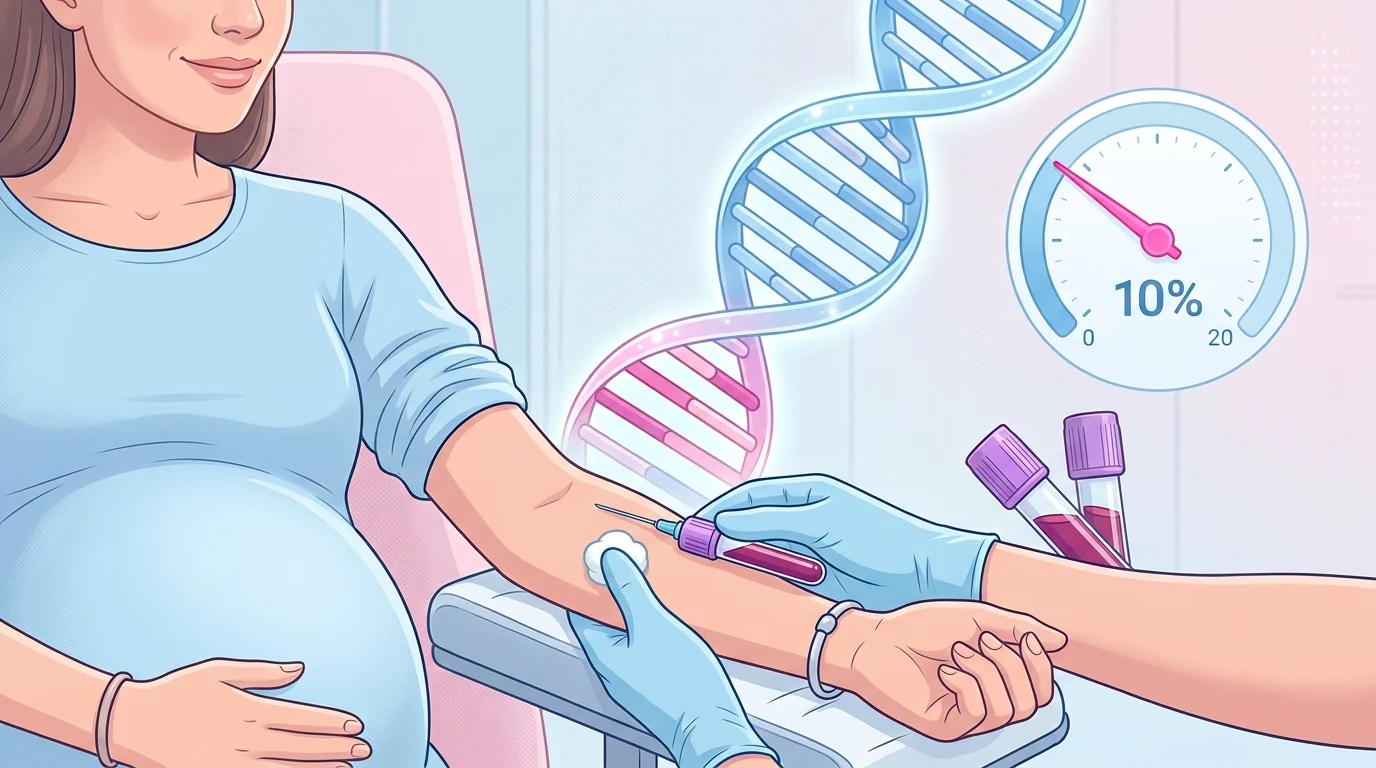
Quick Ans: The fetal fraction meaning is a key concept in modern prenatal care. In noninvasive prenatal testing (NIPT), fetal fraction refers to the percentage of cell-free DNA in a pregnant woman’s blood that comes from the placenta . This measurement determines whether a test can produce reliable results. Understanding what fetal fraction means helps expectant parents interpret their screening outcomes and prepare for possible follow-up steps.
Fetal fraction is not just a technical number. It reflects the biology of pregnancy and influences the accuracy of screening for conditions like Down syndrome. Knowing the factors that affect this measurement can reduce anxiety when results come back unclear.
What Does Fetal Fraction Mean?
Fetal fraction is the proportion of total cell-free DNA (cfDNA) in maternal plasma that originates from the placenta . The formula is simple: fetal fraction equals fetal cfDNA divided by the sum of fetal and maternal cfDNA . Although the term says “fetal,” the DNA actually comes from placental cells, not the fetus itself .
This measurement is expressed as a percentage. Between 10 and 20 weeks of gestation, the average fetal fraction is approximately 10% to 15% . However, individual values can range widely, from under 3% to over 30% .
Fetal fraction matters because NIPT analyzes placental DNA to assess the risk of chromosomal conditions. If the fetal fraction is too low, the laboratory may not have enough genetic material to produce an accurate result .
Why Is Fetal Fraction Important for NIPT?
Fetal fraction serves as a quality control metric for noninvasive prenatal testing . Laboratories measure it to confirm that placental DNA is present in sufficient quantity to generate a meaningful result .
The minimum threshold for adequate testing varies by laboratory. Most require a fetal fraction between 2% and 4% . With a higher fetal fraction, there is greater statistical separation between normal and abnormal pregnancies, which increases confidence in the final result .
When fetal fraction falls below the laboratory’s cutoff, the test may return a “no call” result . This means the laboratory cannot provide a reliable answer. Approximately 1% to 8% of NIPT samples result in a no call, with low fetal fraction being the most common cause .
What Causes Low Fetal Fraction?
Several biological factors can reduce fetal fraction. The most well recognized influence is maternal weight . Women with higher body mass index tend to have lower fetal fractions. The proportion of women with fetal fraction below 4% increases with maternal weight, estimated at 7%, 11%, and 50% of women weighing 100 kg, 110 kg, and 160 kg respectively .
Gestational age also plays a role. Fetal fraction increases as pregnancy progresses. Testing too early may result in insufficient placental DNA . Most guidelines recommend performing NIPT from 10 weeks of gestation onward .
Other factors include maternal medical conditions. A case report described a woman with severe autoimmune disease who experienced repeated NIPT failures due to persistently low fetal fraction . Her platelet count was very low, and her condition was considered a likely cause .
Recent research has identified additional influences. A 2025 study found that platelet distribution width (PDW) was negatively correlated with fetal fraction, second only to BMI in significance . Higher PDW values were associated with decreased fetal fraction .
What Does High Fetal Fraction Mean?
A high fetal fraction is generally not a cause for concern in terms of test accuracy. In fact, higher fetal fractions improve the statistical confidence of NIPT results .
However, researchers have investigated whether elevated fetal fraction might predict pregnancy complications. Some studies explored connections between high fetal fraction and conditions like spontaneous preterm birth or preeclampsia . Results have been inconsistent, with other studies showing no relationship between elevated placental DNA levels and pregnancy complications .
There is currently no validated clinical test that uses high fetal fraction to predict adverse outcomes . A fetal fraction above 40% has been defined as a no call result in some contexts, but there is no consensus on a maximum threshold .
How Is Fetal Fraction Measured?
Laboratories use several methods to measure fetal fraction. The Y chromosome method works only for male fetuses, as it counts DNA sequences unique to the Y chromosome . This method cannot be used for female pregnancies.
Single nucleotide polymorphism (SNP) based methods analyze allele distributions across hundreds or thousands of polymorphic sites . This approach works for both male and female fetuses.
Methylation based approaches use differences in DNA methylation patterns between maternal and placental DNA . A 2025 study demonstrated that droplet digital PCR with methylation sensitive digestion can accurately quantify fetal fraction .
Size fractionation takes advantage of the fact that fetal DNA fragments are generally shorter than maternal fragments . Enriching for shorter fragments can increase the effective fetal fraction.
The College of American Pathologists conducted a proficiency survey and found wide variability in fetal fraction measurement practices and cutoff values across laboratories . Half of participants reported cutoffs between 1% and 3.9%, while the next most common range was 4% to 6.9% .
When Fetal Fraction Is Too Low
A low fetal fraction result does not necessarily mean something is wrong with the pregnancy. It simply means the laboratory could not obtain enough placental DNA for analysis.
Approximately 50% to 60% of women with a failed NIPT due to low fetal fraction will have a successful result on a second blood draw . The redraw is typically performed one to two weeks later when fetal fraction may have increased.
However, a failed result due to low fetal fraction has been associated with a higher risk of aneuploidy across several sequencing platforms, ranging from 2.7% to 23.3% . This association generates clinical concern and warrants follow-up.
Clinical management for women with failed NIPT due to low fetal fraction should include detailed fetal ultrasound examination and an individualized discussion of options . These options include diagnostic testing, NIPT redraw, or alternative screening tests .
Can You Increase Fetal Fraction?
There is no guaranteed method to increase fetal fraction, but certain factors are within a patient’s control. Timing is the most effective strategy. Performing NIPT at or after 10 weeks of gestation allows fetal fraction to reach adequate levels .
For women with high BMI, some laboratories offer fetal enrichment techniques. A 2025 cohort study found that in vitro fetal enrichment virtually eliminated the need for redraws and improved performance . This technology enriches shorter fetal DNA fragments to increase the effective fetal fraction.
Maintaining stable pregnancy health may also help. A case report described a woman whose fetal fraction improved after steroid treatment for an autoimmune condition . However, this increase could not be confidently distinguished from normal gestational age related increases .
Patients should discuss any history of failed NIPT with their healthcare provider. Understanding individual risk factors helps set realistic expectations and plan appropriate follow-up.
Fetal Fraction and Aneuploidy Risk
Fetal fraction varies depending on the chromosomal condition present. Trisomy 21 (Down syndrome) is associated with higher fetal fraction, which is advantageous for NIPT performance . In contrast, trisomies 13 and 18 are associated with lower median fetal fractions and lower overall detection rates .
Digynic triploidy is associated with extremely low fetal fraction, with measurements below the 0.5th percentile after correction for maternal weight and gestation . This condition may be particularly difficult to detect through standard NIPT.
The relationship between fetal fraction and aneuploidy means that a low fetal fraction result should not be dismissed. It may indicate an underlying chromosomal abnormality that requires further investigation.
FAQs
What does fetal fraction mean?
Fetal fraction is the percentage of cell-free DNA in maternal blood that comes from the placenta. It is measured during NIPT to determine whether the test can produce reliable results .
What is a normal fetal fraction?
Between 10 and 20 weeks of gestation, the average fetal fraction is 10% to 15%. Values can range from under 3% to over 30% . Most laboratories require a minimum of 2% to 4% for a valid result .
What happens if fetal fraction is too low?
A low fetal fraction may result in a no call result, meaning the laboratory cannot provide a reliable answer . Approximately 50% to 60% of women will have success with a second blood draw .
What causes low fetal fraction?
The most common cause is maternal weight or high BMI . Gestational age, maternal medical conditions, and platelet distribution width also influence fetal fraction .
Is low fetal fraction dangerous?
Low fetal fraction itself is not dangerous. However, a failed NIPT due to low fetal fraction has been associated with a higher risk of aneuploidy . Follow-up testing is recommended.
Can I increase my fetal fraction?
Timing is the most effective strategy. Performing NIPT at or after 10 weeks of gestation allows fetal fraction to reach adequate levels . Fetal enrichment techniques are available at some laboratories .
Is fetal fraction different for twins?
Twin pregnancies have higher total fetal fraction, but the accuracy of NIPT is lower than in singleton pregnancies . The minimum fetal fraction threshold for twins is often 8% rather than 4% .
How is fetal fraction measured?
Methods include Y chromosome counting, SNP based analysis, methylation based approaches, and size fractionation . Different laboratories use different methods .
Does fetal fraction affect NIPT accuracy?
Yes. Higher fetal fractions provide greater statistical confidence in results . Low fetal fractions reduce detection rates and may result in no call results .
What should I do if my NIPT result says low fetal fraction?
Discuss the result with your healthcare provider. They may recommend a redraw, detailed ultrasound, or diagnostic testing . Most women who have a redraw receive a result on the second attempt .
Conclusion
The fetal fraction meaning is central to understanding NIPT results. It represents the proportion of placental DNA in maternal blood and determines whether screening can produce reliable answers. Most laboratories require a minimum of 2% to 4% for a valid test. Factors like maternal weight, gestational age, and platelet distribution width influence this measurement. When fetal fraction is too low, a redraw often succeeds. In some cases, low fetal fraction may signal an increased risk of chromosomal conditions, making follow-up care essential. Knowing what fetal fraction means empowers expectant parents to interpret their results and make informed decisions about their prenatal care.