Quick Ans: The doppelganger meaning depends entirely on context, yet unlike many slang terms, this German loanword carries centuries of folklore, psychological, and pop culture weight. It can point to a ghostly double, a lookalike stranger, a literary device, or an internet trend. This guide breaks down every major meaning so you can wield the word with precision.
Understanding borrowed vocabulary has become a daily necessity for anyone navigating modern communication. New slang appears every week; consequently, older words accumulate layers of significance as they travel across cultures. Doppelganger is a perfect example of this evolution. It started as a German term for a spirit double, entered English literature through Gothic horror, and now functions as casual shorthand for anyone who resembles you. Some meanings are supernatural. Some are psychological. One is purely visual. Knowing which one applies can save you from an awkward misunderstanding.
The Core Doppelganger Meanings
In everyday conversation, doppelganger most often carries one of two meanings. The first is folkloric and eerie. The second is modern and playful.
The most widespread traditional definition is a ghostly double or wraith of a living person. This phrase captures a state of supernatural duplication. You are not merely talking about a lookalike. You are pointing to a spectral twin whose appearance traditionally foreshadows misfortune or death. People use it in ghost stories, folklore discussions, and Gothic literature. The word says more than “twin” ever could.
A lighter modern definition is a person who looks exactly like another person. This version expresses visual similarity, often with a humorous or amazed tone. If someone meets a stranger who could pass for their sibling, they might call that person their doppelganger. The word captures a feeling that feels too strange to explain simply.
Both usages share a common thread. They describe a duplicate. One is a duplicate from the spirit world. The other is a duplicate from everyday life.
Doppelganger in Folklore and Literature
Doppelganger takes on a haunting life in folklore and literature. There, it refers to a double that appears as an omen of bad luck, illness, or death.
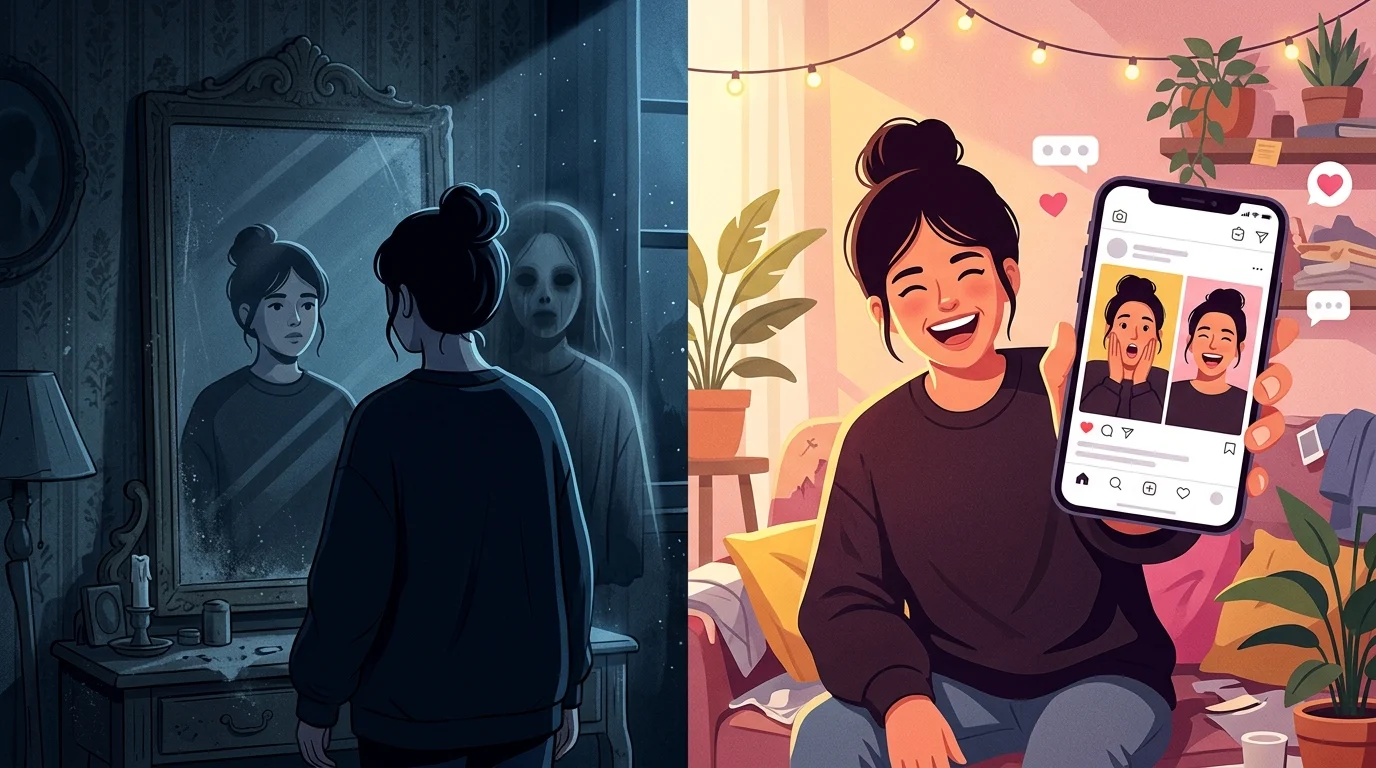
The word entered English from German, where it literally means “double goer” or “double walker.” In German folklore, seeing one’s own doppelganger was considered a sign that death was near. The double might appear as a shadow, a reflection, or a fully formed figure. It mimicked the person’s movements and often vanished without explanation.
Gothic literature embraced the concept. Edgar Allan Poe, Fyodor Dostoevsky, and Robert Louis Stevenson built stories around doubles and divided selves. Stevenson’s Strange Case of Dr Jekyll and Mr Hyde remains the most famous exploration of the theme. In these works, the doppelganger represents hidden desires, moral conflict, or the fragility of identity.
Psychoanalysis later adopted the term. Sigmund Freud and Otto Rank wrote about the double as a manifestation of repressed wishes or self centered anxiety. The doppelganger became not just a supernatural omen but a psychological symbol.
Doppelganger on Social Media and in Pop Culture
Doppelganger takes on a playful life on social media. There, it often accompanies side-by-side photos of strangers who look alike. A collage of two unrelated faces with the caption “my doppelganger” is the visual equivalent of the word.
The “doppelganger trend” has become a cultural phenomenon in its own right. People use apps to find their celebrity lookalikes, post photos with strangers who resemble them, and joke about meeting their double. The posts are amazed, amused, and often hilarious. Finding a doppelganger is a shared experience. Seeing someone else’s doppelganger validates your own.
In comment sections and forums, doppelganger often means “you look exactly like someone.” People use it as a self-aware wink. It signals that the resemblance is so striking that nothing more is needed. The irony of using a German folklore term to describe a casual resemblance is part of the charm.
Another variation exists in celebrity culture. Fans often call certain actors the doppelgangers of older stars. This usage appears in casting discussions, red carpet comparisons, and tribute posts.
How to Tell Which Doppelganger Meaning Is Being Used
Context is everything with this word. The setting and tone reveal the intended meaning before the word does.
If the message involves ghosts, omens, or literature, the folkloric meaning is likely. Phrases like “she saw her doppelganger” or “a doppelganger appeared” point to the supernatural definition. These references often appear in horror discussions, Gothic analysis, or ghost stories. The tone is usually eerie or analytical.
When doppelganger appears in a photo comparison or a meme, the lookalike meaning usually applies. Captions like “my doppelganger” or “found my doppelganger” clearly refer to the visual definition. The presence of an image or a reference to resemblance distinguishes this usage.
A psychological discussion that mentions doppelganger likely uses the symbolic meaning. References to “the double” or “divided self” point in this direction.
If the message sounds playful and appears after a celebrity comparison, the pop culture meaning becomes possible. This usage often follows a movie casting or a red carpet photo.
When Not to Use Doppelganger Casually
Doppelganger does not belong in every conversation. Its folkloric meaning carries supernatural weight and expresses a dark omen. Using it casually in serious discussions of death or illness can come across as dismissive or insensitive.
There is also a psychological sensitivity to consider. In clinical contexts, the double can relate to genuine disorders of identity. Treating doppelganger as pure slang in mental health discussions can seem dismissive of a real struggle.
Other professional contexts use the term differently. In genetics, “doppelganger” can describe a gene or protein variant. In computing, it can refer to a duplicate file or process. Each field has its own vocabulary, and the casual version rarely crosses into these spaces.
The safest approach is to match the register of the conversation. Supernatural words belong in supernatural discussions. When in doubt, clarity beats casualness.
Doppelganger vs Similar Words
Several other words overlap with doppelganger in meaning. Understanding the differences helps avoid confusion.
Lookalike means “a person who resembles another.” It is neutral and visual. Doppelganger carries supernatural or eerie weight. Lookalike is what you see at a party. Doppelganger is what you see in a mirror at midnight.
Twin means “one of two offspring born at the same birth.” It is biological and familial. Doppelganger is unrelated and uncanny. Twin is what you grow up with. Doppelganger is what you meet by chance.
Clone means “a genetically identical copy.” It is scientific and precise. Doppelganger is folkloric and mysterious. Clone is what you make in a lab. Doppelganger is what you see in a dream.
Alter ego means “a second self or different version of oneself.” It is psychological and internal. Doppelganger is external and visual. Alter ego is who you become. Doppelganger is who you meet.
Why Doppelganger Endures as a Word
The word doppelganger endures because it names something universally unsettling. Everyone has experienced the strange feeling of seeing a familiar face in a stranger. Everyone has wondered what it would be like to meet themselves. The word captures that unease in four syllables.
Its survival also reflects a lasting cultural fascination with doubles. Literature, film, and television return to the theme again and again. From Fight Club to The Double to Us, the doppelganger remains a powerful storytelling device.
On social media, the word found new life. The digital age makes it easier than ever to find lookalikes across the world. The ancient omen became a modern game.
Regional and Platform Variations
Doppelganger does not mean the same thing everywhere. Platform culture shapes how the word is used.
On Instagram, the lookalike meaning dominates. Users post side-by-side photos with strangers and celebrities who resemble them.
On TikTok, the trend meaning appears. Creators film reactions to finding their doppelgangers and share apps that match faces.
On Reddit, the folkloric meaning appears in horror forums and literature discussions. Users debate the origins of the double in German folklore.
In academic settings, the psychological meaning dominates. Students of literature and psychoanalysis study the doppelganger as a symbol of divided identity.
FAQs
What does doppelganger mean?
Doppelganger means a ghostly double or a person who looks exactly like another person.
Is doppelganger a bad word?
No, doppelganger is not profane, though its folkloric meaning carries eerie connotations.
What does doppelganger mean on Instagram?
On Instagram, doppelganger refers to a lookalike stranger or celebrity comparison.
What does doppelganger mean in texting?
In texting, doppelganger usually means a person who looks exactly like someone else.
Can doppelganger mean something romantic?
No, doppelganger is about resemblance, not romance.
What is the difference between doppelganger and twin?
Twin is biological and familial, while doppelganger is unrelated and uncanny.
Does doppelganger have a medical meaning?
No, doppelganger is not a medical term, though it appears in psychoanalytic discussions.
Is doppelganger safe to use in professional settings?
It depends, but doppelganger is appropriate in literary or cultural discussions.
Why do people say doppelganger on TikTok?
On TikTok, doppelganger appears in videos about finding lookalikes and celebrity comparisons.
How do I know which doppelganger meaning is being used?
Look at the platform, the tone, and the surrounding words to determine the intended meaning.
Conclusion
The doppelganger meaning shifts with every context. In a ghost story, it means a spectral omen. If it is a photo comparison, it means a lookalike stranger. In case of a literature class, it means a divided self. In a TikTok trend, it means a face match. The only way to know which meaning applies is to read the setting, the tone, and the relationship between the people involved. When in doubt, a simple question clears up any confusion faster than guessing.
Language evolves quickly, and doppelganger may take on new shades of meaning in the coming years. For now, these definitions cover almost every situation you will encounter. Learn them once, and you will never be lost when this word appears in your feed.