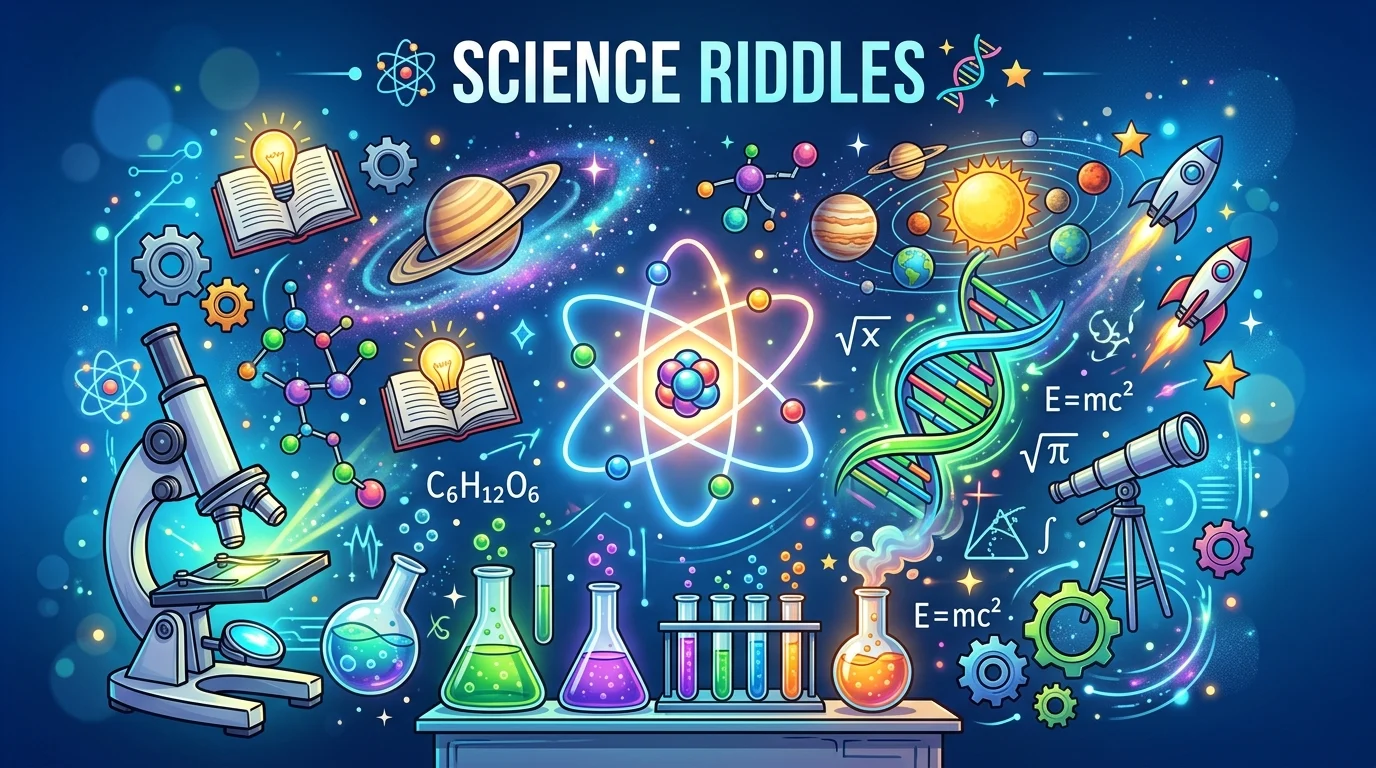
Welcome to the ultimate collection of science riddles! These clever brain-teasers are inspired by the fascinating world of science—from biology and chemistry to physics, astronomy, and earth science. Perfect for students, teachers, science enthusiasts, and anyone who loves to explore the wonders of the universe 🔬💫
People love sharing science riddles on TikTok, Instagram, Facebook, and Pinterest because they combine education with fun and clever wordplay 📱✨
These riddles feature atoms, molecules, cells, planets, chemical reactions, gravity, genetics, fossils, and all the amazing discoveries that science has revealed 🎯
Moreover, clever riddles make classroom activities, science fairs, trivia nights, and family gatherings more entertaining 🎉
Science riddles encourage critical thinking while celebrating the beauty and mystery of the natural world 🌟
At the same time, they create laughter, friendly competition, and memorable moments for every science lover 😊
Biology Riddles 🧬🔬
What is the basic unit of life that contains DNA and organelles?
Answer: A cell 🧬
Guess what is the powerhouse of the cell that produces energy.
Answer: The mitochondria ⚡
Which molecule stores genetic information in all living organisms?
Answer: DNA (deoxyribonucleic acid) 🧬
Find the process where plants convert sunlight into food.
Answer: Photosynthesis ☀️
Guess what is the largest organ in the human body.
Answer: The skin 🫂
Which organ pumps blood throughout the human body?
Answer: The heart ❤️
Find the system responsible for breathing and exchanging gases.
Answer: The respiratory system 💨
Guess what bones are the hardest substance in the human body.
Answer: Tooth enamel 🦷
Which scientist is known for the theory of evolution by natural selection.
Answer: Charles Darwin 🧬
Find the molecule that provides energy for cellular processes.
Answer: ATP (adenosine triphosphate) ⚡
Chemistry Riddles ⚗️🧪
What is the smallest particle of an element that retains its properties?
Answer: An atom ⚛️
Guess what substance is made of two or more elements chemically bonded.
Answer: A compound 🧪
Which is the most abundant element in the universe?
Answer: Hydrogen 💨
Find the element that is essential for human life and makes up about 65% of the body.
Answer: Oxygen 🌬️
Guess what pH level is considered neutral.
Answer: pH 7 (pure water) 💧
Which element is found in all organic molecules?
Answer: Carbon 🌿
Find the process where a solid changes directly into a gas.
Answer: Sublimation 💨
Guess what reaction releases heat and light energy.
Answer: An exothermic reaction 🔥
Which gas is used in balloons to make them float.
Answer: Helium 🎈
Find the element with the chemical symbol “Na.”
Answer: Sodium 🧂
Physics Riddles ⚡🚀
What force pulls objects toward the center of the Earth?
Answer: Gravity 🌍
Guess what is the speed of light in a vacuum.
Answer: Approximately 299,792,458 meters per second 💡
Which law states that for every action, there is an equal and opposite reaction?
Answer: Newton’s Third Law of Motion 📐
Find the particle that carries electromagnetic force.
Answer: A photon 📡
Guess what fundamental particle is found in the nucleus of an atom.
Answer: A proton or neutron 🔬
Which force causes objects to weigh less in water.
Answer: Buoyancy 🌊
Find the unit of measurement for force.
Answer: The Newton (N) 📏
Guess what is the speed of sound in air at room temperature.
Answer: Approximately 343 meters per second 🔊
Which principle states that energy cannot be created or destroyed.
Answer: The Law of Conservation of Energy ⚡
Find the phenomenon where light bends as it passes from one medium to another.
Answer: Refraction 🌈
Astronomy Riddles 🌟🌌
What is the largest planet in our solar system.
Answer: Jupiter 🪐
Guess what is the closest star to Earth.
Answer: The Sun ☀️
Which planet is known as the “Red Planet.”
Answer: Mars 🔴
Find the galaxy that contains our solar system.
Answer: The Milky Way Galaxy 🌌
Guess what celestial body orbits the Earth.
Answer: The Moon 🌙
Which planet has the most moons in our solar system.
Answer: Saturn (has the most confirmed) 🪐
Find the process where a star collapses under its own gravity.
Answer: A supernova or black hole formation 💫
Guess what is the coldest planet in our solar system.
Answer: Uranus (or Neptune) ❄️
Which astronaut was the first person to walk on the Moon?
Answer: Neil Armstrong 🌕
Find the belt of asteroids between Mars and Jupiter.
Answer: The Asteroid Belt ☄️
Earth Science Riddles 🌍🌋
What is the outermost layer of the Earth called?
Answer: The crust 🌍
Guess what plate movement causes earthquakes and volcanic eruptions.
Answer: Tectonic plate movement 🌋
Which type of rock is formed from cooled magma or lava.
Answer: Igneous rock 🪨
Find the process where rocks break down into smaller pieces.
Answer: Weathering 🌧️
Guess what water is found beneath the Earth’s surface.
Answer: Groundwater 💧
Which layer of the Earth is liquid and produces the magnetic field.
Answer: The outer core 🌍
Find the gas that is most abundant in the Earth’s atmosphere.
Answer: Nitrogen (about 78%) 💨
Guess what natural disaster is caused by underwater earthquakes.
Answer: A tsunami 🌊
Which type of rock is formed from compressed layers of sediment.
Answer: Sedimentary rock 🪨
Find the process where plants release water vapor into the atmosphere.
Answer: Transpiration 🌿
Human Body Riddles 🧠🦴
What is the largest bone in the human body?
Answer: The femur (thigh bone) 🦴
Guess what organ filters blood and removes waste products.
Answer: The kidneys 🫘
Which part of the brain controls balance and coordination.
Answer: The cerebellum 🧠
Find the muscle that pumps blood throughout your body.
Answer: The heart ❤️
Guess what is the fastest muscle in the human body.
Answer: The eyelid muscle (blinking) 👁️
Which cells carry oxygen to tissues and organs.
Answer: Red blood cells 🩸
Find the longest bone in the human body.
Answer: The femur 🦴
Guess what is the strongest muscle based on its size.
Answer: The masseter (jaw muscle) 💪
Which organ produces bile and breaks down toxins.
Answer: The liver 🫘
Find the sense that is the most sensitive in the human body.
Answer: Touch (skin) ✋
Genetics & Evolution Riddles 🧬🔄
What is the molecule that carries genetic information.
Answer: DNA 🧬
Guess what scientist discovered the structure of DNA.
Answer: Watson and Crick (with Rosalind Franklin’s data) 🧬
Which trait is passed from parents to offspring through genes.
Answer: Hereditary traits or genetics 🧬
Find the process where species change over time.
Answer: Evolution 🔄
Guess what is the basic unit of heredity.
Answer: A gene 🧬
Which scientist proposed the theory of natural selection.
Answer: Charles Darwin 🧬
Find the study of inherited traits and variation.
Answer: Genetics 🧬
Guess what is the name for different versions of a gene.
Answer: Alleles 🧬
Which cells are reproductive cells that carry genes.
Answer: Gametes (sperm and eggs) 🧬
Find the process where organisms adapt to their environment.
Answer: Adaptation 🏜️
Microbiology Riddles 🦠🧫
What is the smallest living organism that can cause disease.
Answer: Bacteria or viruses 🦠
Guess what organism is larger than bacteria and can be seen under a microscope.
Answer: Protozoa or fungi 🔬
Which scientist developed the first vaccine.
Answer: Edward Jenner (smallpox vaccine) 💉
Find the structure that protects bacteria from antibiotics.
Answer: The cell wall 🧱
Guess what virus caused the COVID-19 pandemic.
Answer: SARS-CoV-2 🦠
Which bacteria are known as “friendly” and help digestion.
Answer: Probiotics or gut bacteria 🦠
Find the process where bacteria reproduce.
Answer: Binary fission 🔬
Guess what microorganism is used to make bread and beer.
Answer: Yeast (a fungus) 🍞
Which infectious agent is not truly alive and needs a host to replicate.
Answer: A virus 🦠
Find the study of microorganisms.
Answer: Microbiology 🔬
Plants & Botany Riddles 🌱🌳
What is the process where plants make their own food.
Answer: Photosynthesis ☀️
Guess what part of the plant absorbs water and minerals from the soil.
Answer: The roots 🌱
Which pigment gives plants their green color.
Answer: Chlorophyll 🍃
Find the gas that plants release during photosynthesis.
Answer: Oxygen 🌬️
Guess what is the largest plant on Earth.
Answer: The giant sequoia tree (by volume) 🌳
Which part of the plant is responsible for reproduction.
Answer: The flower 🌸
Find the plant that moves to follow the sun.
Answer: Sunflower 🌻
Guess what is the smallest flowering plant in the world.
Answer: Duckweed 🌿
Which plant uses insects as a food source.
Answer: Venus flytrap or pitcher plant 🪴
Find the process where plants absorb water through their roots.
Answer: Osmosis 💧
Chemistry Reactions Riddles 🔥🧪
What reaction releases heat and light energy.
Answer: Exothermic reaction 🔥
Guess what reaction absorbs heat from the surroundings.
Answer: Endothermic reaction ❄️
Which catalyst helps break down hydrogen peroxide into water and oxygen.
Answer: Catalase enzyme 🧪
Find the reaction between an acid and a base.
Answer: Neutralization reaction ⚗️
Guess what salt is formed when hydrochloric acid reacts with sodium hydroxide.
Answer: Sodium chloride (table salt) 🧂
Which reaction involves the transfer of electrons between atoms.
Answer: Redox reaction 🔬
Find the reaction that produces carbon dioxide and water when a hydrocarbon burns.
Answer: Combustion reaction 🔥
Guess what element is produced when hydrogen combines with oxygen.
Answer: Water 💧
Which process turns iron into rust when exposed to oxygen and water.
Answer: Oxidation (rusting) 🔧
Find the reaction where a single compound breaks into two or more products.
Answer: Decomposition reaction ⚗️
Famous Scientists Riddles 👨🔬👩🔬
Which scientist developed the theory of gravity after watching an apple fall.
Answer: Isaac Newton 🍎
Guess who discovered the planet Uranus.
Answer: William Herschel 🌌
Which scientist is known for the periodic table of elements.
Answer: Dmitri Mendeleev 📋
Find the scientist who developed the first successful polio vaccine.
Answer: Jonas Salk 💉
Guess who discovered penicillin and revolutionized medicine.
Answer: Alexander Fleming 🧫
Which scientist is known for the laws of motion and universal gravitation.
Answer: Isaac Newton 📐
Find the physicist who developed the theory of relativity.
Answer: Albert Einstein 🧠
Guess who discovered radium and polonium.
Answer: Marie Curie ☢️
Which scientist is known for the laws of genetics.
Answer: Gregor Mendel 🧬
Find the scientist who proposed the Big Bang Theory.
Answer: Georges Lemaître or Edwin Hubble (depending on interpretation) 🌌
Environmental Science Riddles 🌿🌎
What is the layer of the atmosphere that protects us from UV radiation.
Answer: The ozone layer ☀️
Guess what greenhouse gas is the most abundant in the atmosphere.
Answer: Carbon dioxide (CO2) 💨
Which renewable energy source uses the sun’s rays.
Answer: Solar power ☀️
Find the process where plants remove carbon dioxide from the atmosphere.
Answer: Carbon sequestration 🌿
Guess what is the greatest threat to biodiversity.
Answer: Habitat destruction and climate change 🏞️
Which ecosystem is the most diverse on Earth.
Answer: The rainforest 🌴
Find the climate pattern known for warming ocean waters in the Pacific.
Answer: El Niño 🌊
Guess what is the single-use plastic that pollutes our oceans the most.
Answer: Plastic bottles and bags ♻️
Which gas is released when fossil fuels are burned.
Answer: Carbon dioxide and other greenhouse gases 💨
Find the process where ecosystems repair themselves.
Answer: Ecological succession 🌱
Physics Phenomena Riddles 🌈⚡
What is the visible spectrum of colors produced when light passes through a prism.
Answer: A rainbow 🌈
Guess what phenomenon occurs when two waves combine to form a larger wave.
Answer: Constructive interference 🌊
Which force opposes the motion of objects through air.
Answer: Air resistance or drag 💨
Find the electromagnetic spectrum with the longest wavelength.
Answer: Radio waves 📻
Guess what phenomenon causes the sky to appear blue.
Answer: Rayleigh scattering 🌤️
Which wave type requires a medium to travel through.
Answer: Mechanical waves (sound waves) 🔊
Find the principle that explains how airplanes generate lift.
Answer: Bernoulli’s principle ✈️
Guess what type of energy is stored in a stretched rubber band.
Answer: Elastic potential energy 🔧
Which law states that the current through a conductor is directly proportional to voltage.
Answer: Ohm’s Law ⚡
Find the phenomenon where light behaves as both a particle and a wave.
Answer: Wave-particle duality 💡
Frequently Asked Questions About Science Riddles ❓
What are science riddles? 🔬
Science riddles are fun, clever brain-teasers inspired by the world of science—from biology and chemistry to physics, astronomy, and earth science. They combine scientific knowledge with creative wordplay and humor. 😊
Who can enjoy science riddles? 🧪
Everyone can enjoy science riddles! They’re perfect for students, teachers, science enthusiasts, parents, and anyone who loves learning about the natural world. They’re great for all ages and knowledge levels. 🎉
Are science riddles suitable for kids? 👦
Yes! Many science riddles are educational and family-friendly. They help children learn scientific concepts in a fun, engaging way. Some advanced riddles are better for older students and adults. 📚
Where can I use science riddles? 📱
You can use these riddles at classroom activities, science fairs, trivia nights, social media posts, family gatherings, and as icebreakers in educational settings. They’re perfect for engaging students and sparking curiosity. 🎯
What topics do science riddles cover? 📖
Science riddles cover biology, chemistry, physics, astronomy, earth science, human body, genetics, microbiology, plants, famous scientists, environmental science, and scientific phenomena. 🌟
How can I solve science riddles? 🧠
Think about scientific concepts, terminology, and common facts from biology, chemistry, physics, and other sciences. Each riddle gives clues about specific scientific topics. The answers are always related to science. 😊
Can I share these riddles with friends? 🤝
Absolutely! These riddles are perfect for sharing with fellow science lovers, testing your friends’ scientific knowledge, or hosting your own science trivia night. They’re also great for social media engagement and classroom activities. 💬
Conclusion 🌟
Science riddles bring learning, laughter, and curiosity to every science enthusiast. Moreover, they help people explore the wonders of the natural world while enjoying clever wordplay and mental challenges. 🔬
Whether you’re a student, teacher, scientist, or just someone who loves the beauty of science, these science riddles are perfect for sharing with classmates, colleagues, friends, and family. Finally, save this collection for your next classroom activity, science fair, trivia night, or family game night! 🌌🏆