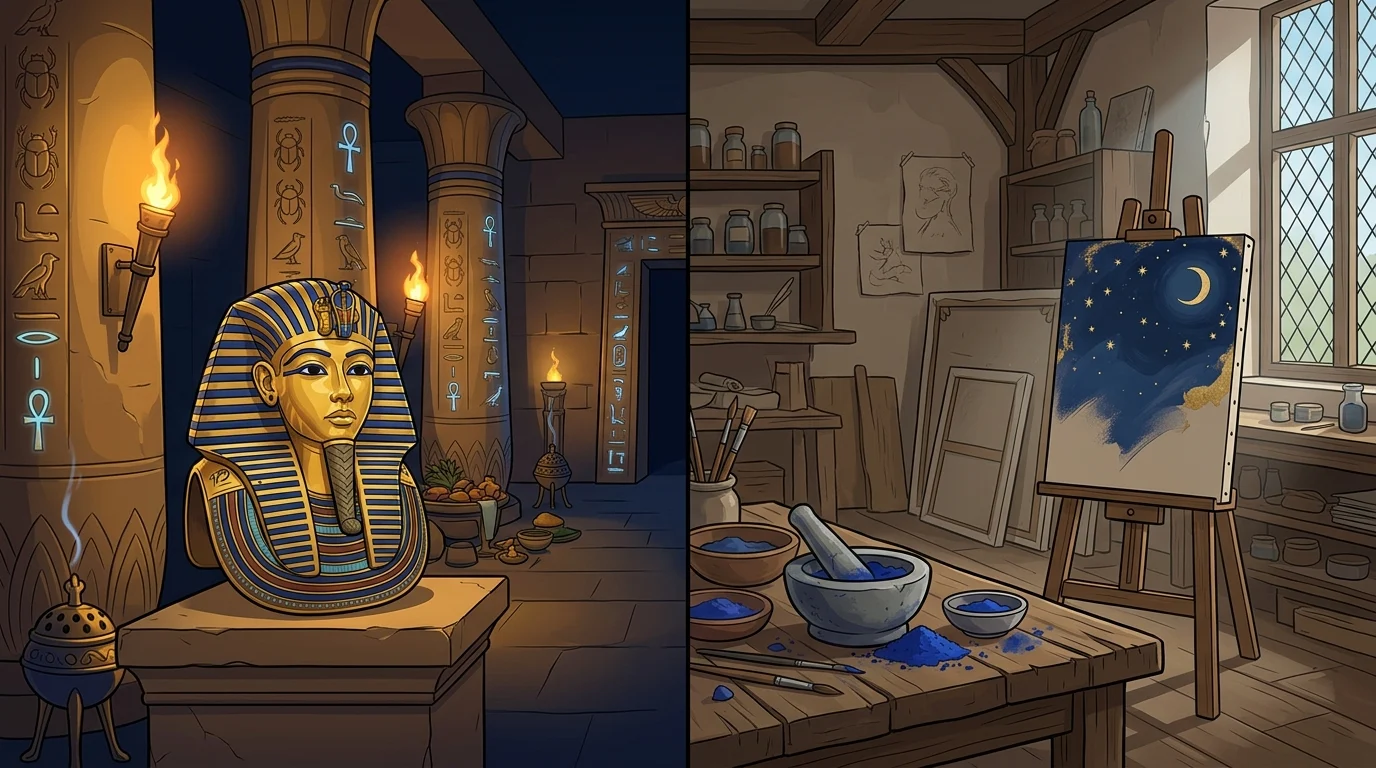
Quick Ans: The lapis lazuli meaning depends entirely on context, yet unlike many gemstones, this deep blue rock carries millennia of spiritual, royal, and artistic weight. It can point to the heavens, a divine throne, a pharaoh’s protection, or a modern healing tool. This guide breaks down every major meaning so you can decode the stone no matter where you encounter it.
Understanding symbolic vocabulary has become a daily necessity for anyone engaging with history, spirituality, or art. New gemstone trends appear every week; consequently, older stones accumulate layers of significance across civilizations. Lapis lazuli is a perfect example of this evolution. It originated in the mountains of Afghanistan, traveled to Egypt and Mesopotamia, and now appears in jewelry, crystal shops, and biblical scholarship. Some meanings are celestial. Some are royal. One is purely artistic. Knowing which one applies can save you from an awkward misunderstanding.
The Core Lapis Lazuli Meanings
In cultural and historical conversations, lapis lazuli most often carries one of two meanings. The first is celestial and divine. The second is royal and protective.
The most widespread interpretation is the stone of heaven and the divine. This phrase captures the stone’s connection to the sky, the gods, and the afterlife. The deep blue color, flecked with golden pyrite that resembles stars, evoked the cosmos itself . People in ancient Mesopotamia and Egypt believed the stone carried the presence of deities . The stone says more than “blue gem” ever could.
A secondary interpretation is royalty, power, and protection. This version focuses on the stone’s use by kings, pharaohs, and high priests. Tutankhamun’s funeral mask contained lapis lazuli . The High Priest’s breastplate included the stone . Judges in Egypt wore emblems of Maat, the goddess of truth, made from lapis . The stone marked those who held authority and those who needed safeguarding.
Both meanings share a common thread. They describe transcendence. One is transcendence toward the heavens. The other is transcendence of earthly status.
Lapis Lazuli in Ancient Civilizations
Lapis lazuli takes on a profound life in ancient history. There, it functioned as a bridge between the human and the divine.
In Mesopotamia, the Sumerians believed that wearing lapis amulets meant carrying the deity with you . The moon god Sin had a beard made of lapis, symbolizing heaven and honor . The epic of Gilgamesh describes journeys to obtain the stone, and the goddess Inanna descended to the underworld bearing a lapis necklace and rod .
In Egypt, lapis lazuli became inseparable from the gods. Egyptians described deities as having bones of silver, flesh of gold, and hair of lapis lazuli . The god Amun-Ra appeared entirely blue, while other gods wore blue hair to signify their celestial nature . Djed pillar amulets, carved from lapis, symbolized stability and the spinal column of Osiris . Lotus amulets in lapis represented rebirth and creation .
The stone was not found locally in Egypt. It traveled from the mines of Badakhshan in Afghanistan, making it a luxury import and a marker of wealth and international trade . An inscription from the time of Thutmosis III lists lapis lazuli before silver and gold, showing its supreme value .
Lapis Lazuli in Biblical and Religious Traditions
Lapis lazuli takes on sacred weight in biblical and religious texts. There, it often appears in visions of the divine throne and sacred garments.
In the Book of Exodus, Moses and the elders see God, and beneath His feet is a pavement like sapphire, clear as the sky itself . Many scholars believe this “sapphire” was actually lapis lazuli, since true sapphire was virtually unknown in the ancient Near East . The deep blue stone, workable and well-known, fit the description perfectly.
The Book of Ezekiel describes a throne like sapphire stone above the expanse, with a figure like a man upon it . Again, lapis lazuli likely stands behind the traditional translation. The stone also appears in the High Priest’s breastplate, listed among the precious stones set in gold .
In the Book of Job, wisdom is described as more valuable than the gold and lapis lazuli of Ophir . The stone becomes a measure of ultimate worth, something that even wisdom surpasses.
How to Tell Which Lapis Lazuli Meaning Is Being Used
Context is everything with this stone. The setting and surrounding words reveal the intended meaning before the stone’s name does.
If the discussion involves ancient Egypt, Mesopotamia, or the Bible, the divine and celestial meaning is likely. Phrases like “throne of God,” “hair of the gods,” or “heavenly pavement” point to the sacred definition . These references often appear in religious studies, archaeology, or art history. The tone is usually reverent or analytical.
When lapis appears in royal contexts, the power and protection meaning usually applies. References to Tutankhamun, pharaohs, or high priests clearly point to the status definition . The stone marked authority and safeguarded the afterlife.
A crystal healing context that mentions “throat chakra” or “inner truth” likely uses the modern metaphysical meaning. The placement within wellness content, rather than historical discussion, is the giveaway .
If the image involves ultramarine pigment or Renaissance painting, the artistic meaning becomes relevant. Mentions of skies, seas, or pigment production point in this direction .
When Not to Use Lapis Lazuli Symbolism Casually
Lapis lazuli does not belong in every conversation. Its sacred meanings carry deep religious weight and express profound spiritual concepts. Using the stone casually, without awareness of its history, can come across as dismissive or ignorant.
There is also a scholarly sensitivity to consider. The translation of “sapphire” in the Bible remains debated. Many translators preserve the traditional reading even when they believe lapis lazuli is correct . Treating the issue carelessly can seem dismissive of genuine textual scholarship.
Other professional contexts use lapis differently. In art conservation, it refers to a specific pigment source. In gemology, it describes a rock composed of lazurite, calcite, and pyrite. Each field has its own vocabulary, and casual usage rarely crosses into these spaces.
The safest approach is to match the register of the conversation. Sacred stones belong in serious discussions. When in doubt, clarity beats casualness.
Lapis Lazuli vs Similar Stones
Several other stones overlap with lapis lazuli in meaning. Understanding the differences helps avoid confusion.
Sapphire is often confused with lapis in biblical translations. True sapphire is corundum, second only to diamond in hardness. Lapis is softer, workable, and was far more common in the ancient world . The two stones share a blue color but little else.
Sodalite resembles lapis but lacks the golden pyrite flecks. Lapis is largely composed of sodalite but also contains lazurite, calcite, and pyrite . Sodalite is more common and less valued. Lapis carries the history.
Turquoise is another blue stone used in ancient Egypt and the Near East. It was prized for protection but lacked the celestial, starry appearance of lapis. Turquoise is green-blue. Lapis is deep, star-flecked blue.
Azurite is a blue copper mineral used as a pigment. It is softer and less stable than lapis. Renaissance painters preferred lapis for ultramarine because of its superior color and durability .
Why Lapis Lazuli Endures as a Symbol
Lapis lazuli endures because it attaches to things that matter. The stone marked the throne of God in biblical vision. It adorned the pharaohs in death and it traveled from Afghan mountains to Egyptian tombs to European studios.
Each meaning has its own trajectory. The divine meaning persists in religious scholarship. The royal meaning survives in museum collections. The artistic meaning lives in every ultramarine sky painted during the Renaissance. Together, they show how a single stone can carry vastly different weights depending on time and place.
Modern crystal healing adds another layer. Lapis is now promoted as a stone of truth, wisdom, and communication, associated with the throat chakra . Whether or not one accepts these metaphysical claims, they demonstrate the stone’s continued cultural power.
Regional and Platform Variations
Lapis lazuli does not mean the same thing everywhere. Culture and context shape how the stone is understood.
In Afghanistan, lapis remains a national treasure. The mines of Badakhshan have produced the stone for over six thousand years . It represents heritage and natural wealth.
In Egypt, the stone evokes pharaonic grandeur. Museum collections display lapis amulets and jewelry as markers of ancient sophistication .
In biblical scholarship, lapis lazuli appears in discussions of divine visions and priestly garments. The stone connects the text to the material world of the ancient Near East .
In crystal shops and wellness spaces, lapis lazuli is a tool for inner work. It promotes self-knowledge, expression, and spiritual alignment .
FAQs
What does lapis lazuli mean?
Lapis lazuli symbolizes heaven, divinity, royalty, and protection, with deep roots in ancient Mesopotamian and Egyptian cultures.
Is lapis lazuli a bad stone?
No, lapis lazuli is not negative; it carries sacred and protective associations.
What does lapis lazuli mean in the Bible?
In the Bible, lapis lazuli likely appears as “sapphire” in visions of God’s throne and the High Priest’s breastplate.
What does lapis lazuli mean in ancient Egypt?
In ancient Egypt, lapis lazuli symbolized the heavens, the gods, and the afterlife, used in amulets and royal burial masks.
Can lapis lazuli mean something romantic?
Yes, lapis lazuli can symbolize love and friendship in gem language traditions.
What is the difference between lapis lazuli and sapphire?
Sapphire is corundum, extremely hard, while lapis lazuli is a softer rock composed of multiple minerals.
Does lapis lazuli have a healing meaning?
Yes, modern crystal healing associates lapis lazuli with truth, wisdom, and throat chakra activation.
Is lapis lazuli safe to use in professional settings?
Yes, lapis lazuli is appropriate in historical, artistic, and academic discussions.
Why do people say lapis lazuli on TikTok?
On TikTok, lapis lazuli appears in crystal healing videos and historical content about ancient Egypt.
How do I know which lapis lazuli meaning is being used?
Look at the context, the surrounding words, and the setting to determine whether the reference is religious, royal, artistic, or metaphysical.
Conclusion
The lapis lazuli meaning shifts with every context. In a biblical vision, it means the pavement beneath God’s feet. In case of an Egyptian tomb, it means protection for the afterlife and in a Renaissance painting, it means the deepest blue sky. If it is a crystal shop, it means inner truth. The only way to know which meaning applies is to read the setting, the tone, and the relationship between the stone and its viewer. When in doubt, a simple question clears up any confusion faster than guessing.
Symbols evolve quickly, and lapis lazuli may take on new shades of meaning in the coming years. For now, these definitions cover almost every situation you will encounter. Learn them once, and you will never be lost when this ancient stone appears in your feed.