Quick Ans: The dolittle meaning is one of the most interesting terms in English because it combines a literal definition with a famous literary character. In everyday language, a dolittle is a lazy person who avoids work. In literature and film, Dr. Dolittle is a beloved character who can talk to animals. This guide covers every major meaning so you can understand the term no matter where you encounter it.
Understanding words with dual meanings helps you navigate both casual and cultural conversations. Some terms shift meaning based on context and history. Dolittle is a perfect example. It began as a medieval nickname for a lazy man and evolved into one of the most famous names in children’s literature. Knowing how to use it correctly helps you avoid confusion and appreciate its clever wordplay.
What Does Dolittle Mean?
Dolittle carries two distinct meanings depending on context. The literal definition describes a person who performs very little work despite claiming to do much. It is a synonym for sluggard, idler, or lazybones. The name literally combines the English words “do” and “little,” creating a perfect description of someone who accomplishes almost nothing.
The term belongs to both casual and literary communication. It fits in discussions about work ethic, literature, and cultural references. It does not belong in formal writing when used as an insult. The tone shifts based on which meaning applies.
Sometimes people write it as “Dolittle” with a capital D when referring to the character. Other times they use lowercase “dolittle” when describing a lazy person. The capitalization signals the intended meaning.
Where Did Dolittle Come From?
The dolittle origin traces back to medieval England. The name began as a nickname applied to a lazy man. It comes from the Middle English words “do” and “little,” meaning someone who does very little. The name was descriptive and often humorous, capturing a recognizable personality type in the community.
The name has appeared in literature for centuries. George Bernard Shaw used a variant spelling, Doolittle, for Eliza Doolittle in his 1913 play Pygmalion. This character was a flower seller with a sharp wit and a strong personality. The name carried working-class connotations and a touch of irony.
The most famous use of the name came in 1920 when Hugh Lofting published The Story of Doctor Dolittle. Lofting chose the surname deliberately. He wanted a name that suggested laziness or idleness on the surface. This created a contrast with the character’s actual nature. Doctor Dolittle was not lazy at all. He was curious, kind, and deeply engaged with the world around him.
Dr. Dolittle: The Famous Character
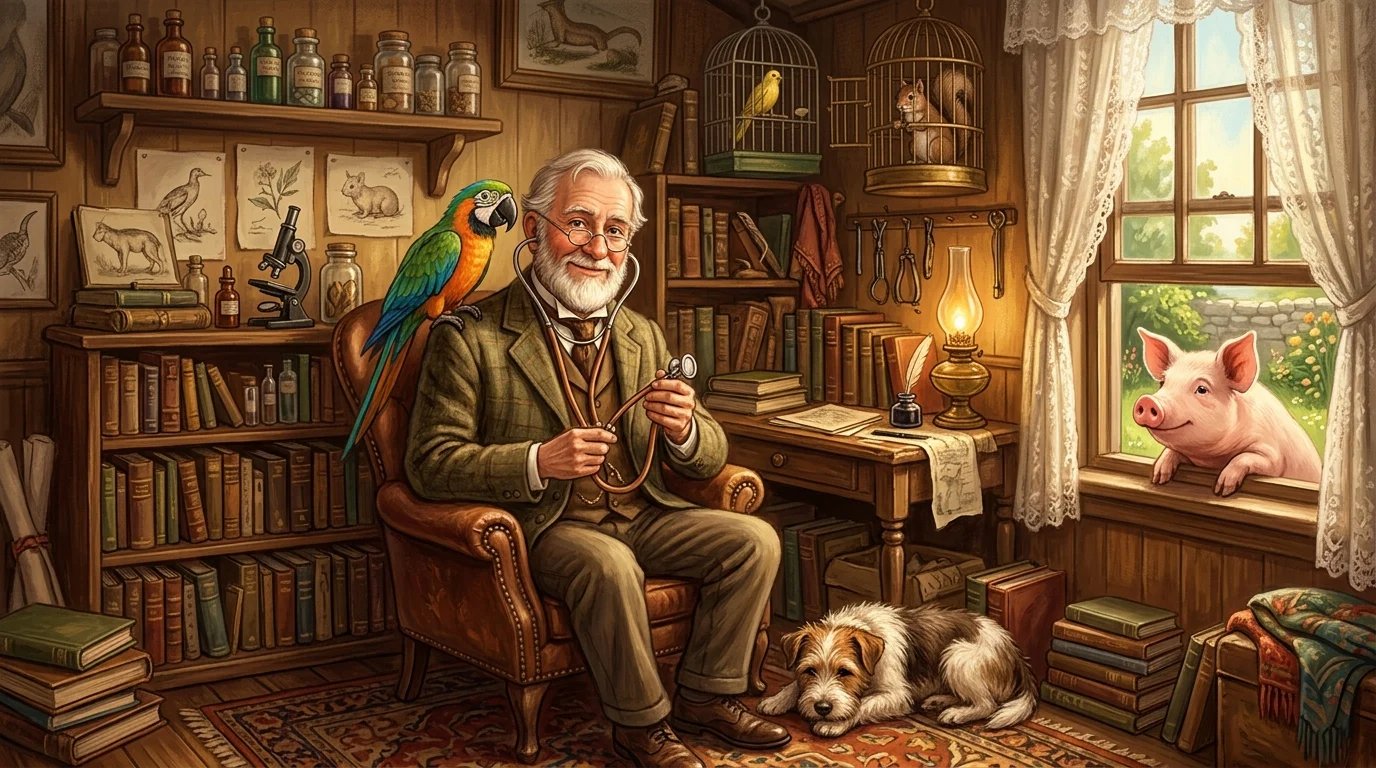
Doctor John Dolittle is the main character of a series of children’s books written by Hugh Lofting. He is a physician who discovers he can understand what animals are saying and can speak to them in their own languages.
The character first appeared in letters Lofting wrote to his children while serving in World War I. He later turned these stories into books. The first book, The Story of Doctor Dolittle, was published in 1920. The series continued for over a decade and became a beloved classic of children’s literature.
Doctor Dolittle is portrayed as a kind, eccentric man who cares more about animals than about social status or money. He loses his human patients because his house is full of animals, but he finds a new purpose in helping creatures around the world. His adventures take him to Africa, the bottom of the sea, and even to the moon.
The name “Dolittle” was a deliberate choice by Lofting. He wanted a name that would make superficial people underestimate the doctor. The name suggests laziness, but the character is anything but lazy. This irony is part of the book’s charm. It teaches readers not to judge by names or appearances.
How to Pronounce Dolittle
The dolittle pronunciation is simple. You say it as DOO-lit-ul. The first syllable rhymes with “too” or “blue.” The second syllable is soft and quick. The third syllable is light and unstressed.
The emphasis falls on the first syllable. In American English, the “t” sounds often soften into a “d” sound, making it sound like “DOO-lid-ul.” In British English, the “t” remains crisp and clear.
The name is sometimes spelled Doolittle with an extra “o.” This variant is pronounced the same way. The spelling difference is a matter of preference and family tradition.
Dolittle vs Doolittle: What Is the Difference?
Many people confuse Dolittle with Doolittle. The two spellings sound identical, which creates confusion in writing.
Dolittle is the spelling used by Hugh Lofting for his famous character. It is also the spelling used in most modern adaptations and films.
Doolittle is a variant spelling that appears in real surnames. The most famous bearer was James H. Doolittle, an American aviation pioneer who led a famous air raid on Japan during World War II. The poet Hilda Doolittle also used this spelling.
Both spellings carry the same literal meaning. They both derive from the medieval nickname for a lazy person. The difference is purely orthographic.
Dolittle in Popular Culture
Dolittle has appeared in many forms of popular culture beyond the original books. The character has been adapted into films, television shows, and stage productions.
The most famous film adaptation starred Eddie Murphy in 1998. The movie updated the story to modern times and changed the character to a human doctor who can talk to animals. A sequel followed in 2001.
Robert Downey Jr. played the character in the 2020 film Dolittle. This version returned to the Victorian setting of the original books. It featured a star-studded voice cast for the animals.
The character has also appeared in animated films, radio dramas, and audiobooks. Each adaptation brings a new interpretation while keeping the core idea of a man who communicates with animals.
When Not to Use Dolittle
Dolittle does not belong in every conversation. Its literal meaning can be offensive when directed at a person.
Avoid calling someone a “dolittle” in professional settings. The word implies laziness and incompetence. It can damage relationships and create hostility. Use neutral language like “needs to improve productivity” instead.
In formal writing, the term is too informal for business reports, academic papers, or official documents. Use precise vocabulary when discussing work performance.
When referring to the fictional character, always use capitalization. “Dr. Dolittle” is a proper noun. Writing “dr. dolittle” looks careless and disrespectful to the source material.
Alternative Meanings of Dolittle
While laziness and the literary character dominate, Dolittle carries other associations in specific contexts.
In technology, Dolittle is the name of a programming language developed at Osaka Electro-Communication University in Japan. Unlike most programming languages, it uses keywords based on Japanese. This makes it more accessible to Japanese-speaking programmers.
In slang from the 18th century, doolittle was a euphemism for a penis, with implications of impotence. This usage is archaic and rarely appears in modern language.
In some dictionaries, do-little appears as a separate entry with the same meaning as dolittle. The hyphenated form is less common but carries the same definition.
Why Dolittle Became Popular
Dolittle became popular because of one brilliant author’s decision. Hugh Lofting chose the name deliberately to create irony. The name suggests laziness, but the character is active, curious, and heroic. This contrast made the character memorable and endearing.
The books also arrived at the perfect time. After World War I, readers craved stories of kindness and adventure. Doctor Dolittle offered both. He traveled the world, helped animals in need, and showed that compassion matters more than social status.
The name itself is clever. It is easy to remember and easy to pronounce. It carries a clear meaning that children can understand. The wordplay makes it stick in the mind long after the story ends.
FAQs
What does dolittle mean?
Dolittle means a lazy person who performs very little work despite claiming to do much. It is a synonym for sluggard, idler, or lazybones.
Who is Doctor Dolittle?
Doctor Dolittle is a fictional character created by Hugh Lofting. He is a physician who can understand and speak to animals.
Why did Hugh Lofting name his character Dolittle?
Lofting chose the name deliberately to suggest laziness. This created irony because the character was actually active and kind.
Is Dolittle a real name?
Yes. Dolittle is a real surname derived from a medieval nickname. Variant spellings include Doolittle.
What is the difference between Dolittle and Doolittle?
The two spellings sound identical and carry the same meaning. Dolittle is the spelling used for the fictional doctor. Doolittle is a variant used in real surnames.
Can I use dolittle as an insult?
The word can be offensive when directed at a person. Avoid using it in professional or formal settings. Use neutral language instead.
What does the name Dolittle literally mean?
The name combines “do” and “little.” It literally means “do little” or “accomplish very little”.
Is Doctor Dolittle a children’s book?
Yes. The books were written for children and have been adapted into films, television shows, and stage productions.
What animals can Doctor Dolittle talk to?
Doctor Dolittle can talk to all animals. He learns their languages and uses this ability to help them.
Is Dolittle a programming language?
Yes. Dolittle is also a programming language developed in Japan that uses Japanese keywords.
Conclusion
The dolittle meaning is both literal and literary. In everyday language, a dolittle is a lazy person who avoids work. In literature, Doctor Dolittle is a kind physician who talks to animals and helps those in need. The name itself was a deliberate choice by author Hugh Lofting, who used irony to create a memorable character. Whether you are discussing work ethic, children’s books, or classic films, the word carries layers of meaning. Now you know exactly what this clever name can mean.