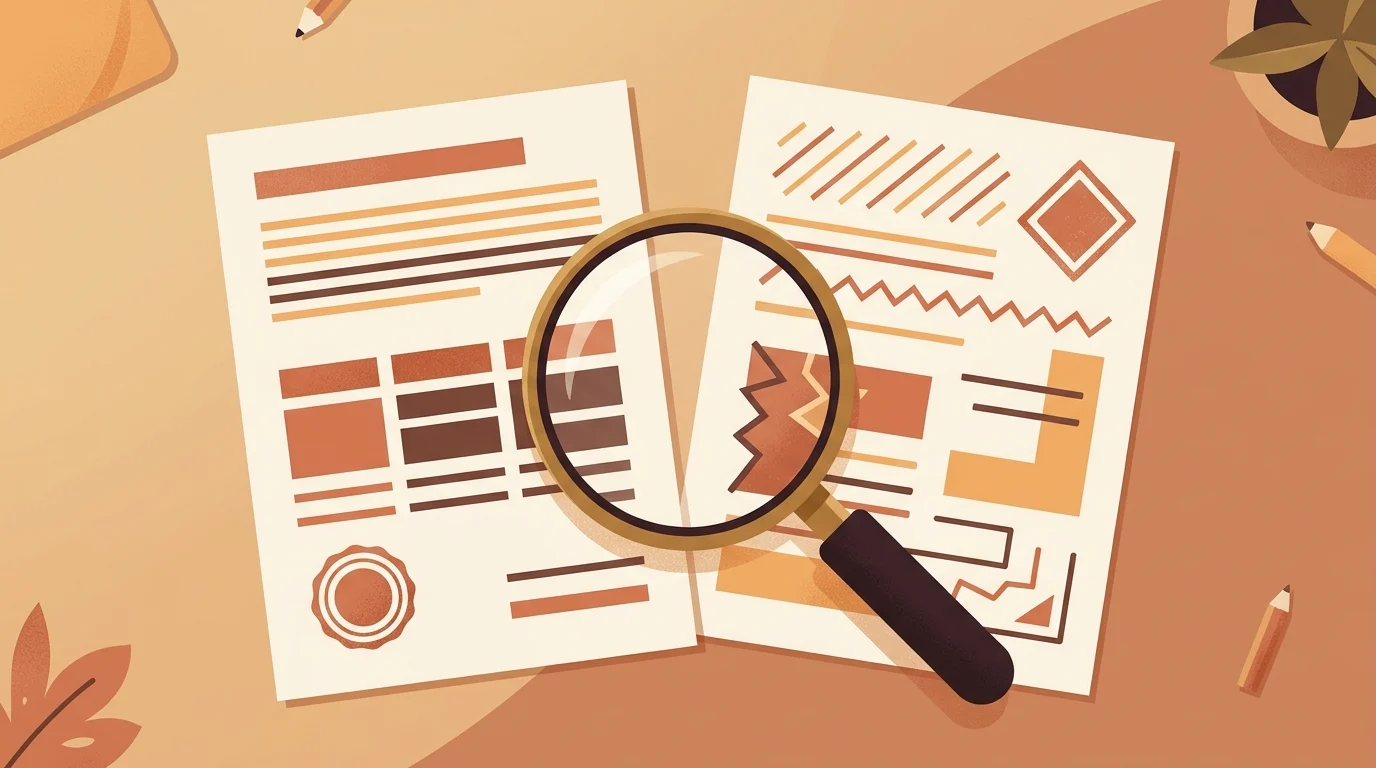
Quick Answer: Discrepancy meaning: a discrepancy is a difference or inconsistency between two things that should agree, such as figures, facts, stories, or records. It can be a small error or a significant mismatch, but the key point is that the two things ought to match and do not.
Imagine checking your bank statement and finding a different total from the one you calculated. Or hearing two witnesses describe the same event in ways that do not line up. In both cases, you have found a discrepancy. It is one of those precise English words that describes a very common experience: something does not add up.
Discrepancy is used in finance, science, law, medicine, and everyday conversation. Learning exactly what it means, and how it differs from similar words like disparity and difference, will make your writing clearer and more accurate.
What Does Discrepancy Mean?
A discrepancy is the state of being discrepant, or an instance of disagreement between things that should be the same. The word is a noun, and its plural is discrepancies. You can talk about a discrepancy in general, as in “there is a discrepancy in the accounts,” or about specific discrepancies, as in “police found several discrepancies in his story.”
The crucial element is expectation. A discrepancy is not just any difference. It is a difference where agreement was expected. Two different paintings can simply be different. Two copies of the same invoice showing different totals show a discrepancy, because they should be identical.
Discrepancies can be small or large. A one-cent rounding error is a discrepancy. So is a million-pound gap in a company’s accounts. Size alone does not decide whether something counts. The mismatch itself is what matters, though larger discrepancies naturally attract more attention.
Discrepancy Meaning in Context
In finance and business, discrepancy usually means numbers that do not match. An auditor might find a discrepancy between inventory records and actual stock, or between reported income and bank deposits. Such findings often trigger further checks, because they can signal error, or in serious cases, fraud.
In law and investigations, discrepancy refers to conflicting details. If a suspect gives one time in an interview and another time in a written statement, investigators note the discrepancy. It does not prove dishonesty on its own, but it raises questions that need explanation.
In science and research, a discrepancy means results that do not agree with theory, with previous studies, or with each other. Scientists take discrepancies seriously because they can point to a measurement error, a flawed assumption, or a genuinely new discovery.
In everyday life, discrepancies appear in bills, timetables, school records, medical notes, and even family stories. “There is a discrepancy between what the website promised and what arrived” is a perfectly natural everyday use.
How to Pronounce Discrepancy
In American English, discrepancy is pronounced dih-SKREP-uhn-see. In British English, it is pronounced dih-SKREP-uhn-see as well, with a very similar stress pattern. The stress falls on the second syllable, “skrep.” The plural, discrepancies, is pronounced dih-SKREP-uhn-seez.
Origin and History of Discrepancy
Discrepancy comes from Latin discrepantia, from discrepare, meaning to sound differently or to disagree. The Latin root combines dis, meaning apart, with crepare, meaning to rattle, creak, or crack. The original image is of sounds that do not harmonise, like instruments playing out of tune with each other.
The word entered English in the early seventeenth century, first recorded around 1615 to 1625. Its musical origin still fits: a discrepancy is a kind of discord between facts that should be in tune.
The related adjective is discrepant, meaning disagreeing or inconsistent, though it is much less common than the noun. The verb form is rarely used in modern English.
Discrepancy in Sentences: Real Examples
- There is a discrepancy between the amount on the receipt and the amount charged to my card.
- Auditors found discrepancies between the company’s reported profits and its bank records.
- Police noticed discrepancies in the two witnesses’ accounts of the accident.
- The discrepancy between the predicted temperature and the actual temperature surprised forecasters.
- She asked the university to correct a discrepancy in her exam record.
- Even a small discrepancy in the data can change the conclusion of a study.
Each example follows the same pattern: two things that should agree, a difference between them, and a need to explain or resolve it.
Synonyms for Discrepancy Meaning
Close synonyms include inconsistency, variance, disagreement, incongruity, divergence, and mismatch. Each has a slightly different flavour. Inconsistency stresses lack of coherence over time or across statements. Variance stresses numerical difference. Mismatch is more informal and works well in everyday speech.
Related but distinct words include error, which is a mistake itself, and anomaly, which is something that deviates from what is normal or expected. A discrepancy is often caused by an error, but the discrepancy is the difference you observe, not necessarily the error itself.
Discrepancy vs Disparity: A Key Difference
This is the most important distinction for this word, and the one most often confused. A discrepancy exists between things that ought to be the same. A disparity is a large difference between things that are measured separately, such as incomes, ages, or opportunities.
For example, a discrepancy exists if two payroll records for the same employee show different salaries. A disparity exists if one group of employees is paid much more than another group on average. The first is a mismatch to be corrected. The second is an inequality to be examined.
A useful test is to ask: should these two things be identical? If yes, use discrepancy. If they are simply different in size, amount, or level, and no identity was expected, disparity or difference is usually better.
Discrepancy vs Difference
Difference is the broadest word. Every discrepancy is a difference, but not every difference is a discrepancy. Two houses painted different colours simply differ. Two measurements of the same room giving different sizes show a discrepancy, because one room should have one size.
Use difference when you are neutrally noting that things are not the same. Use discrepancy when you want to signal that the difference is unexpected, problematic, or worth investigating.
When to Use Discrepancy (and When Not To)
Use discrepancy in formal and professional writing, especially in finance, audit, research, law, and administration. It sounds precise and serious, which suits reports, emails about records, and academic work.
Avoid using it for casual, purely personal differences of taste. Saying “there is a discrepancy between our favourite films” sounds oddly formal. Difference or disagreement fits better there. Also avoid using it when you simply mean a large gap between two unrelated quantities. That is a disparity or a gap, not a discrepancy.
Common Mistakes With Discrepancy Meaning
The most common spelling mistake is writing “discrepency” with an e in the final syllable. The correct ending is -ancy: d-i-s-c-r-e-p-a-n-c-y. Another mistake is using the plural incorrectly. One mismatch is a discrepancy. Two or more are discrepancies.
Another mistake is using discrepancy as a synonym for problem in general. A delayed train is a problem, but it is not a discrepancy unless a timetable and reality disagree in a specific, checkable way. Keep the word tied to mismatched facts, figures, or accounts.
FAQs About Discrepancy Meaning
What is the simple meaning of discrepancy?
A discrepancy is a difference or inconsistency between two things that should agree, such as numbers, facts, or records.
What is an example of a discrepancy?
If your payslip says you earned one amount and your bank payment shows another, that is a discrepancy.
What is the difference between discrepancy and disparity?
A discrepancy is a mismatch between things that should be the same. A disparity is a large difference between measurable things, such as pay levels, where identity was not expected.
Is discrepancy a formal word?
Yes, it is formal and professional, common in business, finance, law, and academic writing, but it is also understood in everyday speech.
What is the plural of discrepancy?
Discrepancies.
Conclusion
A discrepancy is a signal that something does not line up. Whether it appears in accounts, stories, data, or records, it tells you that two things that should agree do not, and that the gap deserves a closer look. Used precisely, it is one of the clearest words English has for that everyday moment when the numbers, or the facts, simply do not match.